United States Hesitant In Providing Arms To Taiwan.

Washington DC; February 2026: The United States is reportedly hesitating over whether to fulfill its next arms sales to Taiwan out of concern that it could impede US President Donald Trump’s upcoming visit to Beijing. Suspending the sales would risk emboldening the China Communist Party (CCP) and encouraging it to pursue further concessions from the United States, however. In a phone call on February 16th, CCP General Secretary Xi Jinping warned Trump against fulfilling the arms sales and threatened that it could upend the Beijing visit. The arms sales would include 20 billion US dollar’s worth of systems for Taiwan.
Xi’s threats come as he has extracted other Taiwan-related concessions from the United States. Washington reportedly denied Taiwanese President William Lai Ching-te permission to enter the country in July 2025 to avoid damaging the chances of a Trump-Xi summit. As per industry experts the timing of denial Lai’s visit to the US risked driving the CCP to further leverage diplomatic engagements and trade negotiations to divide the United States from Taiwan.
The arms package reportedly contains key systems that would support the development of Taiwan’s “T-dome” integrated air and missile defence (IAMD) network. The T-Dome is a proposed multi-layered IAMD network meant to neutralise aerial threats to Taiwan with large quantities of mobile air defence systems and advanced sensor and command-and-control (C2) infrastructure.
As per report from Taipei Times on 14th February, that the package would likely include Integrated Battle Command Systems (IBCS), Patriot Advanced Capability-3 Missile Segment Enhancement systems (PAC-3 MSE), National Advanced Surface-to-Air Missile Systems (NASAMS), and Lower Tier Air and Missile Defence Sensors (LTAMDS).
Inter-Continental Ballistic Missile System (ICBS) are C2 systems that would enable Taiwan to integrate its existing Patriot missile and Tien Kung missile air defence battalions into a single unified system.
PAC-3 MSE missile interceptors would fortify Taiwan’s multi-layered air defence munitions with better velocity, range, and altitude compared to Taiwan’s domestically produced anti-ballistic missiles, enabling Taiwanese forces to defeat a wider range of threats, including hypersonic missiles. NASAMS would further improve air defence coverage by strengthening Taiwan’s ability to intercept cruise missiles, drones, and aircraft.
LTAMDS is an IBCS-compatible air and missile defence radar that would enhance Taiwan’s battlespace awareness with omnidirectional and longer-range detection capabilities to provide early warning for incoming aerial threats.
A robust IAMD network is crucial for Taiwan to survive a PRC attack. PLA operational concepts emphasise joint strike campaigns, which include large-scale missile barrages against C2 centers, key military bases, and critical infrastructure to pave the way for an amphibious invasion.
The reported components of the arms package comprise defensive systems, discrediting PRC accusations that Taiwan’s ruling Democratic Progressive Party (DPP) is acting aggressively by procuring offensive capabilities. The Lai administration proposed in November 2025 a record $40 billion special defence budget that, if passed, would provide significant funding for the acquisition of T-dome systems.
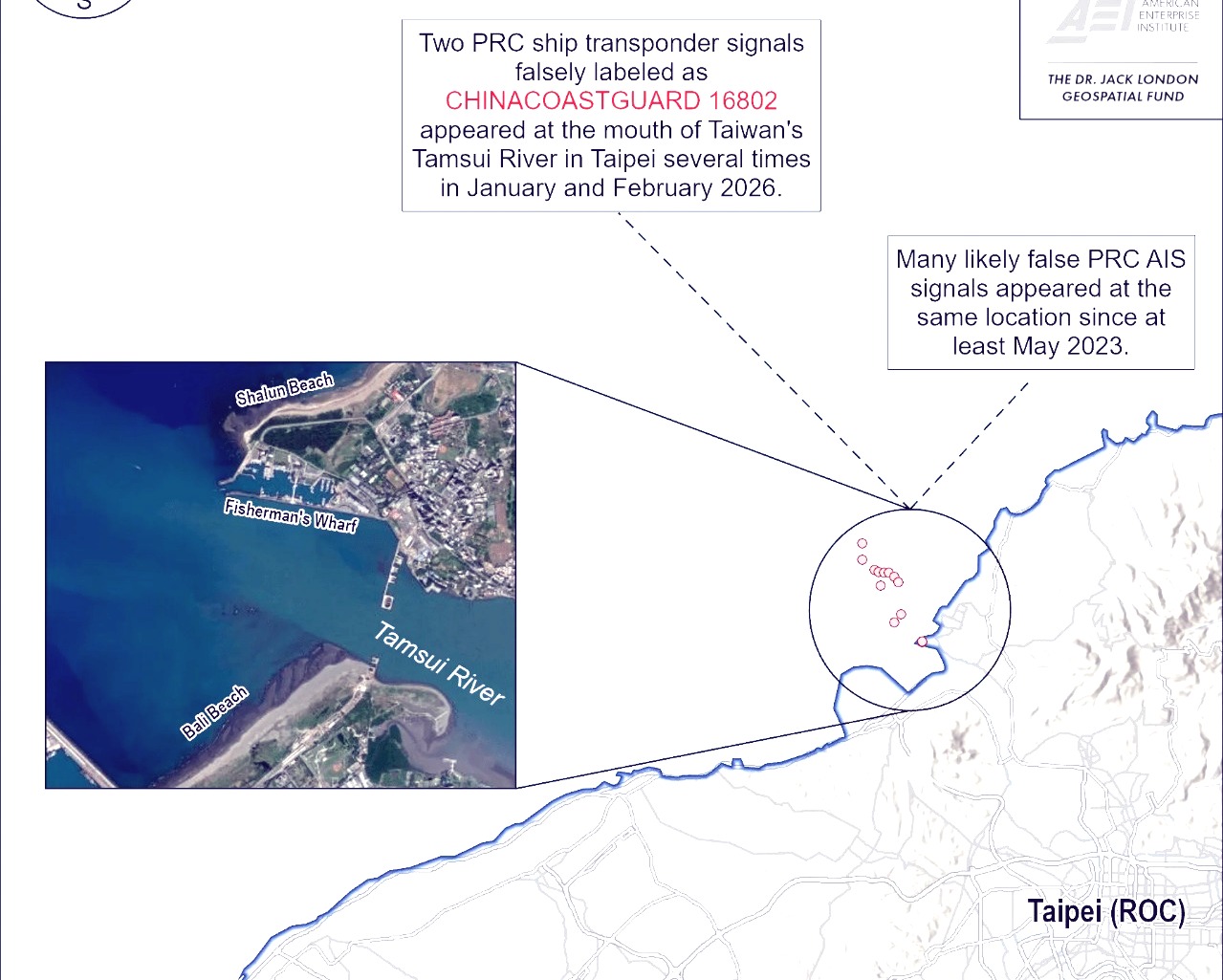
The PRC may be using signal spoofing to make ship-tracking software detect illusory PRC vessels, including a China Coast Guard (CCG) ship, inside a Taiwanese harbour. A PRC boat that has infiltrated New Taipei may be broadcasting the spoofed signals as part of a cognitive warfare effort to degrade Taiwan’s threat awareness.
Dozens of Automatic Identification System (AIS) signals of PRC vessels that have intermittently appeared and disappeared at the mouth of the Tamsui River in New Taipei, was found at Taiwan from at least May 2023 through February 2026, based on ship-tracking data from Starboard Maritime Intelligence.
AIS is a system installed on most ships that broadcasts the ship’s identity, location, and other relevant data. At least 02 of the PRC signals near the Tamsui harbour had the name “CHINACOASTGUARD 18602”, the name of a real CCG ship. No sources reported a CCG ship entering Taiwan’s internal waters, however, indicating that the signals were fake. Dozens of other AIS signals indicated the presence of PRC fishing or cargo vessels. All of these signals were spoofed and do not represent real PRC vessels near New Taipei, because the signals appeared very briefly before “teleporting” to other locations hundreds of miles away. All of the signals appeared in or near Tamsui Fisherman’s Wharf, a fishing harbour in New Taipei’s Tamsui district, suggesting that a boat docked at that harbour may be broadcasting the signals.
It was previously assessed that the PRC was experimenting with spoofing fake AIS signals around Taiwan to confuse Taiwan’s threat awareness. One such signal impersonated a Russian warship, and another impersonated a PRC Maritime Safety Administration ship. It was assessed that PRC fishing boats, likely affiliated with the Chinese Maritime Militia (CMM), took turns hosting these false signals, causing them to move between locations in the PRC’s maritime periphery much faster than would be possible for real boats. The signals near Tamsui follow the same pattern of “teleporting” around the map. The signals sometimes change their names: the fake “Russian Warship” signal that appeared in August and September 2025 is now broadcasting the generic name “123”. Starboard data shows the two fake “CCG 18602” signals have appeared periodically near Tamsui since at least 2023, but they likely used different names at the time.
Although not very certain, that the PRC may have smuggled an AIS transponder into Tamsui’s Fisherman’s Wharf, possibly aboard a fishing boat that has remained docked there for years to support a PRC cognitive warfare campaign or other malign activities. The wharf is located at the mouth of the river that flows through Taipei and New Taipei and is also between Shalun and Bali Beaches, two “Red Beaches” that the Taiwanese military identified as viable landing sites for a PRC amphibious invasion.
It is conceivable that a small PRC boat infiltrated the harbor undetected or smuggled an AIS transponder onto a lawfully registered Taiwanese boat that can dock at the harbor long-term. A PRC national sailed a speedboat into the Tamsui River in June 2024 and was only detected and detained after he collided with boats at a ferry terminal.
Team Maverick.







Israel Rejects Gaza Disarmament Plan, Says IDF Will Stay Until Hamas Fully Disarmed
Jerusalem, July 2026 : Israel has reiterated its strong opposition to the US-backed plan f…

Israel Rejects Gaza Disarmament Plan, Says IDF Will Stay Until Hamas Fully Disarmed
Jerusalem, July 2026 : Israel has reiterated its strong opposition to the US-backed plan …