US Sabotaging Democracy In Iraq Should Be A Lesson Of The Consequences In Iran.

February 2026: If someone is optimistic that Donald Trump led United States would restore democracy in Iran, then a lesson from Iraq can clear all ambiguities.
Iraq’s Coordination Framework has nominated Nouri al-Maliki as their leader to attempt to form the next Iraqi government after November’s election. Maliki was Iraq’s premier from 2006 to 2014, and has led the State of Law bloc since then, trying to return to the position. Now, it seems, he’s on the verge of doing so.
President Trump, however, appears to be trying to veto that appointment, declaring on Truth Social that Maliki “should not be allowed” to return to power, and threatening to withhold all US support for Iraq if he does. “If we are not there to help, Iraq has ZERO chance of Success, Prosperity, or Freedom”, Trump declared in the post, accusing Maliki of “insane policies and ideologies”. Maliki’s nomination had been spoken of favorably by a number of Shi’ite factions as well as Kurdish ones, suggesting that he has the votes, if indeed Trump isn’t able to order him replaced.
Trump’s threat comes back to the recent threats by US officials to cut off all of Iraq’s oil revenue, which is held in a dollar-denominated account at the Federal Reserve Bank of New York, if the government included any factions that were sign as “Iran-backed”. Trump’s threat takes this one step farther though, threatening not just to bankrupt Iraq by seizing functionally all of their government’s money, but by completely severing US ties with the nation if Maliki specifically returned to power.
The Federal Reserve Bank relationship was established in 2003 during the start of the US occupation and reconstruction of Iraq, and made some measure of sense at the time. Now that Iraq has moved on, it is merely leverage for the US to dictate terms to them whenever the mood suits.
During his two terms as Prime Minister from 2006 to 2014, Maliki laid the foundations of the current state in Iraq, making him largely responsible for many of its worst defects. During Maliki’s time in office, corruption and cronyism took root in government institutions. His record of entrenched sectarianism and paranoia, combined with his hostility toward Kurds and Sunnis during his eight-year premiership, led Iraq to the brink of civil war and culminated in the Islamic State of Iraq and al-Shams’s (ISIS’s) takeover of a third of Iraqi territory.
While the US-led coalition reclaimed that ISIS-held territory, many of the ills that plagued Iraq under Maliki’s premiership continue to undermine the state. Former US officials who served in Iraq during Maliki’s time in power have since publicly described his disastrous run as prime minister in unsparing terms.
What’s more, Maliki has long-standing ties to Iran, going back to his years in exile prior to 2003, and his ideological commitment to Shiism has produced policies that supported Iranian interests at the expense of the United States. Maliki’s support for the total withdrawal of US forces in 2011 and subsequent support for Iran-backed militias entrenched Tehran’s influence over Iraq in lasting ways. US public statements on the most recent round of government formation rejected the idea of a “government installed by Iran”, suggesting that Trump’s opposition to Maliki is at least partially motivated by Iran’s support for his candidacy.
However, to suggest that Maliki is beholden to Iran is to misunderstand Maliki’s motivations, which are often driven by his own personal political and economic interests. Given the political influence that Tehran and Iran-backed factions have over Iraqi politics, each one of Iraq’s prime ministers has received the nod from Iran, and the next prime minister will be no different.
Trump’s public opposition to Maliki has upended the government formation process, embarrassing Maliki and the Framework. The Framework now faces a stark choice: find a way to back down to preserve its relationship with the United States or risk political and economic consequences from the Trump administration. Maliki responded to Trump defiantly on X on January 28, rejecting US interference in Iraqi internal affairs and claiming the mantle of the defender of Iraq’s sovereignty. In public at least, Maliki’s denunciation of US interference was echoed by his colleagues in the Framework, which reaffirmed its support for Maliki’s nomination on January 30.
Trump is able to sway Iraqi politics with credible threats due to the US control that was imposed on the nation’s economy following the Iraq invasion: Underpinning this whole thing is that after the 2003 US invasion and occupation of Iraq, the country was restructured such that all of Iraq’s oil revenue was paid in US dollars through the New York Federal Reserve Bank. Since that revenue is almost the entirety of Iraq’s government budget, that means the US can virtually seize Iraq’s treasury at any time and bankrupt the country on a moment’s notice.
This is what US-imposed “democracy” looks like in practice: giving a nation the freedom to do what Washington tells them to do and elect the leaders that Washington allows them to elect.
One can recall that the narrative to justify the US coalition’s overthrow of Saddam Hussein in 2003 was the urgent need to bring freedom and democracy to the Iraqi people. The US literally titled the invasion “Operation Iraqi Freedom”. They then killed a million people, plunged the region into chaos and instability for years, and ensured that the Iraqi people would forever remain under the boot of the US empire.
Now, the question of the US empire wants to bring democracy to Iran. The US consistently props up dictatorships and monarchies in the middle east exactly because they do not want the will of the people to determine the actions and policies of the governments of those nations. Truly democratic states in the region would see people using their votes to elect leaders who are hostile to Israel and the United States, and who set fossil fuel policies which advance the interests of their own people rather than the interests of the western empire.
This is why the middle east is rife with wealthy monarchies who are extremely friendly with the US and its allies. That didn’t happen by accident; the west has been intimately involved with aggressively manipulating middle eastern affairs for generations. This includes Iran; the CIA staged a coup in 1953 to replace its democratically elected government with a US-aligned monarchy, who was then overthrown in the Iranian Revolution in 1979.
The plan is not to bring democracy to Iran, and there’s a convincing argument to be made that it’s not even to preserve Iran as a unified state. Influential Iran hawks have been pushing balkanisation as the preferred strategy lately, with war propagandists now promoting the idea that an Iran fractured along ethnic lines might be in everyone’s best interest. This strategy would create unfathomable strife and horrifically deadly chaos, but it would allow for the toppling of the Iranian government without having to go to all the trouble of replacing it with a new government. They can just smash Iran to eliminate a disobedient regional power and let the pieces land where they may, with no fear of a future revolution replacing their puppet regime in a large and unified state.
The US does not seek democracy, it seeks planetary domination. That’s all these moves are ever about, and the empire doesn’t care how many people it needs to hurt along the way in order to get there.
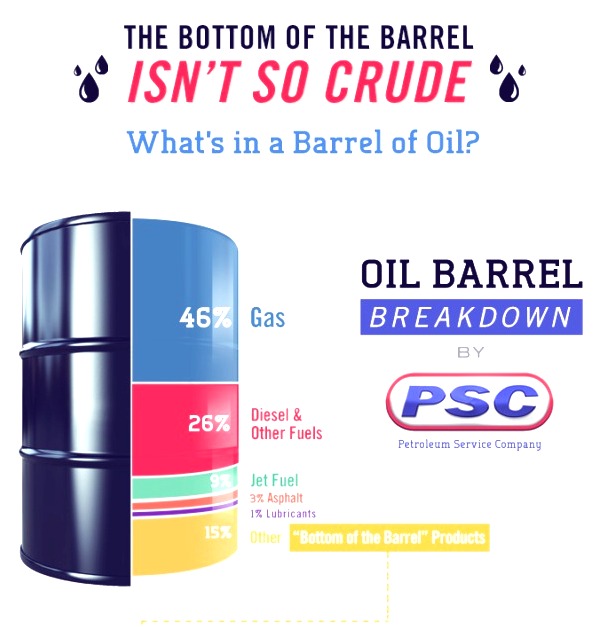
The US intervention may also could be killing two birds with one stone; if the US levels Iran and induces long term closing of the Strait of Hormuz? 90% of Iran’s 1,700,000 barrels of exports goes to China, or something like 1,500,000 barrels a day, which, at 42 gallons of crude per barrel, is something like 63,000,000 gallons of crude heading to China every day on average through the Strait of Hormuz, and that’s just from Iran. About four-fifths of each barrel of crude is turned into fuel like gas, diesel, and jet fuel and the “bottom of the barrel” is the raw material for everything from lipstick to cell phones. If nothing else, stealing Iran’s oil resources for Israel is now a recognised objective after Huckabee disclosed that plans for Greater Israel includes annexing much of the Middle East. Presumably Israel isn’t interested in more desert sand but obviously what’s beneath it. On the lighter side, here’s what’s made from the typical barrel of crude oil.
Team Maverick.





South Africa Midfielder Jayden Adams Dies at 25, Nation Mourns Rising Football Star
Johannesburg, July 2026 : South African football has been plunged into mourning following …

South Africa Midfielder Jayden Adams Dies at 25, Nation Mourns Rising Football Star
Johannesburg, July 2026 : South African football has been plunged into mourning following the …