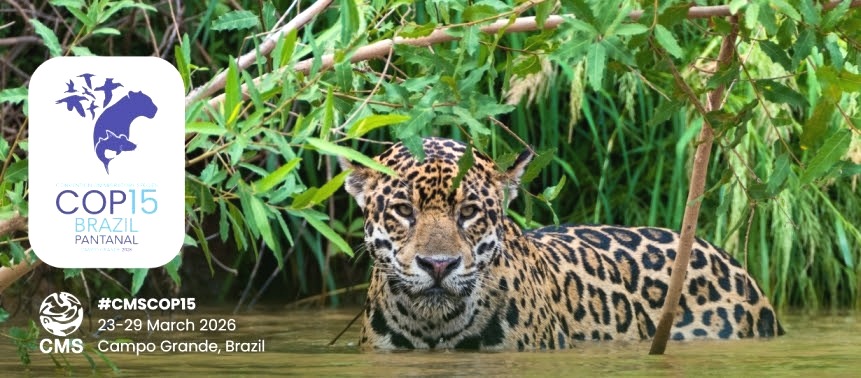
Convention On Migratory Species COP 15.

Campo Grande, Brazil; February 2026: As pressure have started stemming from habitat loss, overexploitation, pollution, climate change and invasive species intensify, international commitment to greater, more effective, coordinated conservation and protection efforts for migratory species has never been more essential. At the forthcoming 15th Meeting of the Conference of the Parties to the Convention on the Conservation of Migratory Species of Wild Animals (CMS COP15, Campo Grande, Brazil, 23-29 March), governments will consider new steps deemed vital – literally – to many migratory aquatic, bird, and terrestrial wildlife populations essential to the well-functioning of nature and to human well-being.
With some 100 agenda items, issues on the table span a vast range and include deep-sea mining impacts, illegal and unsustainable take, bycatch, habitat loss and fragmentation, light, noise and other forms of marine pollution, vessel strikes, priority areas for conserving marine migratory species, safeguarding ecological connectivity and migratory corridors, infrastructure and renewable energy impacts, as well as insect decline, climate change and other cross-cutting risks.
Amy Fraenkel, CMS Executive Secretary says: “COP15 will build on the scientific findings of the first State of the World’s Migratory Species (2024), the key priorities to address its recommendations that were adopted by COP14 under the Samarkand Strategic Plan for Migratory Species, and adopt significant targeted actions aimed at addressing the most urgent needs of migratory species”.
Anticipated outcomes of the week-long negotiations include:
- A high-level political declaration,
- Strengthened global coordination of migratory species conservation,
- Addition of a wide variety of species at risk to CMS Appendices I and II,
- New internationally Concerted Actions and species-specific Action Plans to address acute challenges and enhance the conservation of vulnerable populations of CMS-listed species,
- Strengthened measures to address illegal take and the overexploitation of species, and to combat bycatch,
- Enhancement of ecological connectivity and safeguard of vital migratory bird flyways and stopover sites,
- Advancement of work to minimize negative impact on migratory species from marine and terrestrial infrastructure, including renewable energy,
- An evaluation of progress and measures to achieve the Samarkand Strategic Plan for Migratory Species (2024–2032),
- Strengthened synergies with other multilateral environmental agreements such as the Convention on Biological Diversity, Ramsar, and CITES, including the CITES-CMS Initiatives on African carnivores (lion, cheetah, leopard, African wild dog).
Actions for Species in Urgent Need of Conservation –
Species Listings – Appendices I and II:
CMS Appendix I covers endangered species requiring strict protection and prohibits taking; Appendix II lists species that require international cooperation for their conservation. Parties will consider proposals to add 42 migratory species to the CMS Appendices.
The Proposed new listings include:
- Iconic wildlife such as the snowy owl, hammerhead and several other shark species, giant otters, and the Spotted sorubim catfish, which can grow to an enormous 120 kg (265 lb)
- Terrestrial species, including the cheetah population of Zimbabwe, and the striped hyena
- Migratory birds, including seabirds, across several flyways
Also under consideration: Removal from Appendix I of Uzbekistan’s population of Bukhara deer.
Concerted Actions and Action Plan priorities:
Parties will consider new species-specific and Multi-Species Action Plans, as well as targeted Concerted Actions to coordinate conservation across range states. These include:
- Amazonian migratory catfish
- Tope shark
- Basking shark
- Bustards (plan covers 26 bustard species across 102 range states)
- Steppe eagle
- European Eel (Anguilla Anguilla, one of the world’s most critically endangered migratory fishes)
- Arabian Sea humpback whales
- Straw-coloured fruit bat
- Chimpanzee
- Giraffes
- A new Global Initiative on Illegal and Unsustainable Taking of Migratory Species. Special event launch: Wednesday 25 March (further details below)
- Flyways:
A Central Asian Flyway Coordination Unit hosted by India is also expected to be announced, strengthening collaboration with the East Asian–Australasian Flyway Partnership on issues such as illegal killing and bird-safe renewable energy.
Designating Internationally Important Raptor Areas, using globally-agreed scientific criteria to protect critical habitats for migratory raptors (such as condors, vultures, and eagles), more than half of whose populations across Africa and Eurasia are declining due to habitat loss, poisoning, illegal killing and collisions with infrastructure.
Science in the spotlight:
- State of the World’s Migratory Species: Interim Report (2026) – This interim report of the flagship State of the World’s Migratory Species analyses recent IUCN Red List updates, summarizes new findings on population trends and distribution, reports on habitat identification and protection for CMS-listed species, and highlights work to map migratory routes since COP14. Launch at COP15 opening press conference, Monday 23 March.
- Global Assessment of Migratory Freshwater Fishes – Some of the longest, most important migrations of species on Earth are happening beneath the surface of the world’s rivers, and face significant threats from overuse, fragmentation, and pollution. This report identifies 325 new candidate species that could benefit from being added to CMS Appendices. Special event launch, Tuesday 24 March.
- Migratory Species and Health: CMS One Health Case Studies, A Resource for Parties to the CMS. Launch webinar, Wednesday 11 March.
- Launch of a new Americas Flyways online Atlas
Developed by the Cornell Lab of Ornithology to identify priority corridors and stopover sites. Special event launch, Thursday, 26th March.
Additional scientific assessments, reports and tools at COP15 include –
Combating Illegal Take and Addressing Overexploitation of Species and their Habitats:
- Global Review of Direct Take of Seabirds (covering all 318 migratory seabird species, the world’s most threatened bird group),
- Technical and Operational Measures to Mitigate Bycatch of Marine Turtles in Commercial Fisheries,
- Quantifying contemporary whaling and aquatic wild meat take of all CMS Appendix I listed cetaceans (e.g., whales, dolphins, porpoises) in all regions,
- Assessing the Use and Impact of Nets on Wild Bird Populations in Asia and the Mediterranean.
Integrating ecological connectivity into planning frameworks and strengthening implementation tools:
- Online Global Atlas of Ungulate Migration (features interactive maps that use tracking data to highlight important migration corridors and their intersections with linear infrastructure. This atlas showcases some of the largest and longest terrestrial animal migrations worldwide, including 24 species of hooved mammals such as deer, the iconic Serengeti wildebeest, elk, African elephant, and saiga).
- Online Central Asian Mammals Migration and Linear Infrastructure (CAMI) Atlas Reports (using updated satellite tracking data to map species ranges and analyse how roads, railways, fences, pipelines, and canals affect large mammals in Central Asia).
Reducing the Damaging Impacts of Environmental Pollution:
- Impacts of Deep-sea Mining on Migratory Species: Review and Knowledge Gaps,
- Anthropogenic Underwater Noise Impacts and Mitigation Strategies for CMS-Listed Freshwater Mammals (Cetaceans, Sirenians, Otters) and Their Prey Species (Impacts of noise on the Amazonian dolphin and other CMS listed freshwater species),
- Fish Aggregating Devices (FADs) and Marine Debris in the Mediterranean Sea,
- Report of the CMS Marine Pollution Workshop.
Addressing Climate Change Impacts:
- Impacts of Climate Change on Cetacean Welfare and Conservation,
- Case Studies: Ecosystem Services related to Climate Change Mitigation and Adaptation Supported by Migratory Species,
- Out of Habitat Marine Mammals – Identification, causes and management recommendations (Climate-induced range shifts can lead to cetaceans appearing out of habitat. Adaptive management is needed to respond to animals that occur outside of their normal ranges).
Team Maverick.







Shivakumar Meets Sonia, Rahul and Priyanka Gandhi Amid Karnataka Cabinet Discontent
New Delhi, June 2026 : Karnataka Chief Minister D.K. Shivakumar on Wednesday met senior Co…

Shivakumar Meets Sonia, Rahul and Priyanka Gandhi Amid Karnataka Cabinet Discontent
New Delhi, June 2026 : Karnataka Chief Minister D.K. Shivakumar on Wednesday met senior …