Remove the Burden from Women’s Heads; Plan Water Supply

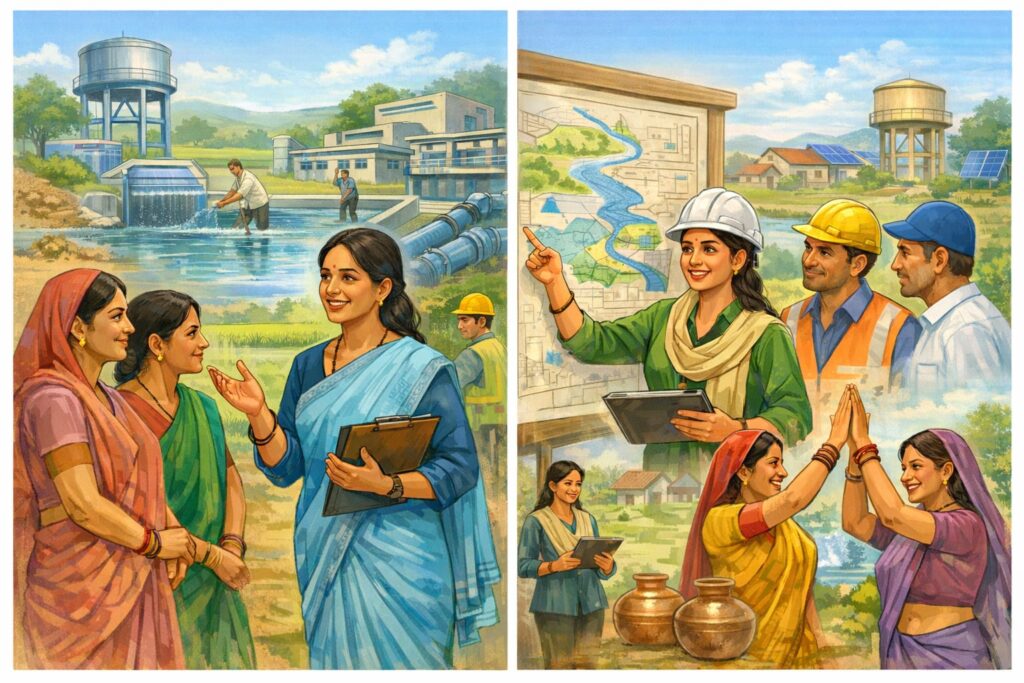
March 2026 : In India’s traditionally patriarchal society, the responsibility of ensuring water availability at home—from cooking to managing wastewater—has long been borne by women. Even today, many recall images of their mothers, sisters, or grandmothers carrying pots on their heads, walking long distances to fetch water. While this scene is gradually becoming outdated in India, millions across the world still lack access to clean and regular water supply. Recognising this, the United Nations has emphasised women’s empowerment in water management as a key theme for World Water Day this year.
India has made significant progress in providing drinking water through initiatives like the Jal Jeevan Mission, which aims to deliver tap water to every household. However, water scarcity persists in several regions, disproportionately affecting women. This issue is not limited to India but remains a global concern, prompting the focus on “Water and Women’s Empowerment.”
Water Crisis: A Question of Inequality
Although about 71% of the Earth’s surface is covered with water, only 2.5% is freshwater, and an even smaller fraction is accessible for human use. Climate change, population growth, urbanisation, and industrialisation have widened the gap between water demand and supply. This inequality impacts women and girls the most.
Women Bear the Brunt
According to global reports, over one billion women still lack access to safe drinking water. Around 1.8 billion people do not have water available near their homes. In two out of three households worldwide, women are responsible for collecting water. Across 53 countries, women and girls collectively spend about 250 million hours daily fetching water—time that could otherwise be used for education, employment, or personal growth.
Lack of clean water and sanitation leads to nearly 1,000 child deaths every day. Additionally, in about 14% of countries, there are no proper mechanisms to ensure women’s participation in water governance. These figures highlight that the water crisis is not just environmental, but also social, economic, and gender-based.
Women at the Centre of Water Management
While constitutional equality has strengthened women’s roles in various sectors, their involvement in water management remains limited. Their experience and understanding of water usage make them essential stakeholders. According to the United Nations, greater participation of women leads to more sustainable and effective water services. It is crucial to shift their role from “water carriers” to “water planners.”
Water and the Economy
Water is not only vital for life but also for economic growth. Nearly 70% of freshwater is used in agriculture, with industries and energy sectors also heavily dependent on it. Countries like Israel (drip irrigation), Singapore (wastewater recycling), the Netherlands (flood control), and Australia (water conservation policies) demonstrate how effective water management drives development.
Solutions and Initiatives
Efforts such as desalination, wastewater treatment, and river rejuvenation are being promoted globally. In India, cities like Nagpur use treated wastewater for industrial purposes, while Navi Mumbai’s water management is considered a model. Rainwater harvesting, afforestation, and groundwater recharge remain essential strategies.
Government schemes like Jal Jeevan Mission, Atal Bhujal Yojana, Jal Shakti Abhiyan, Swachh Bharat Mission, and various state-level water conservation programmes are working to ensure water security.
Role of Citizens
While governments play a key role, citizens must also act responsibly. Simple measures like fixing leaks, adopting rainwater harvesting, reusing water, using drip irrigation, planting trees, and involving women in household water decisions can make a significant difference.
Water is not just a natural resource—it is a human right, a matter of social justice, and a foundation for gender equality. On this World Water Day, the call is clear: relieve women of the burden of fetching water and move towards equitable, sustainable water management.
Because saving water means securing the future of society.




106-Year-Old Nun Continues Service and Faithful Devotion in Italy
March 2026 : Sister Anna Maria of the Sacred Heart, an Italian nun, turned 106 on March 14…

106-Year-Old Nun Continues Service and Faithful Devotion in Italy
March 2026 : Sister Anna Maria of the Sacred Heart, an Italian nun, turned …