NASA Observes Réunion Island Lava Reaches The Sea.

Florida; April 2026: On March 28 this year, NASA Earth Observatory in Florida has captured by the virtue of Thermal Infrared Sensor (TIRS) on Landsat 9 that lava is flowing in the east direction towards the ocean. The signal reveals the amount of heat emanating from surfaces on Earth based on certain detections of thermal radiation in two wavelengths. Warmer areas are mapped in yellow and cooler surfaces in blue. The thermal data were overlaid on a digital elevation model of the island.
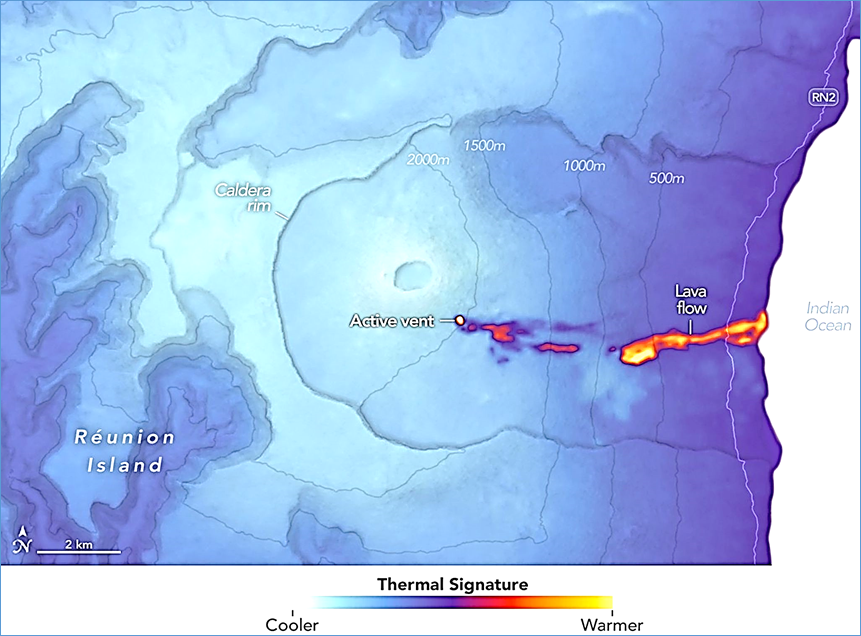
Located 700 kilometers (440 miles) east of Madagascar, Réunion Island is the product of a long-lived mantle hotspot on the floor of the Indian Ocean. The island first emerged above the ocean’s surface about 2 million years ago. It remains active today, with frequent eruptions from Piton de la Fournaise, a shield volcano on the island’s eastern side.
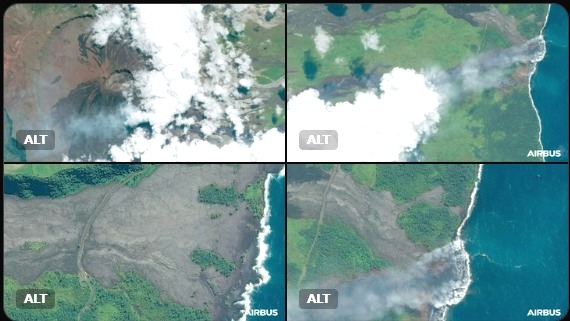
Since the 17th century, the volcano has had more than 150 documented eruptions. The most recent began within the Enclos Fouqué caldera on February 13, 2026, with the opening of four fissures that fueled sustained lava fountains reaching 10 to 50 meters (30 to 160 feet). Throughout February and March, basaltic lava spilled down the volcano, advancing through forested and grassy areas toward its eastern side.
Eminent volcanologists while asserting the cause of such a natural phenomenon have reiterated that:
“The hottest areas, shown as the brightest tones, correspond to the eruptive vent, the active lava channel, and the flow front”, said Adele Campus, a University of Turin volcanologist. From the vent, lava flows downslope for several kilometers, often through lava tubes. “The places where lava re-emerges at the surface through breakouts appear as localized hotspots”, she added.
Meanwhile, Diego Coppola, of the same University of Turin have affirmed that, “This eruption appears to be longer and to have produced a larger volume of lava than usual. The current activity likely marks the onset of a new cycle of frequent eruptive activity at Piton de la Fournaise”, while further stating that such characteristics are often associated with the onset or end of an eruptive cycle. The most recent cycle began in 2014, culminated in 2015, and ended in July 2023.
On March 13, lava cut through the island’s Route Nationale 2 (RN2). By March 16, it had begun to spill into the Indian Ocean, producing acidic plumes of steam and volcanic gases, known as laze, according to the Observatoire Volcanologique du Piton de la Fournaise (OVPF). Scientists on the ground measured lava temperatures of 1,100 to 1,130 degrees Celsius (2,010 to 2,070 degrees Fahrenheit) as lava neared the ocean. Thermal surveys also showed that water temperatures exceeded 36°C (97°F) up to 600 meters from the entry point, according to OVPF. As of March 24, materials entering the ocean had created a new lava delta that extended the coastline by 190 meters.
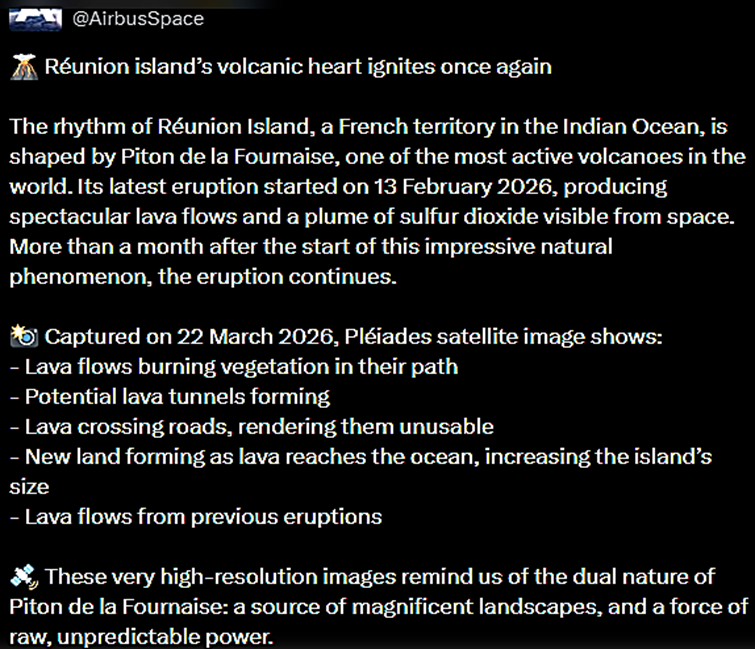
While further confirming Airbus Space on their “X” handle has said:
Suvro Sanyal – Team Maverick.








Trump Vows Continued Military Pressure on Iran, Expresses Doubts Over Diplomacy
Washington, Aug 2026: US President Donald Trump has vowed to maintain military pressure on…

Trump Vows Continued Military Pressure on Iran, Expresses Doubts Over Diplomacy
Washington, Aug 2026: US President Donald Trump has vowed to maintain military pressure on …