UNCJ: Spain’s Penalties on Misuse of Fixed-Term Public Contracts May Violate EU Law

UNCJ: Successive Fixed-Term Contracts – Measures Taken In Spain To Penalise Their Misuse In The Public Sector Do Not Appear To Be In Line With EU Law.
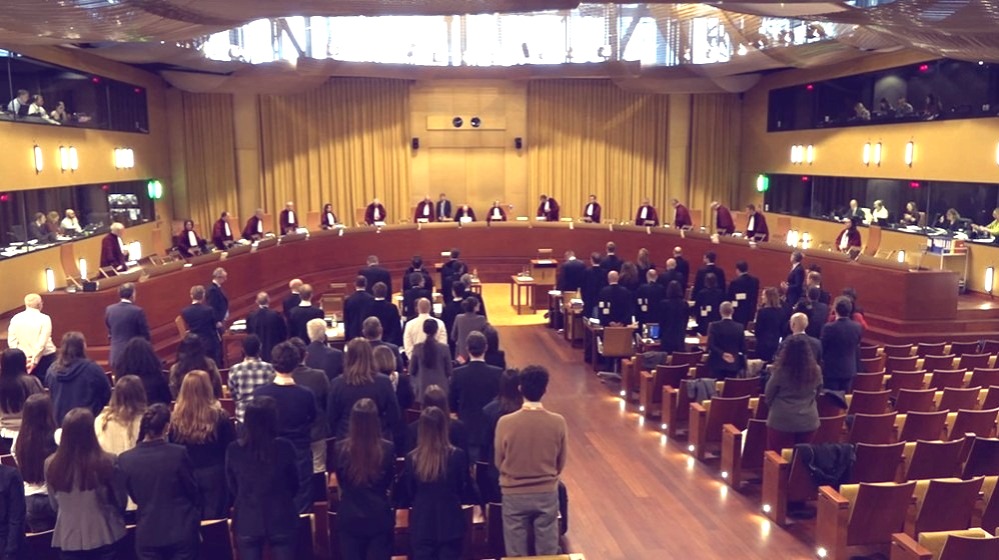
Luxembourg; April 2026: In this preliminary ruling, the Court of Justice provides the Spanish Supreme Court with a series of clarifications concerning the compatibility with EU law of measures taken in Spain to remedy abuse arising from the use, in the public sector, of successive fixed-term contracts.
The Court takes the view that those measures (the conversion of those contracts into a ‘non-permanent employment relationship of indefinite duration; the payment of compensation to workers upon termination of the employment relationship; the system of rules governing the liability of public administrations; and the organisation of selection procedures which take into account the workers’ previous experience and the working time spent by them in performing their duties) do not make it possible duly to penalise such abuse or to nullify the consequences of the breach of EU law.
A worker has performed childcare duties as a member of the contract staff since March 2016 at a public educational establishment under the responsibility of the Autonomous Community of Madrid (Spain). The basis of her employment relationship was six successive fixed-term contracts, all of which were intended to cover a vacant post or to replace a worker.
The Spanish courts classified her employment relationship as a ‘non-permanent employment relationship of indefinite duration’ owing to the abuse that had occurred in respect of her successive fixed-term contracts. This means that the worker will remain in post until that post has been definitively filled by means of a selection procedure (The Spanish Supreme Court explains that the status of ‘permanent worker’ in the public sector can only be conferred on persons who have entered public employment after passing a selection procedure in accordance with the principles of equality, merit and ability, as laid down in the Spanish Constitution, and the principles of equality and non-discrimination, enshrined in the Charter of Fundamental Rights of the European Union), and that she will receive compensation upon termination of her employment relationship. The worker has brought an action before the Spanish Supreme Court seeking to have her employment relationship declared permanent.
That court points out that the Court of Justice ruled on the obligations arising from clause 5 of the framework agreement on fixed-term work (Clause 5 of the framework agreement on fixed-term work concluded on 18 March 1999, annexed to Council Directive 1999/70/EC of 28 June 1999 concerning the framework agreement on fixed-term work concluded by ETUC, UNICE and CEEP) in a 2024 judgment (Judgment of the Court of 22nd February 2024, Consejería de Presidencia, Justicia e Interior de la Comunidad de Madrid and Others, C-59/22, C-110/22 and C-159/22).
The purpose of that clause is to prevent abuse arising from the use of successive fixed-term employment contracts or relationships. However, that judgment of the Court has been applied in an inconsistent manner by the Spanish courts. The Spanish Supreme Court seeks guidance from the Court to be able to determine whether national legislation and national case-law on the concept of ‘non-permanent employment relationship of indefinite duration’ are compatible with the requirements deriving from clause 5 of the framework agreement, namely whether they contain appropriate measures to penalise such abuse in the public sector.
The Court notes, first of all, that it is not for it to give a ruling on the interpretation of provisions of national law, that being for the national courts having jurisdiction. It will therefore be for the Spanish Supreme Court to assess whether the measures laid down in the relevant national legislation duly penalise the abuse of successive fixed-term employment contracts or relationships in the public sector and make it possible to nullify the consequences of the breach of EU law.
Nevertheless, the Court provides clarification to give the Spanish Supreme Court guidance in its assessment.
According to the Court, the conversion of successive fixed-term contracts into a ‘non-permanent employment relationship of indefinite duration’ does not constitute an appropriate measure duly to penalise abuse. That measure effectively preserves an employment relationship of a temporary nature and thus perpetuates the insecurity of the worker concerned, whereas the benefit of stable employment is viewed as a major element in the protection of workers.
Next, the Court considers that the compensation provided for in the relevant national legislation, which is paid upon termination of the employment relationship and is subject to a double ceiling (namely, the limit of 20 days remuneration per year of service and the cap of 12 months’ salary in the first case, and the limit of 33 days remuneration per year of service and the cap of 24 months’ salary in the second) does not appear to be such as to nullify the consequences of the breach of EU law in all situations of abuse of successive fixed-term contracts (that compensation cannot constitute either proportionate and effective compensation for instances of abuse that exceed a certain duration in terms of years or adequate and full compensation for the damage resulting from such abuse. Furthermore, since such compensation is paid only upon termination of the employment relationship owing to the completion of a selection procedure, it does not appear to be capable of effectively remedying all cases of abuse, such as those involving workers who retire, resign or are dismissed before the end of the selection procedure).
In addition, as regards the system of rules governing the liability of public administrations, the Court finds that such a system does not constitute an appropriate measure for the purpose of clause 5 if it is ambiguous, abstract and unforeseeable and is not accompanied by other effective, dissuasive and proportionate measures enabling the consequences of the breach of EU law to be nullified. It will be for the Spanish Supreme Court to ascertain, first, whether the system of rules governing liability provided for in Spanish law is based on national provisions that are specific, foreseeable and applicable in practice, such as to make it possible duly to penalise the public administration concerned, and, secondly, whether that system is accompanied by measures of that kind.
Finally, the Court considers that the organisation of selection procedures which, while taking account of the previous experience of the workers concerned and the working time spent by them in performing their duties, do not limit that taking into account to candidates in respect of whom abuse has occurred, also does not constitute an appropriate measure to prevent and penalise such abuse. First of all, the worker concerned might not participate in the selection procedure or his or her application might not be successful. Furthermore, subject to verification by the Spanish Supreme Court, the taking into account of the experience and working time mentioned above appears to benefit all fixed-term workers with such experience, including those in respect of whom no such abuse has occurred.
[[The name of the present case is a fictitious name. It does not correspond to the real name of any party to the proceedings]].
Team Maverick.







Shivakumar Says Congress United, Assures Women Will Get Cabinet Berth
Bengaluru, Aug 2026 : Karnataka Chief Minister D.K. Shivakumar on Monday sought to dismiss…

Shivakumar Says Congress United, Assures Women Will Get Cabinet Berth
Bengaluru, Aug 2026 : Karnataka Chief Minister D.K. Shivakumar on Monday sought to dismiss …