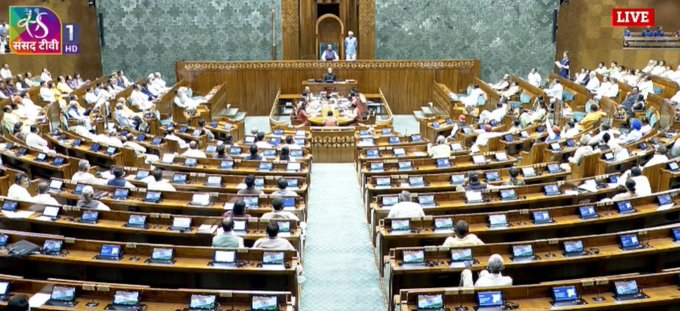
Lok Sabha Clears Introduction of Women’s Reservation Bill After Division Vote

New Delhi, April 2026 : The Lok Sabha on Thursday approved the introduction of the Constitution (One Hundred and Thirty-First Amendment) Bill, 2026, aimed at enabling women’s reservation and paving the way for delimitation, following a division of votes in the House. The move marked a significant step in the legislative process amid strong political contestation.
Union Law Minister Arjun Ram Meghwal formally introduced the Bill, along with the Delimitation Bill, 2026, and the Union Territories Laws (Amendment) Bill, 2026. The introduction came after Members of Parliament voted in favour of taking up the proposal for discussion.
The voting process assumed importance as the Opposition demanded a formal division instead of the usual voice vote. Acting on the demand, Lok Sabha Speaker Om Birla ordered a recorded vote. According to the initial count announced in the House, 251 members voted in favour of introducing the Bill, while 185 opposed it, though the figures were noted as subject to verification.
Typically, the Lok Sabha passes motions through voice votes. However, when the outcome is disputed, a division is conducted to record individual votes. In this case, the Automatic Vote Recorder system was used to register votes under “Ayes,” “Noes,” and “Abstain,” ensuring transparency in the process.
Following the electronic voting, vote slips were also utilised as part of the proceedings. In that round, a total of 333 members cast their votes, with no abstentions recorded. The use of both systems highlighted the heightened political engagement surrounding the Bill.
Lok Sabha Secretary General Utpal Singh briefed members on the voting procedure, explaining the functioning of the electronic system. He clarified that votes would only be registered if members pressed the voting buttons within the specified time between the sounding of the gongs. Members were also informed that they could verify their votes on the individual results board.
He further noted that if any member wished to change their vote, they could request the use of vote slips, providing an additional layer of procedural flexibility.
The Opposition’s insistence on a division underscored the contentious nature of the legislation, even at the stage of introduction. Despite the objections, the motion required only a simple majority to pass, which the government secured.
The Constitution (One Hundred and Thirty-First Amendment) Bill, 2026, seeks to operationalise one-third reservation for women in legislative bodies, a reform that has been widely debated for years. Its introduction, along with related bills on delimitation and Union Territories laws, sets the stage for an intense parliamentary debate in the coming days.
As the House moves forward with discussions, the focus will now shift to detailed deliberations on the provisions of the Bill and its broader implications for political representation and electoral restructuring in the country.





AAHL’s Navi Mumbai, Guwahati Airports in Prix Versailles 2026 List
Editor’s Synopsis • Navi Mumbai International Airport and Lokpriya Gopinath Bordoloi Inter…

AAHL’s Navi Mumbai, Guwahati Airports in Prix Versailles 2026 List
Editor’s Synopsis • Navi Mumbai International Airport and Lokpriya Gopinath Bordoloi International Airport, both …