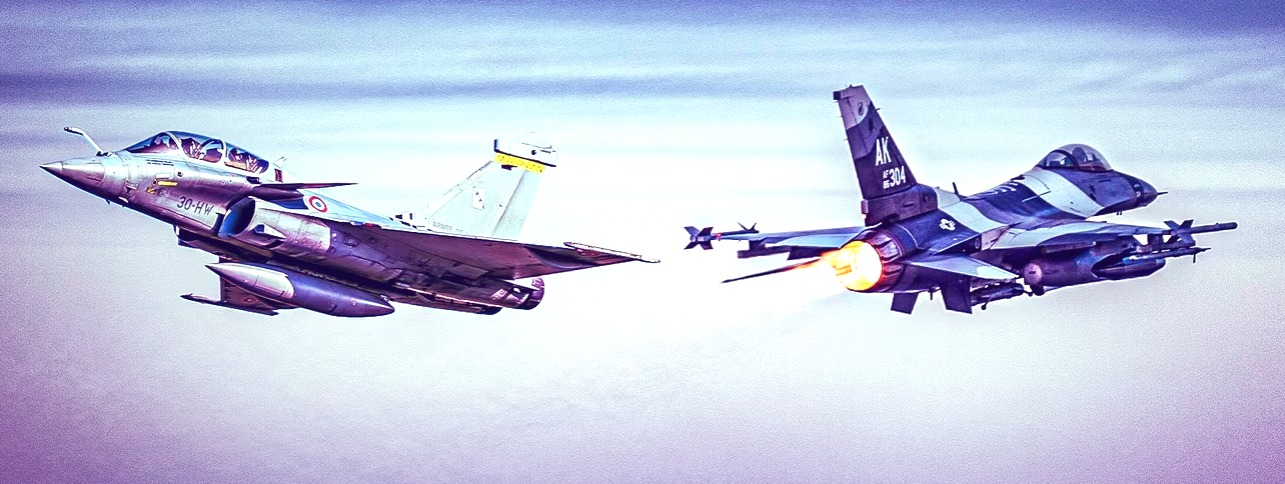
How The Dassault Rafale Competes With F-16 Fighter Falcon.

April 2026: The cutting edge of air warfare is defined by data-centric tactics, ever-increasing automation, and stealth technology. Yet some legacy airframes that will never be able to evolve into an all-aspect fighter jet continue to serve on the front line. Two examples of high-performance fighters that are not only still relevant but just as strategically important as fifth-generation jets are the Lockheed Martin F-16 Fighting Falcon and Dassault Rafale.
Technologically, the F-16 is considered a 4th-Gen while the Rafale outclasses it with sophisticated systems that bump it up to 4.5-Gen. While Rafale has evolved to become a premier fighter jet that can match 5th-Gens in virtually every category except stealth; the F-16 has stuck to its roots as a dogfighter (close range aerial combatant) and still leverages its kinematic advantage to make the most of the lightweight airframe. While the Rafale has the advantage in beyond visual range engagement with a more powerful arsenal and suite of electronics, the F-16 can still give the larger French fighter a run for its money in such a dogfight (close range aerial combat).
The latest and greatest iteration of the Viper (as the F-16 is also known), has evolved over five decades since the US Air Force’s ‘Fighter Mafia’ pushed it to production. The once simple, visual dogfighter now carries advanced AESA radar and other systems derived from 5th-Gen jets. The Block 70/72 variants are true multirole platforms that incorporate all of the lessons learned and best tech accumulated from 52 years of service as the workhorse of 25 air forces.
The Rafale did not enter service until 22 years after the F-16 debuted on the flight line. It was developed with different technical goals and a much broader mission goal. The single airframe replaced seven legacy platforms across both the French Air Force and French Navy. It was intended to have the ability to perform virtually any mission, including nuclear deterrence, as an ‘omnirole’ fighter. To make the Rafale capable of doing so much, it has both superior performance and firepower over the Viper.
Going head-to-head, even a high-G dogfight where the F-16 shines would give the Rafale an extra edge. The French fighter can match the 9G pulls of the Falcon, but its canards give it a ‘snappier’ nose, which makes it easier to gain a target lock, and its higher power-to-weight ratio also means it can outmaneuver the F-16 in many scenarios. But the Viper still has some tricks up its sleeve, plus the F-16 is smaller than the Rafale, making it significantly easier to lose sight of during a high-stress visual fight.
The F-16 is a rate fighter, optimised to maintain energy and airspeed while pulling high G-loads. The F-16’s primary tactical advantage in a dogfight against the Rafale lies in its visual profile and sustained energy management. While the Rafale is a 4.5-generation powerhouse with superior low-speed nose authority, the F-16 excels when the fight stays at high speeds.
At airspeeds above 400 knots, the F-16’s flight control system is exceptionally efficient, allowing it to sustain its maximum 9G turn limit longer than many delta-wing competitors that experience higher drag during aggressive maneuvers. In a prolonged two-circle fight, the F-16 can often out-rate the Rafale by maintaining a higher constant speed, eventually working its way behind the Rafale as it bleeds energy to make tighter turns in a circling aerial combats
While the Rafale has a high thrust-to-weight ratio, an air-to-air loaded F-16 has better acceleration because of its lower gross weight. That allows a Viper pilot to quickly convert speed into altitude, allowing them to reset a fight or dive back into an engagement with an energy advantage if the Rafale has bled its speed in low-speed maneuvers. And in this scenario, the latest upgrades to off-boresight tech in the F-16 help close the gap in weapons capability with the larger and better-equipped French jet
In modern close-range combat, the F-16 remains formidable due to its integration with the JHMCS, or Joint Helmet Mounted Cueing System, paired with the AIM-9X Sidewinder. This allows the pilot to achieve off-boresight locks simply by looking at the target, negating some of the Rafale’s aerodynamic advantages in pointing its nose. The AIM-9X Block II can track and hit targets at extreme angles, sometimes even behind the F-16.
An F-16 pilot sees critical targeting data projected onto their visor. Unlike older missiles, the pilot doesn’t need to point the jet at the enemy; they only need to point their head. If a Rafale is pulling a tight turn to the side, the F-16 pilot just looks at it, gets a look-to-lock, and fires. The missile’s thrust-vectoring nozzle then does the work of turning sharply to intercept.
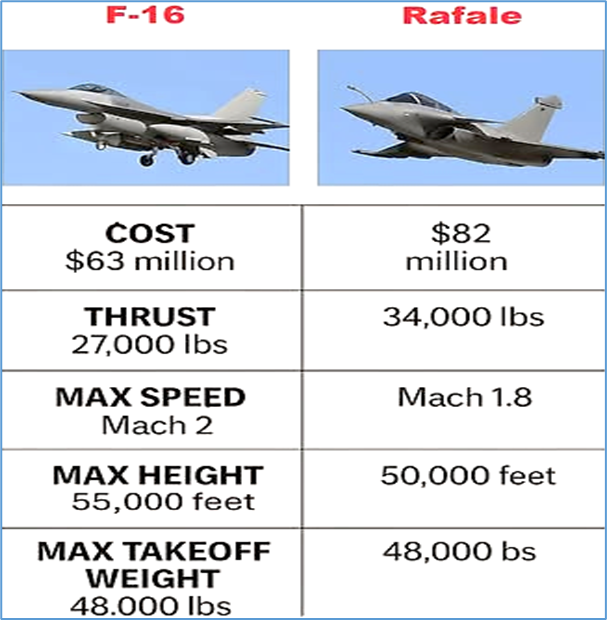
The two aircraft are very closely matched in thrust-to-weight ratio, but the Rafale has a slight advantage. This is a very important metric in determining which aircraft will reign supreme in aerial combat, as that number will determine which jet falls out of the sky first in extreme maneuvers. While the F-16 has a ratio of 1.11, the French fighter has a T/W ratio of 1.31, and because of all that engine power, it can actually accelerate in a vertical climb, which few other fighters can perform.
If the F-16 pilot tries to follow a Rafale onto a steep climb, the Rafale’s extra power-to-weight margin means it will maintain its speed longer. The F-16 will eventually “stall out” or bleed too much speed, leaving it vulnerable to a diving attack. This has been degraded by conformal fuel tanks and the addition of more equipment in the newest generation of the Viper, which has traded some performance for new gear.
An F-16 pilot will need to keep the speed of the engagement relatively high in order to deny the Rafale its high alpha and T/W ratio advantage. After a high-G turn that bleeds speed, the Rafale can regain that lost energy and return to its optimal fighting speed faster than the F-16. On the other hand, if the Rafale bleeds too much energy, its higher T/W ratio is needed just to keep from falling behind the F-16’s constant, high-speed circle.
While the F-16 is the most widely operated fighter in the world, with over 4,600 units built, the Rafale has recently experienced a sales surge, securing over 530 firm orders by 2026 as a premium alternative to American systems. The F-16 has enjoyed a very long production run that has slowed down, but it’s far from over. Its extensive support base dramatically cuts down procurement costs, which is one area in which the French jet is a much harder sell.
Lockheed Martin and Dassault produce similar numbers of these jets every year, with around 25 on average rolling out of the factory doors annually. The US Air Force no longer buys F-16s, but LM has found success with exports to Taiwan, Bahrain, Slovakia, and potentially India in the future. Currently, the Rafale is still being delivered to the French Armed Forces, and of the backlog that is over 200 jets, around 80% are also export airframes.
A French Rafale can cost more than a 5th-Gen fighter to procure, even though its operational costs are around the same as the F-16, varying between $20,000 and $25,000 per flight hour. The F-16 is bit cheaper by comparison at $30 million on the low end and around $65 million on the high end. Another advantage to the Viper is that components, infrastructure, and weapons are readily available at a lower cost than its French counterpart as well.
The F-16 is seen as a “high-low” mix workhorse that allows air forces to maintain a larger fleet size for the same budget as a smaller, premium Rafale fleet. Several air forces even maintain a ‘best of both worlds’ strategy by operating both the Lockheed Martin F-16 Fighting Falcon and the Dassault Rafale simultaneously. Egypt was the first export customer for Dassault’s omnirole jet and is expected to receive a total of 55 examples, but it also has one of the world’s largest F-16 fleets with more than 200 in its inventory.
Greece also has two dozen Rafale fighters that complement its fleet of over 80 F-16s. The United Arab Emirates Air Force has a similar number of F-16E/F Desert Falcons and ordered 80 Rafale F4 variants to replace their aging Mirage 2000s. Even Ukraine has placed an order for the Rafale and expects to receive up to 100 F4 variants by 2035, which will strengthen its Air Force that has only recently received donated F-16 jets from NATO allies like the Netherlands and Denmark.
Team Maverick.







Jana Sena Picks Lingamaneni Ramesh for Rajya Sabha, Strengthening NDA’s Parliamentary Presence in Andhra Pradesh
Amaravati, June 2026 : The Jana Sena Party has officially nominated senior leader Lingaman…

Jana Sena Picks Lingamaneni Ramesh for Rajya Sabha, Strengthening NDA’s Parliamentary Presence in Andhra Pradesh
Amaravati, June 2026 : The Jana Sena Party has officially nominated senior leader Lingamaneni …