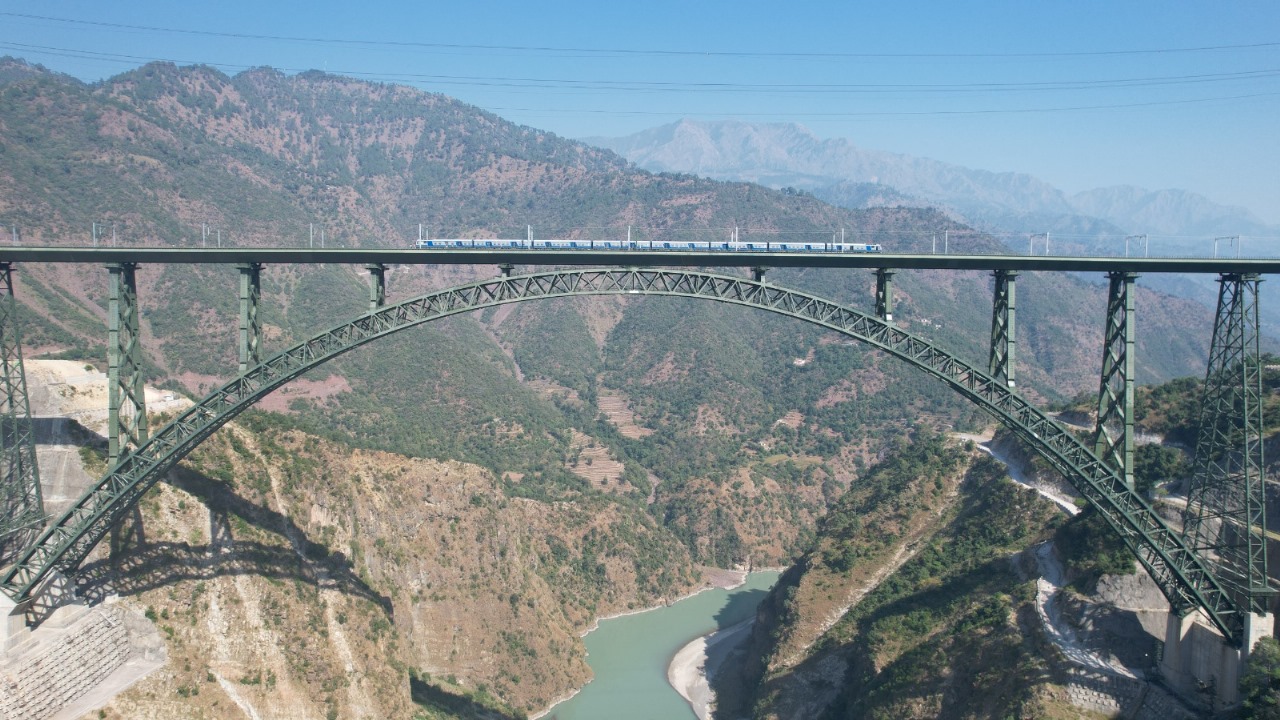
Mountains Moved! – Elevating the Kashmir Journey by stretching Railways along the Chenab Bridge.

Where snow-capped peaks meet the sky and the Chenab carves deep into the earth with sharp biting cold winds whip against you as you stand on the deck of the world’s highest railway bridge spanning the blue green waters of Chenab, India has etched its resolve in steel that course through the gorge, like adrenalin in your veins. The Chenab Bridge, now the world’s highest railway bridge, rises 359 metres above the riverbed, standing as a symbol of engineering excellence and national ambition. Flanked by high mountain peaks, the Chenab Bridge stands 359 meters above mean sea level, dwarfing the Eiffel Tower by 35 meters, and the Qutub Minar five times over! With its head in the clouds and feet firmly anchored in football field size foundations. Stretching 1,315 metres across the Chenab River near the Salal Dam, the bridge features a stunning main arch span of 467 metres, and is built to withstand windspeeds up to 266 kilometres per hour. Equipped with state of the art monitors and maintenance machinery, the Chenab Bridge will ensure an all season, seamless rail connectivity to Kashmir through the Udhampur – Srinagar – Baramulla Rail Link (USBRL) which has a length of 272 kilometres.
As the country awaits the first commercial run of the newest Vande Bharat train between Katra and Srinagar, the journey promises to be more than just a passage. The route traverses some of the most picturesque and challenging geographies in the world. Recognised as a highly complex construction project, the USBRL comes at an estimated cost of ₹37,000 crore, with ballast-less tracks laid over bridges and tunnels, spanning deep gorges and piercing the heart of mighty mountains. More than ninety percent of the route is traversed over 943 bridges and 36 main tunnels, including India’s longest railway tunnel, the T-50, stretching for more than 12.7 kilometres.

On the Katra – Banihal section of USBRL, lies the Anji Khad Bridge, the country’s first cable-stayed rail bridge. The 725 meter long bridge, built with the support of 96 cables, stands 331 meters above mean sea level, and is a masterclass in design and engineering. Beyond the engineering marvel, the rail link also promises to boost tourism, trade, and all weather connectivity in the region, potentially transforming the socio-economic landscape of Jammu and Kashmir.
The project is home to several railway stations that are key to the progress, security, and prosperity of Jammu and Kashmir. Qazigund, known as the ‘gateway of Kashmir,’ serves as a vital connection between South Kashmir and the rest of the region. Stations like Pampore, Srinagar, Sopore, and Anantnag are central to the valley’s economic activity, serving as major business hubs. Additionally, the significance of Reasi and Katra stations lies in their proximity to the renowned Mata Vaishno Devi temple, making them crucial for both spiritual and economic growth.
The state-of-the-art Vande Bharat Express has been tailored to specifically operate in the region’s challenging winter conditions with a view to ensuring reliability, safety and comfort. Apart from its modern amenities, the Kashmir version of Vande Bharat is equipped with climate-specific adaptations to provide world-class travel experience. Its Advanced Heating Systems promise smooth operations even in sub-zero temperatures. The Driver’s front lookout glass has also been embedded with heating elements for defrosting, ensuring clear visibility even in harsh winter conditions.
Pir Panjal, the sentinel of Kashmir valley, awaits the reassuring rhythm of train wheels chugging through the Banihal Tunnel, bringing alive in their wake, our long cherished dream of seamless connectivity, from ‘Kashmir to Kanyakumari’, India has always been one. The newest rail link only deepens that centuries old connection, with the added promise of making Kashmir accessible to all!
Part of the Udhampur-Srinagar-Baramulla Rail Link (USBRL) project, the bridge connects not just terrain but aspirations — linking the Kashmir Valley to the rest of India with an all-weather, reliable rail route.
The construction of this engineering marvel involved over 28,000 metric tons of steel and introduced a first-of-its-kind cable crane system in Indian Railways — used to ferry materials across a 915-metre-wide gorge with two massive cable cars and pylons towering over 100 metres high. Built in the geologically complex and unstable terrain of the Himalayas, the Chenab Bridge is more than a feat of infrastructure — it is a symbol of India’s grit, innovation, and unwavering resolve to bring progress to even the most remote corners. As it stands tall over the Chenab, the bridge doesn’t just connect two mountains — it connects dreams, development, and a new era for Jammu & Kashmir.
Team Maverick








Iran Set to Acquire Chinese MANPADS Amid Rising Regional Tensions, Report Says
New Delhi, July 2026 : Iran is expected to receive its first shipment of Chinese-made shou…

Iran Set to Acquire Chinese MANPADS Amid Rising Regional Tensions, Report Says
New Delhi, July 2026 : Iran is expected to receive its first shipment of …