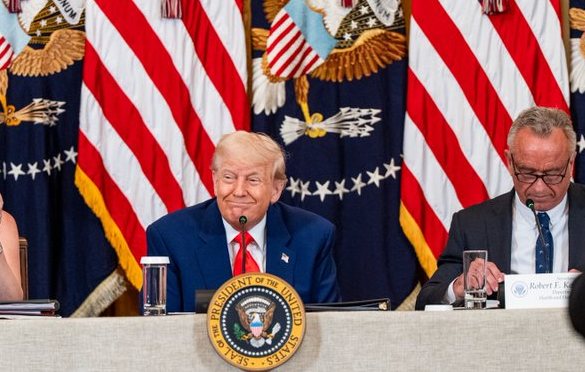
Trump Escalates Trade War: Threatens 50% EU Tariffs, 25% on Smartphones

Washington – In a bold escalation of his aggressive trade stance, former U.S. President Donald Trump announced plans to impose a 50% tariff on all imports from the European Union (EU) and a 25% tariff on smartphones manufactured outside the United States. The threat, made via a series of posts on Trump’s social media platform Truth Social, underscores his continued use of tariffs as a tool to pressure allies and adversaries alike in pursuit of trade reforms and domestic manufacturing.
Trump’s latest move has sent shockwaves across global markets, raising concerns among economists, businesses, and foreign leaders. Despite years of imposing tariffs, Trump’s efforts have not yet yielded the desired results in terms of new trade deals or significant reshoring of American manufacturing. Still, the former president appears determined to double down.
A Stark Warning to the European Union
Trump expressed frustration with the lack of progress in ongoing trade negotiations with the EU. While the EU has offered to mutually reduce tariffs to zero, Trump has insisted on maintaining a baseline 10% tax on most imports. Dissatisfied with the stalemate, Trump proposed a steep 50% tariff on all EU imports, effective from June 1, 2025, unless the products are manufactured within the United States.
“Our discussions with them are going nowhere!” Trump posted. “Therefore, I am recommending a straight 50% Tariff on the European Union, starting on June 1, 2025. There is no tariff if the product is built or manufactured in the United States.”
Speaking later from the Oval Office, Trump reinforced his hardline approach. “I’m not looking for a deal,” he told reporters. “We’ve set the deal. It’s at 50 per cent.”
Targeting Tech Giants: Apple and Beyond
The tariff threats extended to technology companies, particularly smartphone manufacturers. Trump specifically targeted Apple, demanding that iPhones sold in the U.S. must be manufactured domestically. If not, he warned, the company would face a 25% import tariff.
“I have long ago informed Tim Cook of Apple that I expect their iPhones to be manufactured in the United States, not India, or anyplace else,” Trump wrote. “If that is not the case, a tariff of at least 25% must be paid by Apple to the U.S.”
Trump later clarified that the tariff would apply to all smartphones, including those made by Samsung and other foreign manufacturers. “It would be also Samsung and anybody that makes that product,” he said. “Otherwise, it wouldn’t be fair.”
Shifting the Burden: Who Pays the Price?
Trump’s statement that Apple would have to pay the tariff marks a shift from his earlier claims that foreign countries bore the cost of his import taxes. In reality, importers typically pay the tariffs, and those costs are often passed on to consumers in the form of higher prices.
In response to the growing tariff pressures, Apple CEO Tim Cook recently announced that most iPhones sold in the U.S. during the current fiscal quarter would be produced in India, with other devices sourced from Vietnam. However, analysts warn that moving production back to the U.S. could lead to steep price hikes. Some estimates suggest that a $1,200 iPhone could cost as much as $3,500 if manufactured domestically.
Market Reaction and Economic Concerns
Following Trump’s latest posts, U.S. stock markets dipped. The S&P 500 fell by about 0.5% in afternoon trading, a sign of how sensitively markets respond to Trump’s trade announcements. Investors are wary of the economic disruption tariffs can cause, including inflation, supply chain uncertainty, and reduced corporate earnings.
Treasury Secretary Scott Bessent attempted to explain the administration’s reasoning during a Friday interview. He criticized the EU for what he called a “collective action problem,” suggesting that the bloc’s 27 member states were being represented ineffectively by central negotiators in Brussels.
Bessent also confirmed he had spoken with Tim Cook recently and emphasized the administration’s desire for Apple to localize more of its supply chain, especially for computer chips.
A Deepening Rift with Europe
Trump’s tariffs have created friction not just with China but now with one of America’s oldest allies—the EU. He argues that the U.S. runs an “unacceptable” trade deficit with the EU, despite data from the European Commission showing the imbalance is more nuanced when services are included. While the U.S. imports more goods from the EU than it exports, it runs a surplus in services such as finance and tech, bringing the overall trade gap to €48 billion ($54 billion).
German Foreign Minister Johann Wadephul responded cautiously, expressing hope for continued negotiations and warning that tariffs would harm both economies. “I think such tariffs help no one, but would just lead to economic development in both markets suffering,” he said. “We are still counting on negotiations.”
Strategic Miscalculations?
Some economists argue that Trump’s escalating tariff threats could backfire. Instead of isolating China and securing better deals with allies, his strategy risks alienating those very allies. German economist Marcel Fratscher said the EU and Germany’s approach to negotiations with Trump had been a “total failure,” adding that Trump viewed Europe’s hesitation and concessions as signs of weakness.
Mary Lovely, a senior fellow at the Peterson Institute for International Economics, believes Trump’s 50% tariff threat is likely a negotiation tactic. She said Trump tends to push talks to the brink in hopes of forcing an agreement. However, she warned that this approach portrays the U.S. as an unpredictable trading partner, making long-term agreements harder to secure.
Apple in the Crosshairs
Apple’s relationship with Trump has been inconsistent. Although the company pledged $500 billion in domestic investment earlier this year—largely for AI development—Trump appeared to turn against Apple during a recent event in Qatar.
“I had a little problem with Tim Cook yesterday,” Trump said at the event. “I said to him, my friend, I treated you very good. You’re coming here with $500 billion, but now I hear you’re building all over India. I don’t want you building in India.”
Analysts have pointed out that moving iPhone production to the U.S. would be extremely challenging due to the complexity and scale of Apple’s current supply chains in China and elsewhere. Ben Wood, chief analyst at CCS Insight, said companies like Apple face enormous uncertainty under Trump’s trade policy.
“At any moment, things can change overnight, making it extremely difficult for companies such as Apple to plan their business,” he said. “It seems that despite the best efforts of Apple’s leadership to lobby the U.S. administration, a curveball can come out of nowhere and derail their plans.”
Looking Ahead
Trump’s proposed tariffs come at a time when the global economy is still recovering from supply chain disruptions caused by the COVID-19 pandemic and geopolitical tensions. If implemented, the tariffs could not only strain U.S. relations with the EU but also contribute to global inflation, reduced consumer choice, and economic instability.
With the June 1 deadline looming for EU tariffs and the smartphone levies potentially arriving by the end of June, businesses are scrambling to prepare. Analysts say the uncertainty may already be causing damage, with companies delaying investments and reassessing long-term supply chain strategies.
Whether Trump’s threats are a negotiating tactic or a firm policy stance remains to be seen. What is clear is that the former president continues to wield economic pressure as a political tool—one that could have far-reaching consequences for American consumers, businesses, and international partners alike.






Taiwan Reaffirms South China Sea Claims After Philippines Submits Scarborough Shoal Chart to UN
Taipei, Aug 2026 : Taiwan on Sunday reaffirmed its sovereignty claims over islands in the …

Taiwan Reaffirms South China Sea Claims After Philippines Submits Scarborough Shoal Chart to UN
Taipei, Aug 2026 : Taiwan on Sunday reaffirmed its sovereignty claims over islands in …