Japan Commits Over $1 Billion to Support Bangladesh’s Development and Reform

Japan has pledged $1.063 billion in assistance to Bangladesh, supporting a wide range of areas including economic reforms, railway infrastructure, scholarships, and capacity building. The announcement was made during a bilateral meeting in Tokyo between Bangladesh’s Chief Adviser Professor Muhammad Yunus and Japanese Prime Minister Ishiba Shigeru. The discussions were part of Professor Yunus’s ongoing official visit to Japan, during which he also attended the 30th Nikkei Asia Forum.
According to the official statement from the Chief Adviser’s Office, Japan reiterated its full support for Bangladesh’s interim government and its efforts towards peaceful democratic transition and institutional reforms.
Of the total commitment, $418 million will be disbursed as a Development Policy Loan, aimed at supporting Bangladesh’s economic reforms and climate resilience initiatives. An additional $641 million will be used to upgrade the Joydevpur–Ishwardi railway segment into a dual-gauge double-track line, boosting connectivity and trade logistics. A further $4.2 million has been granted to fund scholarships for Bangladeshi students.
The two leaders also welcomed the signing of several memorandums of understanding (MoUs) and cooperation agreements. These cover diverse sectors such as the development of a One Stop Service (OSS) system in the Bangladesh Investment Development Authority (BIDA), the installation of prepaid gas meters, establishing a factory for battery-run cycles, launching a pilot project for information security, and land agreements related to the Bangladesh Special Economic Zone (BSEZ) to attract more Japanese investments.
During the talks, both Professor Yunus and Prime Minister Ishiba emphasized the urgent need to conclude an Economic Partnership Agreement (EPA) between the two nations. They instructed their respective teams to accelerate negotiations to finalize the deal soon. Once concluded, the EPA is expected to significantly enhance bilateral trade and open up duty-free and quota-free access for Bangladeshi goods in the Japanese market, especially important after Bangladesh’s graduation from Least Developed Country (LDC) status.
Currently, bilateral trade between the two countries stands at approximately $4 billion. Since Bangladesh’s independence, Japan has provided over $24 billion in loans and grants, playing a key role in major infrastructure developments such as the Dhaka Metro Rail, the third terminal of Hazrat Shahjalal International Airport, and the economic zone in Araihazar.
On the security front, the two leaders reaffirmed their commitment to strengthening cooperation. Japan confirmed the early delivery of five patrol boats to the Bangladesh Navy under its Official Security Assistance (OSA). The two sides also agreed in principle on an Agreement on the Transfer of Defense Equipment and Technology, expressing hope for its early conclusion.
Human resource development and people-to-people exchanges were also key points of discussion. The leaders signed MoUs to facilitate the training and recruitment of Bangladeshi skilled workers for the Japanese job market. With Japan facing a labor shortage, it is estimated that over 100,000 skilled Bangladeshi workers could be recruited in the next five years. Professor Yunus thanked Japan for its continued support through initiatives like the Project for Human Resource Development Scholarship.
Both countries reaffirmed their strategic partnership and shared commitment to a Free and Open Indo-Pacific (FOIP), underlining the importance of regional peace, stability, and prosperity. They pledged to uphold the principles of the UN Charter, promote multilateralism based on the rule of law, and support democracy in the region.
A major humanitarian issue discussed was the Rohingya refugee crisis. Prime Minister Ishiba praised Bangladesh for hosting the forcibly displaced Rohingya population from Myanmar’s Rakhine State and for its continued humanitarian efforts. Professor Yunus acknowledged Japan’s support on this issue and both sides agreed that a safe, voluntary, and dignified repatriation of the Rohingyas to Myanmar is the only sustainable solution. They stressed the need for sincere dialogue among all stakeholders to resolve the crisis.
The meeting concluded with Professor Yunus expressing gratitude for Japan’s warm hospitality and inviting Prime Minister Ishiba to visit Bangladesh at a mutually convenient time.
Team Maverick.




Mandaviya Hails India’s Winning Start at Commonwealth Games as Bowlers Shine in Glasgow
Glasgow, July 2026 : Union Minister for Youth Affairs and Sports Dr. Mansukh Mandaviya on …
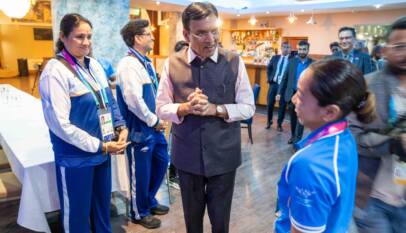
Mandaviya Hails India’s Winning Start at Commonwealth Games as Bowlers Shine in Glasgow
Glasgow, July 2026 : Union Minister for Youth Affairs and Sports Dr. Mansukh Mandaviya …