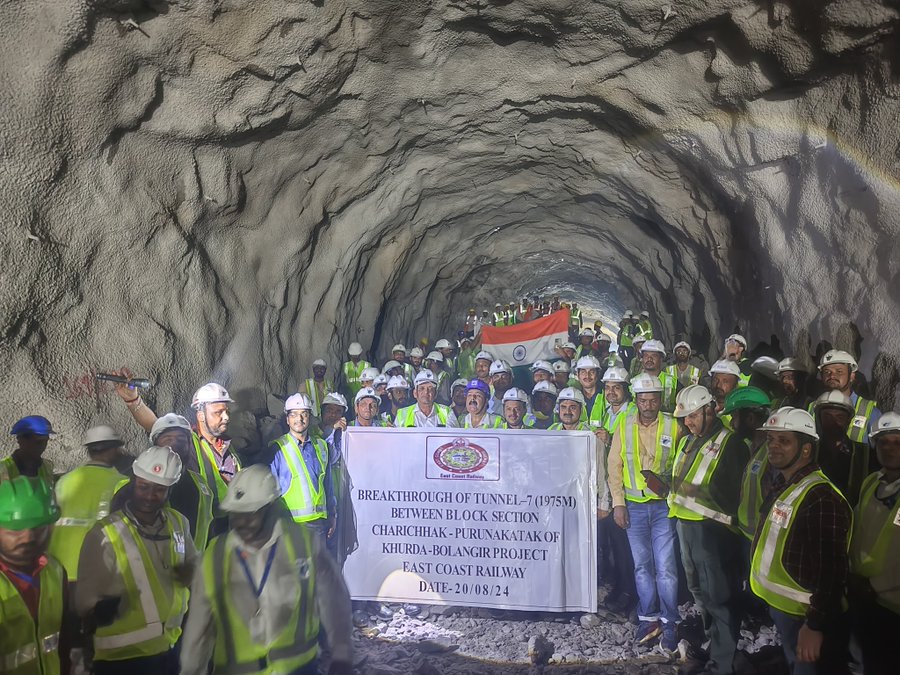
East Coast Railways achieves successful breakthrough of Tunnel No. 2 in Khurda Road – Bolangir Rail Project

The Khurda Road – Bolangir new railway line project has achieved a historic milestone with the successful breakthrough of Tunnel No. T2, located between Buguda and Daspalla in Nayagarh District.
The final breakthrough was completed on May 30, 2025, marking the completion of excavation work across all seven planned tunnels in this strategic railway corridor.
Tunnel No. T2 is a landmark in modern rail construction, with a length of 1,775 meters and a 2 degree curve. It has been constructed using the New Austrian Tunneling Method (NATM), a modern tunneling technology. It is the second-longest tunnel in Nayagarh District and a significant part of the project. It was constructed using advanced technology and tunneling methods to overcome the challenging Eastern Ghats terrain, setting a new benchmark in infrastructure execution for Indian Railways.
According to East Coast Railway (ECoR) sources, the completion of T2, the breakthrough of all seven tunnels in the 75 kilometres stretch between Daspalla and Purunakatak has now been achieved. Constructing these tunnels involved tackling multiple complex challenges, including highly variable soil and rock conditions, multiple tunnels with curved alignments requiring precise design, and simultaneous dual-end tunneling to meet deadlines. ECoR said that some sections of the tunnels were located near wildlife zones, forcing the Railways to deploy ecologically sensitive construction practices and noise and vibration control measures. Despite these obstacles, the project has made steady and impressive progress, with each breakthrough marking a step closer to full connectivity.
The Khurda Road – Bolangir Rail Line spans 301 kilometres, with significant portions already operational. While the Khurda Road to Daspalla (106 km) and Balangir to Purunakatak (120 km) sections have been completed, the remaining 75 km stretch from Purunakatak to Adhenigarh is in progress. Completion of this final segment will establish seamless rail connectivity between eastern and western Odisha, bringing extensive benefits to both passenger and freight traffic. It will reduce travel time between Bhubaneswar and Balangir, improve access to education, healthcare, and markets, stimulate trade and regional development, and support freight
The Khurda Road–Bolangir Rail Line Project is a flagship infrastructure initiative by Indian Railways aimed at enhancing intra-state connectivity across Odisha. It promises to transform regional transportation, bridge gaps, and fuel inclusive economic growth in the state.
The New Austrian tunneling method (NATM), also known as the sequential excavation method (SEM) or sprayed concrete lining method (SCL), is a method of modern tunnel design and construction employing sophisticated monitoring to optimise various wall reinforcement techniques based on the type of rock encountered as tunneling progresses. This technique first gained attention in the 1960’s based on the work of Ladislaus von Rabcewicz, Leopold Müller, and Franz Pacher between 1957 and 1965 in Austria.
NATM has seven elements:
- Exploitation of the strength of native rock mass – Relies on the inherent strength of the surrounding rock mass being conserved as the main component of tunnel support. Primary support is directed to enable the rock to support itself.
- Shotcrete protection – Loosening and excessive rock deformation must be minimised. This is achieved by applying a thin layer of shotcrete immediately after face advance.
- Measurement and monitoring – Potential deformations of the excavation must be carefully monitored. NATM requires installation of sophisticated measurement instrumentation. It is embedded in lining, ground, and boreholes. In the event of observed movements, additional supports are installed only when needed, with a resultant overall economy to the total cost of the project.
- Flexible support – The primary lining is thin and reflects recent strata conditions. Active rather than passive support is used and the tunnel is strengthened by a flexible combination of rock bolts, wire mesh and steel ribs, not by a thicker concrete lining.
- Closing of the invert – Especially crucial in soft ground, the quick closing of the invert (the bottom portion of the tunnel) which creates a load-bearing ring is important, and has the advantage of engaging the inherent strength of the rock mass surrounding the tunnel.
- Contractual arrangements – Since the NATM is based on monitoring measurements, changes in support and construction method are possible, but only if the contractual system enables them.
- Rock mass classification, ranging from very hard to very soft, determines the minimum support measures required and avoids economic waste that comes from needlessly strong support measures. Support system designs exist for each of the main rock classes. These serve as the guidelines for tunnel reinforcement.
Team Maverick





Andreeva Becomes Youngest French Open Champion in Over Three Decades
Paris, June 2026: Russian teenager Mirra Andreeva completed a remarkable rise in world ten…

Andreeva Becomes Youngest French Open Champion in Over Three Decades
Paris, June 2026: Russian teenager Mirra Andreeva completed a remarkable rise in world tennis …