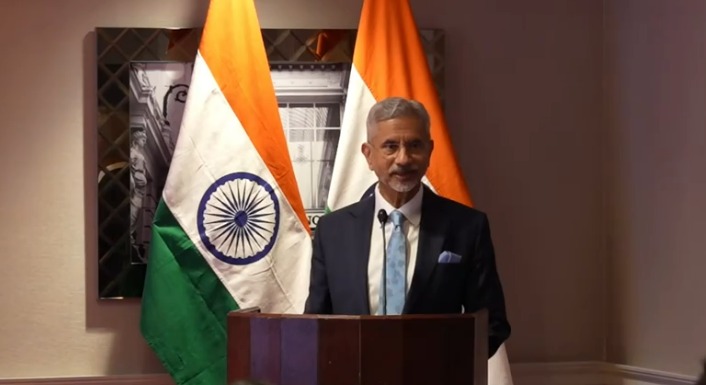
Jaishankar Engages EU on Trade, Climate, and Global Security

Brussels — During his high-level visit to Belgium this week, Indian External Affairs Minister Dr. S. Jaishankar underscored India’s growing strategic importance, its global role, and voiced serious concerns over some of the European Union’s emerging policies. In meetings with European Commission President Ursula von der Leyen and EU foreign policy chief Kaja Kallas, Jaishankar conveyed that India is not only a vital geopolitical player but also a reliable economic and political partner in an increasingly uncertain world.
The visit comes as India and the EU continue negotiations on a Free Trade Agreement (FTA), with Jaishankar making a strong pitch for closer economic cooperation. He described India as a “nation of 1.4 billion offering skilled labour and a more dependable partnership than China,” according to an edited transcript reported by Euractiv.
Countering Narratives and Calling Out Terror Havens
In the wake of the recent terror attack in Pahalgam, Kashmir, which claimed 26 lives, Jaishankar addressed what he sees as global media bias and selective outrage. He questioned the tendency to equate India’s responses with regional tensions, shifting the focus instead to the global threat of terrorism.
“Let’s not forget Osama bin Laden lived for years in a Pakistani military town — right next to their version of West Point,” Jaishankar said pointedly. “This isn’t just an India-Pakistan issue. It’s about terrorism. And that very same terrorism, if ignored, will return to haunt those who look the other way.”
On Ukraine, Neutral but Not Apathetic
India’s neutral stance on the Russia-Ukraine conflict also featured prominently in the discussions. Jaishankar reiterated that New Delhi does not support war as a solution but refrains from taking sides or issuing moral verdicts. “We’re not being prescriptive or judgemental — but we are also not uninvolved,” he clarified.
Responding to criticism of India’s refusal to join sanctions on Russia, he reminded European leaders that India maintains strong relations with both Russia and Ukraine. “Every nation ultimately responds based on its experience, history, and national interests,” he stated.
A Long Memory and a Cautious Eye
Jaishankar took a historical view of India’s diplomatic evolution. Recalling the events soon after Indian independence, he said, “Our borders were violated just months after 1947, when Pakistan invaded Kashmir. And many Western nations, who now speak of global norms, stood by or remained silent.” His message was clear: India has a long institutional memory and expects others to reflect on their past actions before preaching international principles today.
Multipolarity and Strategic Autonomy
Highlighting India’s support for a multipolar global order, Jaishankar welcomed Europe’s increasing desire for strategic autonomy. “Multipolarity is already here. Europe must make decisions based on its own interests and the relationships it fosters. The EU is a major global pole — and that’s why I’m here: to strengthen our ties in this multipolar world.”
He noted with interest that terms like “strategic autonomy,” once unique to Indian diplomacy, are now being widely used in Brussels. “That shows how the world is changing,” he remarked.
On CBAM: India Draws the Line
One of the more contentious topics during the discussions was the EU’s Carbon Border Adjustment Mechanism (CBAM), which could penalize exports from countries with different environmental regulations. Jaishankar didn’t mince words.
“We have very deep reservations about CBAM. Let’s not pretend — we’ve been clear about it. The idea that one part of the world sets standards for everyone else is fundamentally flawed and unacceptable,” he said, pushing back against what India sees as climate protectionism disguised as policy.
On the U.S., Trump, and Global Partnerships
Asked whether India trusts U.S. President Donald Trump, Jaishankar replied, “Meaning what?” before elaborating that India’s foreign policy is not personality-driven. “Our aim is to deepen every partnership that serves our national interests. The U.S. relationship is critical — and it’s not about President X or Y. We take the world as we find it.”
On China and Supply Chain Diversification
Turning to China, Jaishankar acknowledged growing caution among European companies regarding overreliance on Chinese supply chains. “Many firms are relocating operations to India to de-risk. Data security and trust are now bigger concerns than just efficiency. Would you want your critical systems in the hands of actors you don’t fully trust?” he asked.
Jaishankar’s visit to Brussels marked a pivotal moment in EU-India relations. By combining strategic clarity, historical perspective, and diplomatic firmness, he reinforced India’s position as a serious and principled player in global affairs — ready to engage, but on equal terms.
Team Maverick.

Salt, Patidar Firepower Powers RCB to 240/4, Set Mammoth Target for Mumbai Indians
Mumbai, April 2026 : A scintillating batting display led by Phil Salt, Rajat Patidar, and …
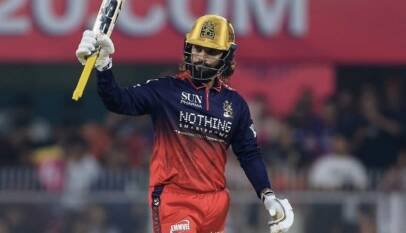
Salt, Patidar Firepower Powers RCB to 240/4, Set Mammoth Target for Mumbai Indians
Mumbai, April 2026 : A scintillating batting display led by Phil Salt, Rajat Patidar, …