Chief Minister Dhami Directs Appointment of Nodal Officers at Government Level for Prompt Resolution of Democracy Fighters’ Issues

Chief Minister Dhami has instructed that nodal officers be appointed at the government level to ensure the swift redressal of issues faced by democracy fighters. He announced that, during the upcoming Monsoon Session, a new Act will be introduced for the welfare and interests of these veterans. The Chief Minister further directed that the process for disbursing the Democracy Fighters’ Honor Fund be simplified, and urged officials to expedite resolution of all grievances. He also ordered immediate issuance of identity certificates to democracy fighters.
Chief Minister Dhami noted that his government had already decided to increase the monthly honorarium given to democracy fighters, and that this amount will be further raised in the near future. “Our administration is fully committed to resolving every problem faced by these patriots,” he said. “We will continue to hold annual ceremonies honoring democracy fighters, ensuring that their incomparable contributions to the nation are celebrated across the land.”
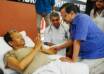
On the occasion of the 50th anniversary of the Emergency, marked today as “Constitution-Killing Day 2025,” Chief Minister Pushkar Singh Dhami welcomed and felicitated democracy fighters and their families at his official residence. He engaged in dialogue with those who had been imprisoned under MISA and the Defence of India Rules during the Emergency. “Salutations to all democracy fighters,” he proclaimed. “Honoring those who sacrificed everything to defend India’s democratic values during that dark period is a matter of great pride.”
Recalling those grim days behind bars, he praised the unwavering resolve of democracy warriors whose courage kept the lamp of freedom burning. “Their penance, sacrifice, and steadfast resolve are why every Indian today holds democracy sacred,” he said.
Attempt to Crush the Spirit of the Constitution
Chief Minister Dhami declared June 25, 1975, as the darkest chapter in India’s democratic history, when a state of Emergency was imposed over the entire country. This act, borne of one man’s obstinacy and authoritarian mindset, trampled the spirit of the Constitution. The Allahabad High Court had found Prime Minister Indira Gandhi guilty of electoral malpractice and annulled her Lok Sabha membership. Fearing the loss of power, a midnight Emergency decree was issued, strangling Parliament, muzzling the press, trampling judicial independence, and crushing millions of fundamental rights.
During that period, the repressive government mercilessly silenced every voice—from opposition leaders to hundreds of journalists—who dared defend democracy. Free expression was stifled as the nation was turned into a vast prison. Harsh laws like MISA and DIR consigned thousands to jail.
The Light of Resistance
Chief Minister Dhami recalled that leaders such as Jayaprakash Narayan, Nanaji Deshmukh, and Atal Bihari Vajpayee, even from behind bars, awakened the youth to democratic ideals. University and college students across Delhi, Banaras, Allahabad, Patna, Jaipur, Pune, Bengaluru, and many other cities took to the streets in protest, sparking a nationwide revolution. Organizations from the RSS to the ABVP and numerous social and cultural groups marshaled their energies to revive democracy. Thousands of young people accepted imprisonment and torture rather than bow to injustice.
A New Dawn for Democracy
In the general election of 1977, the people of India, for the first time, elected a non-Congress government, ushering in a new democratic era—the second-largest people’s revolution since Independence. Prime Minister Narendra Modi himself played a leading role in the underground struggle for democracy during the Emergency. To ensure future generations learn of democracy fighters’ sacrifices and the Emergency’s lessons, he initiated the observance of June 25 as “Constitution-Killing Day.”
Continuing the Legacy
Chief Minister Dhami highlighted that, under Prime Minister Modi’s leadership, governance is viewed as service, with schemes systematically designed for public welfare. “Guided by the Prime Minister, our government is fully resolved to honor democracy fighters,” he said. “On this 50th anniversary of the Emergency, we reaffirm our commitment by honoring these heroes. At the same time, we are organizing exhibitions across the state to educate youth about this pivotal movement against authoritarian rule.”
Setting National Examples
Chief Minister Dhami noted that even a small state like Uttarakhand can set examples for the entire country through bold governance decisions. “We are progressing toward becoming a leading state in every sector,” he said, citing Uttarakhand’s adoption of the country’s strictest anti-cheating law and its top rank in the SDG index.
The ceremony was graced by former Chief Minister Bhagat Singh Koshyari, Secretary Shailesh Bagul, democracy fighters Krishna Kumar Agarwal and Prem Badakoti, and a large gathering of veterans and their families.





Archer, Atkinson Trigger India’s Stunning Collapse After Kohli, Iyer Fifties; England Set 234 to Win Second ODI
Archer, Atkinson Trigger India’s Stunning Collapse After Kohli, Iyer Fifties; England Set …
Archer, Atkinson Trigger India’s Stunning Collapse After Kohli, Iyer Fifties; England Set 234 to Win Second ODI
Archer, Atkinson Trigger India’s Stunning Collapse After Kohli, Iyer Fifties; England Set 234 to …