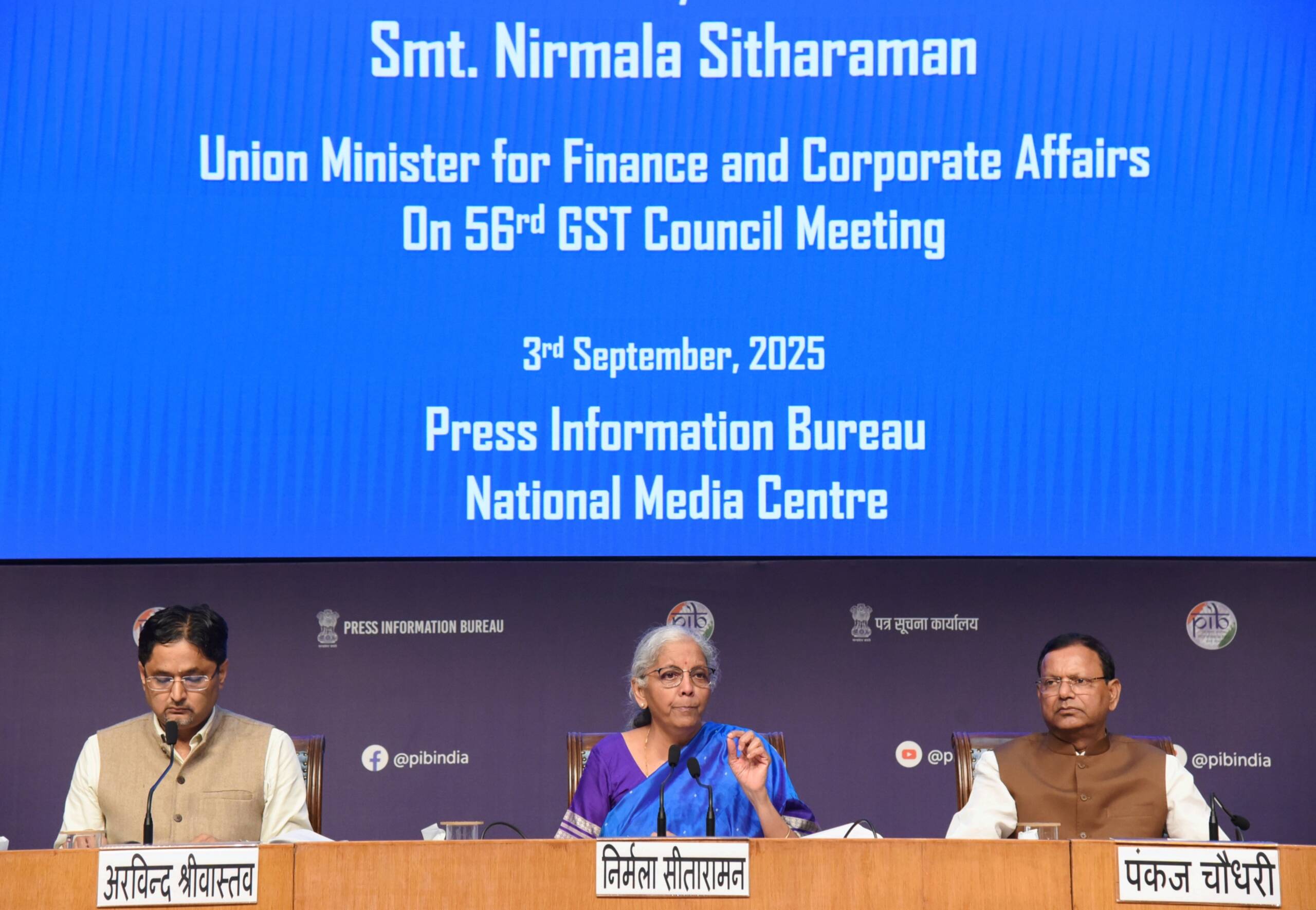
GST Council Brings Sweeping Reforms: From Essentials to Luxury Goods, New Tax Structure Aims to Benefit Consumers and Economy

In a historic overhaul of India’s indirect taxation system, the GST Council, chaired by Finance Minister Nirmala Sitharaman, has rationalised tax slabs from four to two, reducing rates on over 100 essential and everyday goods while raising levies on luxury items and demerit products. Effective from September 22, 2025, the reforms promise cheaper food, healthcare, and farming tools while increasing costs for tobacco, luxury cars, and sugary beverages.
A Landmark Move in India’s Taxation History
New Delhi, Sep 2025 – In a decision hailed as one of the most significant reforms since the introduction of the Goods and Services Tax (GST) in 2017, the 56th GST Council meeting has approved wide-ranging changes to India’s indirect tax regime. The Council has rationalised tax slabs by scrapping the 12% and 28% categories, retaining only the 5% slab for essentials and the 18% slab for most other items, with special rates of 40% reserved for sin goods such as tobacco and aerated beverages.
The reform, announced by Finance Minister Nirmala Sitharaman after a marathon Council session in New Delhi, has been described as both rate rationalisation and structural reform, aimed at reducing disputes, correcting inverted duty structures, and boosting ease of living as well as ease of doing business.
Prime Minister Narendra Modi, who had hinted at GST reforms in his Independence Day address, called it a “next-generation reform” that would benefit all sections of society, especially the middle class, farmers, students, and women.
What Gets Cheaper: Relief for Households and Farmers
The most immediate impact of the reform will be seen in everyday essentials and agricultural tools.
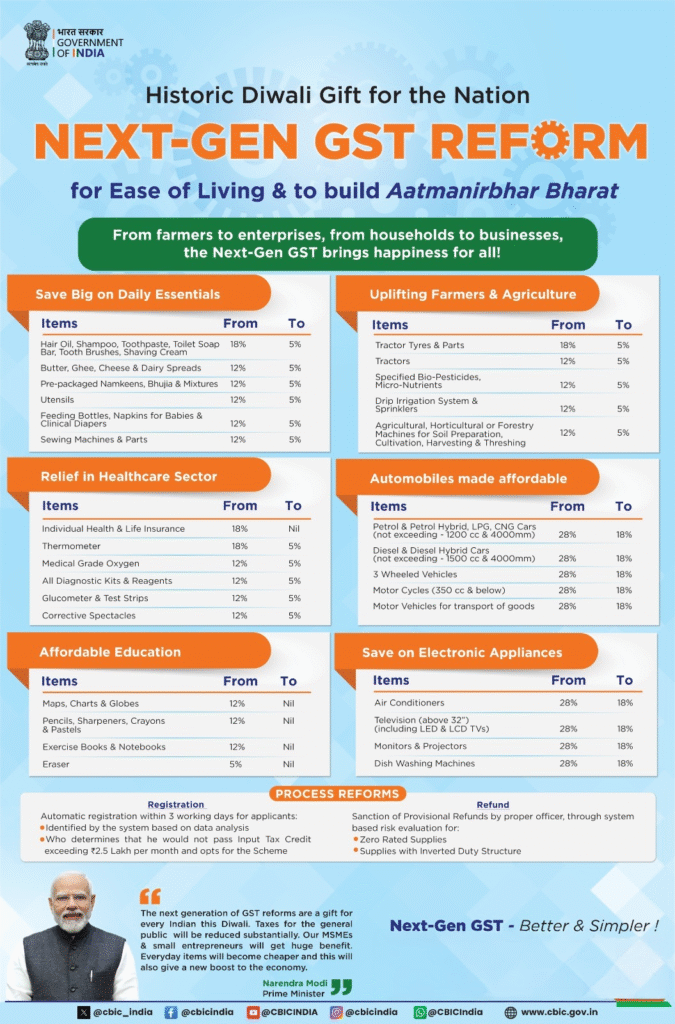
- Personal care items such as hair oil, shampoo, toothpaste, toothbrushes, shaving creams, and dental floss will now attract just 5% GST instead of 18%, making them significantly cheaper for households.
- Daily food products including butter, ghee, paneer, fish, meat products, pasta, biscuits, chocolates, jams, juices, and even coconut water will move to the 5% slab. Some items like chapati, roti, pencils, notebooks, and maps have been exempted entirely.
- Agricultural machinery and inputs such as tractors, harvesters, irrigation equipment, composting machines, sprinklers, and bio-pesticides have seen reductions from 12–18% down to 5%, giving a major boost to farmers and rural productivity.
- Healthcare too benefits, with thermometers, diagnostic kits, medical-grade oxygen, blood glucose monitors, and many essential drugs shifting to 5% or even nil GST. Health and term insurance premiums, previously taxed at 18%, are now completely exempted.
“These reductions,” Sitharaman explained, “are designed to directly ease the burden on the common man while encouraging sectors vital to India’s growth—agriculture, healthcare, and education.”
What Gets Costlier: Luxury and Sin Goods
While essentials have become cheaper, the Council has increased taxes sharply on luxury and harmful products:
- Tobacco and related products (cigarettes, cigars, gutkha, zarda, chewing tobacco) will now attract 40% GST, up from 28%. The government has also shifted their taxation to be calculated on retail sale price (RSP) instead of transaction value to prevent under-reporting.
- Sugary, caffeinated, and carbonated drinks are also taxed at 40%, in line with public health concerns.
- Luxury and large vehicles such as SUVs, racing cars, and premium hybrids have been pushed into the 40% bracket, while smaller cars under 1200cc and bikes under 350cc remain at 18%.
- Cinema tickets, casinos, race club entry, and cricket match tickets have all seen hikes, reflecting the Council’s attempt to target non-essential and luxury consumption.
By raising taxes on sin goods, the government aims to discourage unhealthy consumption patterns while generating additional revenue for welfare spending.
Industry-Specific Adjustments
The reform is not just about cheaper essentials and costlier luxuries. The Council also addressed sectoral anomalies:
- Electronics: Air conditioners, dishwashers, televisions, and projectors have been brought down from 28% to 18%, making appliances more affordable.
- Construction materials: Cement, tiles, and stone products have been reduced from 28% to 18%, potentially lowering housing and infrastructure costs.
- Textiles: Synthetic yarns, non-woven fabrics, and apparel under ₹2,500 have been moved to 5%, giving relief to the garment industry.
- Handicrafts: Products like bamboo furniture, carved wooden art, handmade paper, and lamps will now attract just 5% GST, encouraging artisans and cottage industries.
- Renewable energy: Solar cookers, water heaters, and energy derived from waste, wind, or biogas have shifted to 5%, aligning with India’s green energy goals.
Government’s Rationale
The Finance Minister underlined that the reforms are not cosmetic rate cuts but structural corrections:
- Reducing Classification Disputes: By collapsing slabs into two major categories, the scope for disputes over classification of goods is minimized.
- Correcting Inverted Duty Structures: Earlier, certain sectors paid higher taxes on inputs than on finished goods, discouraging domestic manufacturing. The new rates address this imbalance.
- Promoting Ease of Living: Cheaper essentials and healthcare reduce everyday expenses for families.
- Supporting Aatmanirbhar Bharat: Lower rates on domestic manufacturing and agriculture inputs will strengthen India’s self-reliance and export competitiveness.
“All decisions were unanimous,” Sitharaman emphasized. “Every state finance minister supported the rationalisation. The Council worked in full consensus.”
Consumer Impact: A Pre-Diwali Gift
The timing of the announcement—just weeks before Diwali—has been interpreted as a festival-season relief package for households. With prices of soaps, shampoos, oils, and even sweets and chocolates coming down, families will see tangible savings.
Economists predict that cheaper agricultural machinery will boost rural incomes, while reductions in health insurance and medicines will improve access to healthcare.
At the same time, higher taxes on tobacco and sugary beverages may nudge consumer behaviour toward healthier choices.
Challenges and Criticisms
While the reform has been widely welcomed, some industry voices have raised concerns:
- The steep 40% tax on automobiles above certain thresholds could affect the luxury car market and slow down demand in that segment.
- Beverage companies are likely to pass on the higher costs to consumers, impacting demand for soft drinks and energy beverages.
- Revenue-neutrality remains a question: with widespread cuts, will the increased collections from sin goods be enough to offset the revenue loss?
However, government officials remain optimistic, noting that higher consumption volumes of essential goods and the expansion of the tax base will balance the books.
A Reform for the Future
Experts see this reform as the biggest GST restructuring since its launch eight years ago. By simplifying rates, reducing household expenses, supporting key sectors, and aligning taxation with health and environmental goals, the government hopes to create a more efficient and citizen-friendly system.
As PM Modi remarked, “This is not just about tax cuts—it is about building a stronger, fairer economy for every Indian.”
Team Maverick.






Tamil Nadu’s Expanded Free Power Scheme to Roll Out From Next Billing Cycle
Chennai, May 2026 : The Tamil Nadu government’s expanded free electricity scheme for domes…

Tamil Nadu’s Expanded Free Power Scheme to Roll Out From Next Billing Cycle
Chennai, May 2026 : The Tamil Nadu government’s expanded free electricity scheme for domestic …