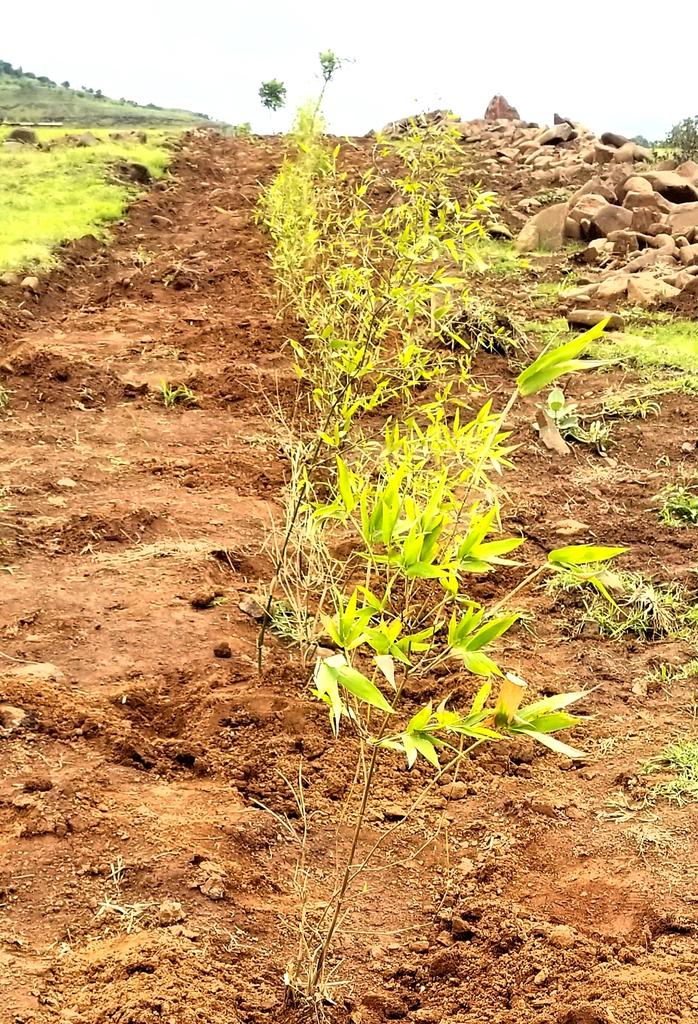
Need for Bamboo-Based Sustainable Development for Protection of Earth and Survival of Humanity

Mumbai, Sept 2025 : “Today the Earth is facing unprecedented environmental crises. The natural disasters of climate change are directly visible through forest fires and cloudbursts happening all over the world. In such a situation, Chairman of the State Agricultural Price Commission and Executive Chairman of the Chief Minister’s Environmental Sustainable Development Task Force, Pasha Patel, has suggested bamboo as a ‘Kalpavriksha’ (wish-fulfilling divine tree) and as the path of sustainable development. Due to the very rapid growth of bamboo, carbon absorption, prevention of deforestation, and biofuel production is possible. An International Bamboo Conference has been organized in Mumbai on September 18–19, 2025. This conference will show new directions to face these crises. In this conference, Chief Minister Devendra Fadnavis, Deputy Chief Ministers Ajit Pawar and Eknath Shinde, along with experts, scientists, and farmers will participate.”
Increasing Threat of Environmental Crisis
For human beings and animals to live peacefully on Earth, 33% of land must be forest-covered. The Earth, which warmed by 0.5°C in the last 2000 years, has warmed by 1.5°C in just the last 150 years after industrialization. This happened due to the reckless use of fossil fuels like petrol, diesel, and coal. As a result, carbon emissions in the atmosphere increased. Excessive use of these fuels is becoming the cause of Earth’s destruction.
Life on Earth can survive properly if carbon emissions remain at 350 PPM. Today, this has reached 427–430 PPM. According to the UN’s IPCC (Intergovernmental Panel on Climate Change), when carbon emissions reach 450 PPM, destruction on Earth will occur. The IPCC report had warned that by 2030, rainfall that used to fall over 100 days will fall within just 52 hours.
2030 is still five years away, but already rains in normal patterns are not occurring anywhere. At 47°C, the human brain, heart, kidney, and organs cannot function. In 2024, Delhi’s temperature reached 52.9°C, and at the same time, Dubai’s temperature reached 64°C. Everything is happening exactly as the IPCC reported — only faster and already around us.
Recently in America, within 24 hours, a wildfire spread across 11 km length and over 1.1 million hectares of forest, burning it completely. In San Francisco, two lakh houses were burnt down in celebrity neighborhoods. In France, lush vineyards burned. In Israel, such a massive fire broke out that even a developed country like Israel could not control it. This year, Europe’s temperature touched 41°C. In India, in Uttarkashi, an entire village was washed away in just 30 seconds due to a cloudburst on 6 August 2025 in the Khirganga area. More than 50 houses were destroyed, 4 people died, and over 50 went missing. In Punjab, 1400 villages are underwater due to heavy rains, 37 deaths occurred, and over 3 lakh acres of land were affected. In Mumbai, extreme rains in May and August paralyzed life, and similar events happened in Pune and Nagpur where the cities almost drowned. In Nanded, the river rose 24 feet within less than 3 hours, destroying farms, homes, and infrastructure.
The Earth is divided into six continents, but today no continent is free from natural disasters. Cloudbursts, floods, wildfires, heatwaves, landslides, droughts — every kind of natural disaster has affected all continents.
Bamboo: The Kalpavriksha of Sustainable Development
Green cover must be increased, and fossil fuel use underground must be stopped. Otherwise, the carbon emissions created from burning even 1 kg of coal or 1 liter of petrol will take 100 years to disappear. The only answer is to stop using petrol, diesel, and coal.
UN Secretary-General Antonio Guterres said in July 2023: “The era of global warming has ended, the era of global boiling has begun. Urgent measures are needed.” He said this against the background of extreme heatwaves, wildfires, and climate disasters in 2023. By 2025, this situation has worsened, and urgent measures are repeatedly stressed.
Bamboo is the fastest-growing grass species. Some species (like Dendrocalamus giganteus) can grow 91 cm (36 inches) per day. Hence bamboo is called the “Timber of the 21st Century.” Normally bamboo matures in 3–5 years, while traditional trees (like teak, oak) take 20–50 years. Bamboo can be an alternative to diesel, petrol, and coal. It also prevents deforestation, supplies abundant oxygen, reduces carbon emissions, and lowers heat. Thus, bamboo is truly the Kalpavriksha against climate crisis. The slogan created is: “Save Earth with Bamboo.”
Government Subsidy for Bamboo Plantation
A human needs 280 kg of oxygen every year. Bamboo growing 3 feet daily produces 320 kg oxygen per year and absorbs 35% carbon.
Through the Magararo Hyo scheme, the Maharashtra Government is providing a subsidy of ₹7.04 lakh per hectare. This includes costs for labor, digging pits, and supply of saplings.
International Bamboo Conference: Beginning of a New Direction
The first engine started in 1750 in Glasgow, England. It consumed oxygen and increased carbon, raising temperature. For 250 years, goods were made with engines. Now the question arises whether humanity will survive on Earth with this development model. If this continues, after 2050, the condition of humanity will be worse than hell.
To save humanity, the fight must be fossil fuels vs. biofuels. Bamboo has become the weapon for biofuel production. On September 14, 2025, at Numaligarh in Assam, Prime Minister Narendra Modi will dedicate to the nation a bamboo-based ethanol project — an event that will give new direction to India and the world.
On September 18–19, 2025, on the occasion of International Bamboo Day, a two-day conference will be held at Yashwantrao Chavan Auditorium in Mumbai, organized jointly by Phoenix Foundation, Maharashtra Government, and MITRA (Maharashtra Institution for Transformation). Experts, scientists, entrepreneurs, farmers, and policymakers from across the world will participate. Chief Minister Fadnavis, Deputy CMs Ajit Pawar and Eknath Shinde will also attend.
The conference will hold discussions on ethanol, methanol, bamboo pellets for thermal, charcoal, wood, furniture, bamboo clothing, as well as on urban forestry, oxygen parks, and green buildings.
According to the IPCC, if no efforts are made now, within a short period, 40% of grain, milk, and fish production will reduce. Already Punjab and Haryana, the food bowl of India, are devastated by floods. This will not be a one-time event but will recur. Hence, it is time to come together for deep thought and reflection to find solutions.





Trump Vows Continued Military Pressure on Iran, Expresses Doubts Over Diplomacy
Washington, Aug 2026: US President Donald Trump has vowed to maintain military pressure on…

Trump Vows Continued Military Pressure on Iran, Expresses Doubts Over Diplomacy
Washington, Aug 2026: US President Donald Trump has vowed to maintain military pressure on …