China’s Solar Ambition: Transforming Deserts into Powerhouses

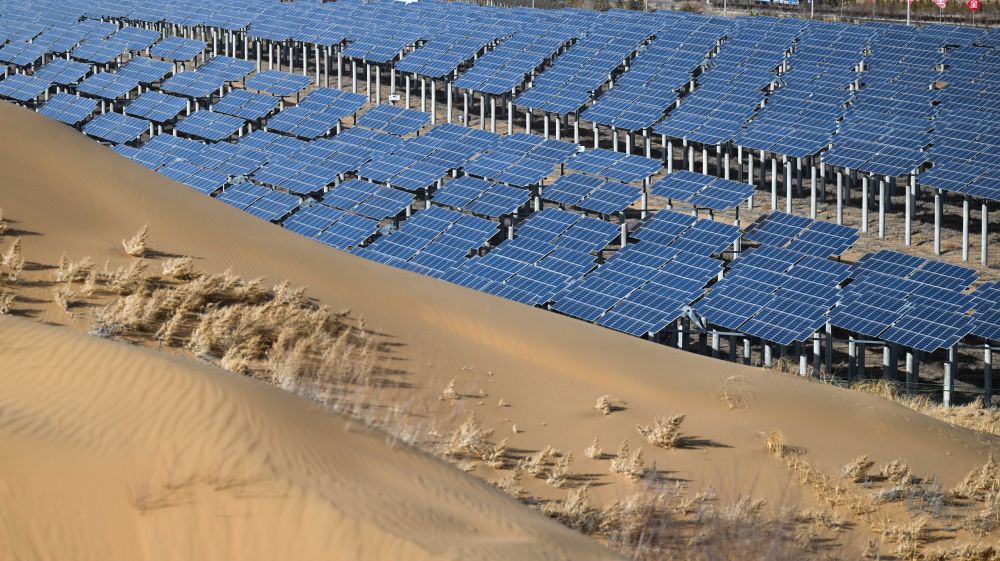
Sept 2025 : An expansive sea of blue solar panels stretches across the ochre dunes of Inner Mongolia’s Kubuqi Desert, offering a dazzling illustration of China’s monumental energy transition. While many countries have paused their desert solar projects due to economic or technical challenges, China—currently the world’s largest emitter of greenhouse gases—continues to advance its ambitious plans unabated.
A Key Element in Carbon Neutrality Goals
The solar installations in deserts like Kubuqi form a crucial aspect of China’s strategy to achieve carbon neutrality by 2060. China’s solar capacity surpasses global efforts, becoming so significant that it could even influence local weather patterns. “Before, there was nothing here… it was desolate,” stated Chang Yongfei, a local resident, as he pointed to the vast fields covered with glimmering panels.
The scale of these installations is staggering; they are so large that they can be observed from space. Over the past decade, satellite imagery reveals that more than 100 square kilometers of solar panels have been established in Kubuqi, equivalent to the size of Paris. On Thursday, China made a commitment to increase its wind and solar capacity to more than six times the levels seen in 2020, as part of its efforts to cut greenhouse gas emissions by 7-10% from their peak levels.
Challenges of Desert Solar Power
According to analyst David Fishman, the availability of unused land is a “defining factor” for developing solar energy in desert areas. However, this remote and sun-drenched terrain comes with its own set of formidable challenges. Sandstorms can degrade panel ventilators, while extreme temperatures can compromise the efficiency of solar cells. Additionally, sand accumulation often necessitates the use of valuable water for cleaning.
To counter these obstacles, Kubuqi’s solar panels have been equipped with self-cleaning ventilators and double-sided cells designed to capture light reflected from the ground, according to reports from Chinese state media.
The distance from energy-demanding urban centers, alongside the complexity of the required infrastructure to transport generated electricity, has stalled desert projects globally, from North Africa to the United States. In Kubuqi, the electricity generated is intended for the energy-hungry regions of Beijing, Tianjin, and Hebei, located hundreds of kilometers away. Unfortunately, the rapid growth in solar capacity—having exceeded governmental targets nearly six years ahead of schedule—has not been paralleled by corresponding power grid development, leading to energy losses and congestion on power lines.
Fishman noted that overcoming these hurdles necessitates infrastructure improvements to ensure that power can be allocated and dispatched across the country efficiently, without creating bottlenecks. In regions like Inner Mongolia, along with neighboring Ningxia and Gansu, new project approvals are being restricted unless it can be shown explicitly that the energy output will not be wasted.
Remarkable Growth Despite Challenges
Despite these concerns, in the first half of this year, China managed to install more solar capacity than the entire cumulative solar capacity of the United States at the end of 2024. The sheer scale of some desert solar fields might even create their own climatic effects. Zhengyao Lu from the University of Lund warned that heat absorption across vast areas could alter atmospheric flows, potentially leading to “negative secondary effects,” such as diminished rainfall in other areas. Nonetheless, Lu emphasized that the risks associated with solar energy “remain minor compared to the dangers posed by continuing greenhouse gas emissions.”
Fossil Fuels Persist Amid Solar Expansion
However, the expansion of solar energy does not signify a complete abandonment of fossil fuels, particularly in Inner Mongolia, a traditional mining region. Signs of the continuing coal industry are visible around Kubuqi, with soot-blackened trucks and smoke-emitting chimneys still prevalent. In fact, reports indicate that China brought more coal power online in the first half of this year than at any point since 2016.
According to the environmental NGO Greenpeace, this reliance on polluting fuels represents a significant structural obstacle to the growth of wind and solar power. As China navigates its ambitious energy goals, the interplay between emerging renewable technologies and entrenched fossil fuel industries will be crucial in determining the nation’s path toward a sustainable future.








Energy Department, Govt. of Odisha and CSTEP Partner to Accelerate Clean Energy Transition and Farmer-Centric Agrivoltaics*
BHUBANESWAR, July 2026— The Energy Department, Government of Odisha, and the Center for St…

Energy Department, Govt. of Odisha and CSTEP Partner to Accelerate Clean Energy Transition and Farmer-Centric Agrivoltaics*
BHUBANESWAR, July 2026— The Energy Department, Government of Odisha, and the Center for Study …