How could the US supplied Tomahawk Missiles transform Ukraine’s strike capabilities and threaten Russia.

A few while ago, Maverick News has reported the swaying of President Trump from the supply of Tomahawk Missile to Ukraine against their war with Russia. Now, let us delve into the uniqueness of Tomahawk, and its possible destructive strike capabilities.

An estimated 1,500 kilometres strike range of a U.S. Tomahawk missile launched from central Ukraine. Key Russian military hubs, including airbases near Voronezh, supply depots in Belgorod, and command centres in Rostov on Don, are within reach, creating a significant threat to Russia’s rear-area logistics and strategic infrastructure. Unlike previous aid packages focused on tactical or medium range systems, the Tomahawk’s capabilities would fundamentally alter the geometry of the battlefield. It would give Ukraine not only reach into occupied Crimea, Donbas, and Zaporizhzhia, but potentially into strategic Russian rear areas that have so far remained untouched by high-precision munitions.

The Tomahawk is a long-range, all-weather, subsonic cruise missile designed to deliver precision strikes against high-value land targets. Developed in the late 1970s by the United States and first fielded in the 1980s, the Tomahawk has undergone multiple upgrades and is now among the most combat-proven missiles in the world. It has been used extensively in U.S. operations from the Gulf War to Syria, often serving as the first weapon launched in a conflict to neutralize enemy defences and command structures.
Technically, the Tomahawk is a terrain-following missile that can fly at extremely low altitudes, allowing it to evade radar detection and enemy air defences. It is powered by a turbofan engine that propels it at a cruising speed of approximately 880 kilometres per hour. Depending on the variant, its range extends between 1,300 and 1,600 kilometres, giving it the ability to strike deep into enemy territory from standoff distances. The missile uses a combination of guidance systems, including GPS, inertial navigation, terrain contour matching (TERCOM), and digital scene-matching area correlation (DSMAC), to deliver near pinpoint accuracy. Its circular error probable (CEP) is often measured in meters, making it one of the most precise long-range strike systems in service.
The destructive power of the Tomahawk comes from its warhead, which typically consists of a 450-kilogram high-explosive unitary charge. This payload is capable of destroying hardened bunkers, air defence sites, radar installations, ammunition depots, and key infrastructure such as bridges or command centres. In its most recent Block IV and Block V configurations, the missile can also loiter in the target area, be re-targeted mid-flight, and communicate with other networked platforms, increasing both its flexibility and survivability in dynamic combat environments. When launched in salvos, Tomahawks can overwhelm enemy defences, creating tactical shock and operational paralysis before larger air or ground operations even begin. For Ukraine, acquiring such a system would represent a major leap in offensive strike capability, enabling it to degrade Russian command infrastructure and logistics far beyond the reach of existing systems.
Although, Ukraine does not operate ships or submarines with Vehicle Launching System or VLS -compatible systems, however, the U.S. Army’s Typhon launcher provides a land-based solution.
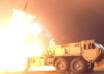
The Typhon system, formally known as the Mid-Range Capability (MRC), is a U.S. Army ground-based launcher platform designed to fire long-range precision missiles, specifically the Tomahawk cruise missile and the SM-6 interceptor. Developed by Lockheed Martin as part of the U.S. Army’s Precision Strike Missile (PrSM) portfolio, Typhon is a key component of the Pentagon’s strategic effort to restore intermediate-range missile firepower following the collapse of the INF Treaty.
The system consists of a mobile launcher unit, based on a modified trailer platform, capable of deploying vertically-launched missiles from Mk 41 Vertical Launch System (VLS) cells, which are standard across the U.S. Navy. It is integrated with an advanced fire control system, secure command and control networks, and multi-domain sensor fusion, allowing real-time targeting and coordination with air, land, and maritime forces.
Typhon was fielded in 2023 as part of a rapid development program initiated under the U.S. Army’s Multi-Domain Task Force. It is capable of launching:
- BGM-109 Tomahawk, a subsonic, long-range land-attack cruise missile with a range exceeding 1,500 kilometres
- SM-6, a multi-role interceptor missile capable of targeting enemy aircraft, cruise missiles, and, in certain variants, ballistic missiles and surface targets.
Unlike air or sea-based systems, Typhon offers the advantage of land mobility, which makes the system harder to detect, target, or preempt. It can be rapidly deployed, repositioned, and concealed, giving commanders a flexible long-range strike option from ground bases in forward-operating theatres.
The Typhon system represents a significant expansion of the U.S. Army’s strike envelope. It bridges the range gap between the Precision Strike Missile (PrSM) and strategic air or naval assets. It provides the United States and its allies with the ability to hold adversary targets at risk from ground-based launch points, without depending on air superiority or sea access.
In the context of Ukraine, a potential deployment of Typhon, either directly or through a derivative launcher capable of firing Tomahawks, would provide Kyiv with the infrastructure necessary to field cruise missile capabilities from Ukrainian soil. Its mobility and precision make it a practical platform for deep-strike missions against heavily defended Russian military infrastructure, especially if air-delivered systems are constrained by airspace threats.
If the United States transfer Tomahawk cruise missiles, Ukraine would gain the ability to conduct deep-strike operations against targets far beyond the front lines. These include critical military facilities that have so far remained out of reach, even with ATACMS or Storm Shadow missiles. Apprehended targets include Russian airbases near Voronezh and Kursk, command and control bunkers in Belgorod and Rostov, munitions depots, and naval facilities in occupied Crimea.
With a reach of over 1,500 kilometres, the Tomahawk could neutralise infrastructure that supports Russia’s war effort but lies deep inside Russian territory. Air Defences would be forced to redeploy, weakening their front-line protection and stretching response capabilities.
Comparison of current U.S.-supplied weapon ranges to Ukraine, including HIMARS, ATACMS, and Storm Shadow, versus the extended reach of the Tomahawk cruise missile. With a range of up to 1,600 kilometres, the Tomahawk dramatically expands Ukraine’s ability to strike deep into Russian territory beyond existing long-range systems.
In a sharp contrast to what Mr. Trump has said to Zelensky yesterday, which is a sway from his earlier affirment by suggesting that such capabilities should be made available to Ukraine, Trump had signalled a more assertive approach to deterrence. His remarks implied that under a potential future administration, advanced U.S. weapons like the Tomahawk may no longer be seen as escalatory, but as necessary tools to counter Russian aggression and force a shift in the strategic balance.
Justifying his reluctance to supply Tomahawk at this juncture, President Trump had addressed the Media in a subtle humoristic approach quoting, he asked Putin if he should supply Ukraine with Tomahawk missiles: “I did actually say would you mind if I gave a couple thousand of Tomahawks to your opposition? He did not like the idea”.
Russia’s steadfast belief that its logistical infrastructure was beyond the reach of Ukrainian strike capabilities may no longer hold. Facilities in Crimea, Belgorod, Bryansk, and even further into Russia could be targeted. Striking rail junctions, airfields, radar arrays, and fuel convoys would create havocs at a strategic scale. The Tomahawk’s accuracy also makes it ideal for disabling hardened positions like command bunkers and underground depots.
Forcing Russia to redeploy S-400 and Pantsir air defence systems to cover rear zones would dilute protection at the front and introduce inefficiencies in command and logistics.
Russia has warned that the transfer of Tomahawks to Ukraine would cross a red line. Russian Security Council Deputy Chairman Dmitry Medvedev claimed such a move would provoke “catastrophic consequences” and blur the line between Ukrainian and U.S. involvement. Russia’s military doctrine allows for retaliation, including the use of tactical nuclear weapons, if strategic command or national infrastructure is threatened by precision weapons.
Despite these warnings, many Western defence analysts argue that providing Ukraine with credible long-range strike capability is a necessary step to deter further aggression and level the operational playing field.
Team Maverick








Chandrababu Naidu Reviews Preparations for PM Modi’s August 1 Inauguration of Bhogapuram International Airport
Amaravati, July 2026 : Andhra Pradesh Chief Minister N. Chandrababu Naidu on Monday conduc…

Chandrababu Naidu Reviews Preparations for PM Modi’s August 1 Inauguration of Bhogapuram International Airport
Amaravati, July 2026 : Andhra Pradesh Chief Minister N. Chandrababu Naidu on Monday conducted …