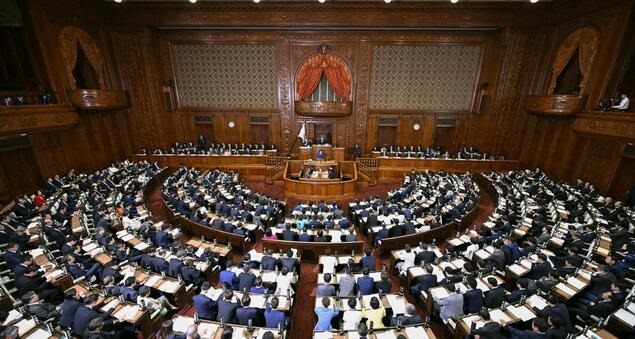
Japanese Prime Minister Takaichi advocates for aggressive fiscal spending and boost defence outlay.

Oct 2025 : Today, the newly elected Japanese Prime Minister Sanae Takaichi said that she will pursue aggressive fiscal spending to revitalise Japan’s economy and boost defence outlays to address growing security challenges, in her first speech in parliament since taking office.
Tinged with her conservative colours and consideration for the Liberal Democratic Party’s new coalition partner, Takaichi’s address drew some jeers from the opposition bloc, which holds a majority in both chambers of parliament.
The 64 years old LDP leader, who became Japan’s first Female Prime Minister on Tuesday, made no mention of women’s empowerment or the high-profile political slush fund scandal that dealt a heavy blow to her party in the past two national elections. Takaichi has underscored her government’s determination to tackle rising living costs on “top priority”, pledging to raise Japan’s defence budget to 02% of gross domestic product by March, two years ahead of the current fiscal 2027 target.
“I will turn (people’s) anxieties about the present and future into hope and build a strong economy“, Takaichi, widely seen as a fiscal dove and security hawk, said at an extraordinary parliamentary session that kicked off Tuesday. She once again has reaffirmed her commitment to “responsible and proactive fiscal policies” to “raise incomes, improve consumer sentiment, enhance business profits and boost tax revenue“.
Her expansionary fiscal policy could boost the issuance of deficit-covering government bonds, but Takaichi said financial sustainability would be achievable if the ratio of government debt to GDP declines by ensuring the increase in outstanding debt is slower than economic growth. In an effort to fight inflation, Takaichi said she aims to abolish the provisional gasoline tax rate, which has been in place since 1974, during the ongoing Diet session through December 17, and lift the non-taxable income threshold from the current 1.03 million yen ($6,700) to 1.60 million yen this year.
The government will begin designing a system to introduce a mix of income tax deductions and cash benefits for households, while ditching an unpopular plan to provide 20,000 yen per person, she added. The 20,000 yen cash handout plan was a pledge by the LDP in the July House of Councillors election, which saw the ruling coalition lose its majority in the upper chamber and prompted the resignation of Takaichi’s predecessor, Shigeru Ishiba.
To find ways to strike a balance between the costs and benefits of the country’s social security system amid its graying population and declining birth rate, Takaichi said she will set up a framework for cross-party discussions involving experts. On the security front, Takaichi voiced her readiness to revise the long-term National Security Strategy, which sets a spending target of 02% of GDP, and two other key documents by the end of next year.
“We need to proactively promote the fundamental strengthening of our nation’s defence capabilities to deal with various changes in the security environment, since the three policy papers were drawn up in late 2022”, Takaichi said.
Calling the alliance with the United States the “cornerstone” of Japan’s diplomatic and security policies, Takaichi said her government will deepen multilateral dialogue with countries such as South Korea, the Philippines, Australia and India, and advance a “free and open Indo-Pacific“, where China is increasing its military activities.
Takaichi emphasised that China is an “important neighbour” with which Japan needs to foster “constructive and stable” ties and promote a “strategic and mutually beneficial” relationship.
Amid media reports that some tourists and foreign residents are not complying with rules, Takaichi vowed to “firmly” handle the matter, while promising the government will “keep a distance from xenophobia“. Takaichi also said the government will step up discussions on the division of responsibilities and functions between Tokyo and a “second capital” to serve as a backup in times of crisis.
Her vision effectively aligns with the “Osaka Metropolis Plan”, a pet project of the Japan Innovation Party, or Nippon Ishin, based in western Japan, aimed at reducing the concentration of power in Tokyo.
After Takaichi won the party’s leadership election on 04th October, 2025, and the centrist Komeito party, the LDP’s long-time ally, quit the ruling coalition on October 10th, her party agreed on Monday to form a coalition with the centre-right JIP.
But the new ruling camp still lacks a majority in the more powerful House of Representatives, requiring it to cooperate with other opposition forces to pass bills and budgets. Takaichi called on other political groups to work with her minority government to “stabilise politics“, saying, “Without political stability, we cannot pursue robust economic measures or effective diplomatic and security policies“. She also said her government would “flexibly and sincerely” accept policy proposals from opposition parties and discuss them, provided that they do not conflict with the LDP’s basic stances.
After the speech, Yoshihiko Noda, head of the largest opposition party, the Constitutional Democratic Party of Japan, voiced concern about the LDP’s rightward tilt on security issues, saying Takaichi’s party will no longer heed Komeito’s views going forward. “Instead of Komeito, we will act as a brake on the LDP”, Noda, the Former Prime Minister, told reporters.
Team Mavericks




Philippines Turns to Russian Oil Amid Energy Crisis Triggered by West Asia Conflict
March 2026 : A tanker carrying over 700,000 barrels of Russian crude oil has arrived in th…

Philippines Turns to Russian Oil Amid Energy Crisis Triggered by West Asia Conflict
March 2026 : A tanker carrying over 700,000 barrels of Russian crude oil has …