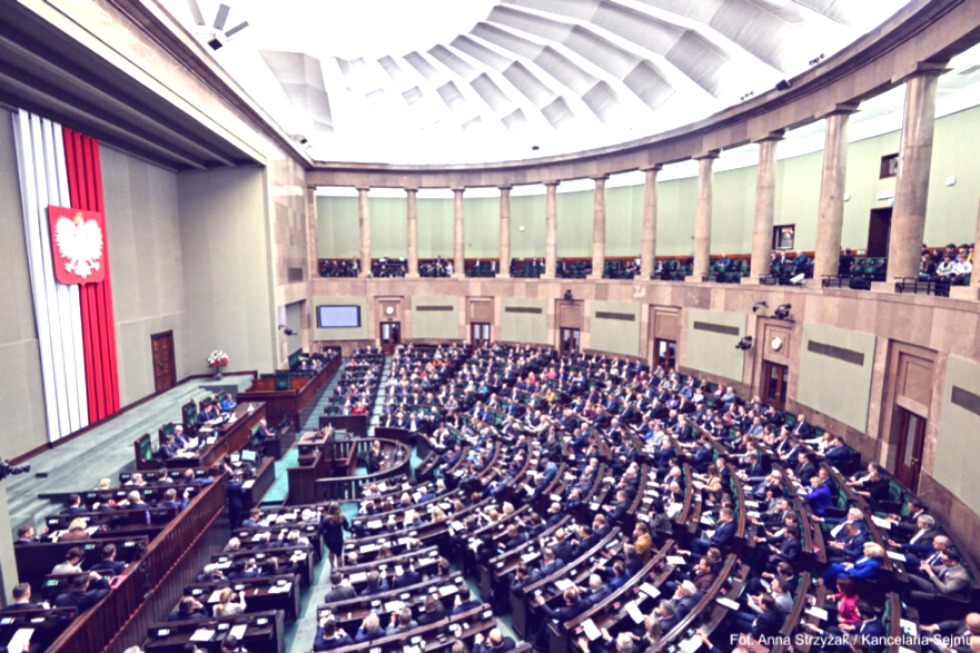
Poland Trapped In Institutional Trapezium In Repairing The Rule Of Law.

January 2026: Between 2015 and 2023, the Polish Government led by the Law and Justice (PiS) party took several measures that led to the deterioration of the rule of law and to systemic democratic backsliding in Poland. The damage included:
• The flawed composition and functioning of the Constitutional Tribunal.
• The appointment process of the National Council of the Judiciary (NCJ), a crucial body responsible for
judicial appointments.
• The status of the approximately 2,700 judges (or one-third of the judiciary), including on the Apex e Court and the Supreme Administrative Court, appointed through a defective process involving the politicised NCJ.
• The structure of the Supreme Court, notably the Chamber of Extraordinary Control and Public Affairs
added in 2018.
• The politicisation of the prosecution office.
• Abuses of power and high-level corruption.
The change of government in December 2023, when the governing coalition led by Prime Minister Donald Tusk raised hopes of democratic repair; but legislative reforms remain at an early stage. This reflects not only the depth of institutional damage done by PiS but also political constraints.
The Tusk government has been operating under the conditions of cohabitation with PiS-backed Presidents, first with Andrzej Duda and since August with Karol Nawrocki. The constitutional framework grants significant powers to the President, including the authority to veto statutes and to refer them for constitutional review. Cohabitation has drastically curtailed the ability to pursue rule-of-law reforms, particularly in judicial governance. Moreover, the preparation of draft legislation in several key fields has proceeded more slowly than expected.
This political dynamic creates significant challenges for the Tusk government’s agenda:
Presidential Veto Power: The Polish President has the constitutional authority to veto legislation. The Tusk government does not hold the three-fifths majority in the Sejm (the lower house of parliament) required to overturn a Presidential veto, allowing the PiS-aligned President to effectively block many key reforms, especially concerning judicial changes, abortion liberalisation, and same-sex civil unions.
Institutional Deadlock: Key state institutions, such as the Constitutional Tribunal, remain largely controlled by PiS loyalists appointed during their previous time in power, creating “illiberal enclaves” that can further obstruct the government’s initiatives by reviewing and invalidating its laws.
Political Confrontation: Both former President Duda and the current President Nawrocki have taken a confrontational stance against the Tusk government, using their positions to launch their own legislative initiatives and engage in a “war for the seat” over who represents Poland in certain international forums.
Policy Paralysis: The cohabitation has drastically curtailed the government’s ability to pursue core rule-of-law reforms and implement key election promises, leading to a period of institutional paralysis and limited progress on the government’s agenda.
This situation has been a major source of political tension in Poland since the Tusk government took office in December 2023. In 2024, the parliament passed three acts aimed at restoring constitutional standards: two concerning the Constitutional Tribunal and one reforming the National Council of the Judiciary, but none has entered into force. Duda referred the three acts to the Constitutional Tribunal, which remains an illiberal enclave aligned with PiS, and in the course of this year ithas invalidated all three.
Consequently, legislative change regarding the institutions central to judicial independence is effectively paralysed. The government also pledged to separate the offices of minister of justice and prosecutor general, a reform long demanded by European monitoring bodies. Despite repeated commitments, this change has not yet been implemented.
Effective governance requires a President who is cooperative with the government. Otherwise, in a situation of cohabitation under extreme political polarization, such as is now the case, the President may obstruct of governmental action. Nawrocki can use all of these powers to stall the rule of law repair.
The governing coalition had based its medium-term rule-of-law repair strategy on winning this year’s Presidential election. It had great hopes for Civic Platform’s Trzaskowski, who led in the polls for months, until the PiS-backed Nawrocki secured an upset victory. Nawrocki’s taking office as President in August therefore marked the end of the first phase of the government’s attempt to repair the rule of law. He is a conservative historian and former PiS-appointed chair of the Institute of National Remembrance. Nawrocki was elected thanks to votes from PiS supporters as well as those of the far-right Konfederacja party and the extreme-right first-round candidate Grzegorz Braun.
Nawrocki has been using his Presidential powers and platform to advance PiS’s agenda and to help it to return to power in the parliamentary elections due in 2027. Some of his actions show that he is also seeking to appeal to far-right voters by shaping his program and rhetoric accordingly. For example, in August, Nawrocki vetoed the bill on aid for Ukrainians, citing what he described as an excessively large volume of social benefits.
In November, he signed a substantially more limited version of the bill. Moreover, the President took part in the controversial nationalist march in Warsaw on Independence Day in November, where he was warmly received by the participants. He is doing everything he can to position himself as the new leader of the right and far-right, and to help lay the groundwork for a future coalition government consisting of PiS, Konfederacja, and potentially other parties, such as Braun’s Confederation of the Polish Crown.
This signals that Nawrocki intends to take control of judicial reform away from the government. He is therefore unlikely to sign related government legislation adopted by the parliament and will instead put forward his own draft bills. The aim will be to demonstrate the effectiveness of his political camp in contrast to the government’s lack of capacity to deliver.
Nawrocki has been supporting Constitutional Tribunal President Święczkowski, Supreme Court First President Manowska, and NCJ Chairperson Pawełczyk-Woicka, and consulting them about the state of judiciary and the rule of law, thereby legitimising their actions and the PiS-era changes in judiciary.
Presidents Duda and Nawrocki, supported by PiS politicians, have consistently advanced the notion of a Presidential “super-prerogative” in judicial appointments. NCJ Chairperson Pawełczyk-Woicka has publicly endorsed Nawrocki’s decision, expressing approval of the criteria he intends to apply when assessing future judicial candidates for promotion. This reflected her longstanding opposition to judges’ use of the “independence” tests and motions to exclude from adjudicating panels individuals appointed or promoted through the politicized NCJ. In her view, Nawrocki’s stance aims to counter such practices. The President has reiterated that he does not recognise any distinction between “neo-judges” and “full-fledged judges”.
The process of restoring the rule of law in Poland under the government that took office in 2023 is still in its early stages. This is due not only to the scale of the damage done by the PiS government during its eight years in office but also to entrenched PiS loyalists in “illiberal enclaves” such as the Constitutional Tribunal, the National Council of the Judiciary, and the Supreme Court, and to the government’s cohabitation with President Duda and now President Nawrocki.
The government’s gamble on winning the 2025 Presidential election has backfired and the cohabitation with Nawrocki will pose a new set of challenges. All political forces are already looking to the next parliamentary elections. The governing coalition and PiS alike claim they are defending democracy and the rule of law from attacks, but no false equivalence should be drawn between these claims. The process of rule-of-law repair is moving forward under the government, albeit slowly. Though no bills have been signed into law and one can argue that the process of drafting legislation is too slow, there have been meaningful changes: the disciplinary system in the judiciary is no longer used to suppress judges and reforms are underway within the Prosecution Service. The government will have to decide whether to continue marginalising the Constitutional Tribunal or to begin appointing new judges to it.
Another challenge is to balance public expectations for accountability for actions during the PiS government with the constraints of liberal democracy. After the 2023 elections, a significant portion of the governing coalition’s electorate had, perhaps excessively high, expectations of a spectacular and swift reckoning with the previous PiS government for abuse of power and corruption. The pace and extent of change since have disappointed many who expected swift accountability and a thorough cleansing of the state institutions from PiS-era appointees.
All this will test the government’s commitment to the rule of law. Under cohabitation with Nawrocki, a truly comprehensive reform of the judiciary and repair of the rule of law is unlikely, however.
Team Maverick.





FIFA Chief Infantino Hails Messi’s ‘Timeless Brilliance’ After Record-Equalling World Cup Feat
New Delhi, June 2026 : FIFA President Gianni Infantino has showered praise on Lionel Messi…

FIFA Chief Infantino Hails Messi’s ‘Timeless Brilliance’ After Record-Equalling World Cup Feat
New Delhi, June 2026 : FIFA President Gianni Infantino has showered praise on Lionel …