Rekha Government’s ‘Mega Resolve’ Against Pollution: 3,330 New Electric Buses to Roll Out on the Capital’s Roads

Delhi Government to Introduce 7-Metre ‘Mini Buses’ for Narrow Streets
With support from the Centre, Delhi Government aims to make public transport 100 percent electric: CM Smt. Rekha Gupta
New Delhi, January 2026 : Under the leadership of Chief Minister Smt. Rekha Gupta, the Delhi Government has taken a major step towards making the capital’s transport system completely ‘green’ and delivering a decisive blow against pollution. In line with the Chief Minister’s far-sighted vision, the Transport Department of the Government of NCT of Delhi has sent a detailed proposal to the Central Government’s agency, Convergence Energy Services Limited (CESL), for the immediate procurement of 3,330 additional electric buses.
A step forward towards a pollution-free Delhi
Chief Minister Smt. Rekha Gupta has made it clear that ensuring clean air in Delhi and providing citizens with a modern, convenient and affordable public transport system are among her government’s highest priorities. With this objective, following a recent high-level meeting with CESL, it was decided to increase Delhi’s bus allocation under the PM E-DRIVE Scheme (Phase-2).
What will the new buses be like?
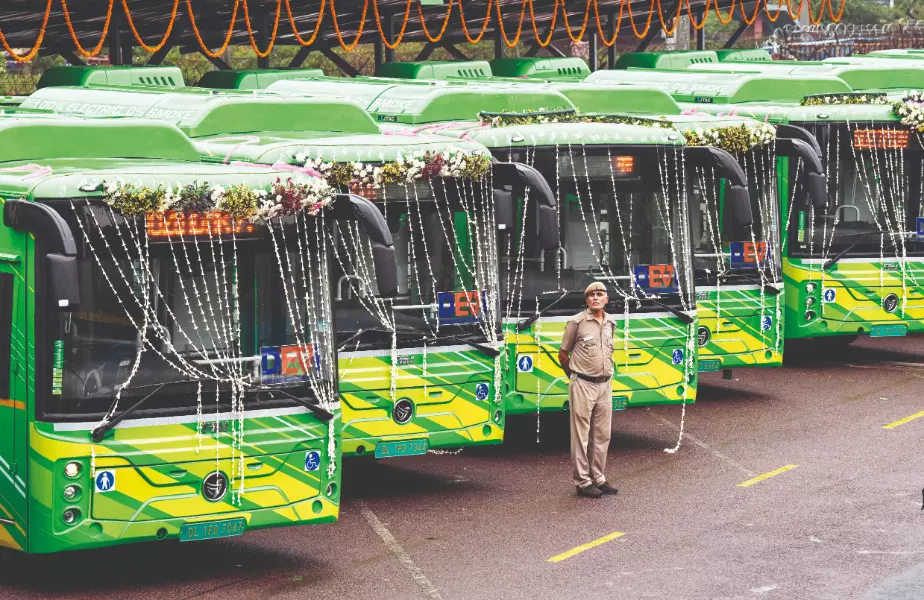
According to the Chief Minister, after reassessing requirements, demand has been placed for buses of different sizes to ensure connectivity from narrow streets to major arterial roads. The Transport Department has sought a total of 3,330 buses, comprising 500 buses of 7 metres, 2,330 buses of 9 metres and 500 buses of 12 metres. All buses will be low-floor, air-conditioned electric buses.
The 7-metre buses will serve narrow streets and provide last-mile connectivity to residents. The 9-metre buses will operate on smaller roads and as feeder services. The 12-metre buses will be deployed on main routes and heavily congested corridors.
Subsidy and financial commitment
Chief Minister Smt. Rekha Gupta stated that her government has requested the Central Government and the Ministry of Heavy Industries to include this additional requirement (separate from the already allotted quota of 2,800 buses) under the subsidy model. Keeping the interests of Delhi’s citizens paramount, the Chief Minister also made it clear that if any technical hurdles arise with regard to subsidies, the Delhi Government is fully prepared to bear the cost itself to ensure that there is no delay in procuring the buses.
Chief Minister’s vision: ‘Clean air, convenient travel’
The Chief Minister believes that these 3,330 new buses are not merely a mode of public transport, but will also form the foundation of Delhi’s green transition. Their induction will reduce citizens’ dependence on private vehicles and lead to a significant reduction in harmful emissions. Low-floor buses will make travel safer and more comfortable for women passengers and senior citizens. The Delhi Government aims to ensure that, in the coming months, Delhi’s bus fleet becomes one of the largest and cleanest electric bus networks in the world.
At present, a total of 5,336 government buses are operating in Delhi, of which 3,535 are electric buses. These include 1,162 nine-metre DEVI buses, 2,273 twelve-metre buses and 100 feeder buses. According to the Chief Minister, more than 5,000 electric buses will be operating on Delhi’s roads by March this year. Her resolve is that by the end of 2026, 7,000 electric buses will be made available to the people of Delhi. After the induction of 2,800 buses under PM E-DRIVE (Phase-1), the total number of buses in Delhi will rise to 10,430, and following the induction of 3,330 buses under PM E-DRIVE (Phase-2), the total fleet will increase to 13,760 buses.
What is the PM E-DRIVE Scheme?
The Prime Minister Electric Drive (PM E-DRIVE) Scheme is a transformative initiative of the Government of India, implemented by the Ministry of Heavy Industries with a budget of ₹10,900 crore, for the period from October 2024 to March 2026. The primary objective of the scheme is to accelerate the adoption of electric vehicles (EVs) by providing financial incentives for the purchase of electric two-wheelers, three-wheelers, e-buses and e-trucks, thereby reducing pollution and improving air quality.
Under the scheme, electric buses are being deployed not only in major cities such as Bengaluru, Delhi and Ahmedabad, but the charging ecosystem is also being strengthened through the installation of 72,300 fast chargers and a digital ‘super app’. This initiative aims to move India towards net-zero emissions and the goal of self-reliant manufacturing.
What is CESL?
Convergence Energy Services Limited (CESL) is a public sector undertaking (PSU) under the Ministry of Power, Government of India. It primarily works to promote electric mobility (e-buses, e-cars and e-trucks) and renewable energy solutions, including issuing large-scale tenders for the procurement of electric buses and developing charging infrastructure.


Thiruvanchoor Radhakrishnan Elected Kerala Assembly Speaker in Historic Three-Cornered Contest
Thiruvananthapuram, May 2026: In a rare blend of parliamentary tradition and political sig…
Thiruvanchoor Radhakrishnan Elected Kerala Assembly Speaker in Historic Three-Cornered Contest
Thiruvananthapuram, May 2026: In a rare blend of parliamentary tradition and political significance, senior …