Russia And China Reengineering Operational Environment In a Bid To Exploit Systemic Vulnerabilities In Western Defence.

January 2026: Technological innovation is reshaping the modern battlefield. Russia and the People’s Republic of China (PRC) are combining conventional warfare with electromagnetic disruption, cyber-attacks, digital influence campaigns, and unmanned and autonomous systems to target U.S. partners and allies. The frontline states of the North Atlantic Treaty Organisation (NATO) are under mounting pressure from these new technological threats.
Russian violations of Polish, Estonian, Latvian, Lithuanian, and Romanian airspace, as well as GPS spoofing and sabotage of critical undersea infrastructure, particularly fibre-optic cables, in the Baltic and Arctic regions, illustrate the expanding scope of targeting technology and its use for subversive means. These activities reflect a broader shift toward multi-domain warfare, where ambiguity and deniability are key assets.
Drone warfare is now a central feature of this evolving technological domain. Ukraine has become a world-leading drone producer and pioneer of maritime and autonomous systems since Russia’s full-scale invasion began in 2022. The PRC has also recently unveiled new unmanned systems capabilities for use in a Taiwan contingency, signaling its intent to operationalise lessons from Russia’s war in Ukraine.
The PRC and Russia’s military technological modernisation builds on decades of Cold War era research, illicit procurement networks, and recent battlefield experience in Ukraine. Military technology procurement, however, remains a challenge. The PRC and Russia are exploiting procurement loopholes and legacy networks to accelerate the acquisition of military technology. Beijing continues to use
middlemen and shell companies to circumvent export controls, while Moscow faces constraints from sanctions, talent shortages, and budget limitations that hinder sustained innovation and production. The development of artificial intelligence (AI)-enabled command systems, autonomous platforms, and integrated air defences depends on state investment.
Russia and the PRC are not merely modernising their military technology and capabilities; they are reengineering the operational environment to exploit systemic vulnerabilities in Western defence architectures. Deterrence in this environment will depend less on mass and more on agility, resilience, and adaptability to counter new and evolving technological threats before they escalate.
Military Artificial Intelligence –
The People’s Republic of China (PRC) is leveraging Artificial Intelligence (AI) to enhance its military capabilities and strategic advantages using Western technology. This includes Meta’s opensource model Llama (Large Language Model Meta AI), which is a preferred model for building features tailored to military and security applications.
The People’s Liberation Army (PLA) is showing signs of adapting to the era of AI, emphasising intelligentsia warfare, prioritising information dominance, algorithms, and systemic disruption over population, resources, or industrial capacity.
Russia’s full-scale invasion of Ukraine marked the first major conflict with widespread AI use. Ukraine, supported by U.S. AI firms, successfully countered Russian forces, prompting Russia to accelerate AI integration in command systems, drones, and air defence networks.
Drones And Autonomous Systems –
Ukraine has become the largest producer of tactical and long-range drones in the world. The country’s defence sector has grown by 350% since the start of Russia’s full-scale invasion in 2022. Low cost, rapid-production systems such as AI-driven drones, robotic ground vehicles, and long-range missiles such as the FP-5 give Ukraine asymmetric advantages. Ukraine’s advanced maritime drones, such as the Magura and Sea Baby, have demonstrated high effectiveness, sinking ships, striking aircraft, and even damaging infrastructure like the Kerch Bridge.
Russia is increasing the production and use of Shahed-type kamikaze drones against Ukraine, constantly improving their effectiveness and ability to break through air defences. Moscow is also developing and testing unmanned aerial vehicles (UAVs) featuring AI for autotargeting and computer vision, which it may transfer to allies such as the PRC and Iran in exchange for resources and weapons.
Chinese military experts are incorporating lessons from Russia’s full scale invasion of Ukraine on the use and importance of drones and autonomous systems, which is reshaping the PLA’s strategic planning and operational doctrine. Chinese strategists emphasise the need to develop stealthier drones, robust anti-jamming capabilities (such as fibre-optic guidance), and autonomous ground logistics systems to enhance battlefield sustainability and reduce vulnerabilities in future combat scenarios.
Satellites & Space Technologies –
Chinese military strategists view commercial space as an essential strategic force in future conflict, as the PRC begins to narrow the gap in its space capabilities relative to the United States. The first national-level long-term plan for space science development from the PRC sets the goal of becoming a global leader by 2050, by which point it aims to lead in revolutionary scientific breakthroughs and deep space missions, and to become the global center for space science.
Russia’s state-owned space corporation, Roscosmos, controls 08% of the Russian military-industrial market and provides the Russian military with technology such as rockets, spacecraft, and satellite systems. Roscosmos faces debilitating challenges, including financial difficulties, inefficiencies, and the loss of Western partnerships since Russia’s full-scale invasion of Ukraine.
Kyiv has recently prioritised developing a national satellite communication system as a key element of Command and Control and military technology development. Ukraine is searching for alternatives to Starlink since the sudden connectivity losses during the maritime drone attack on Sevastopol in 2022 and the Ukrainian Armed Forces’ operation in Russia’s Kursk oblast in 2024.
Military Cyber Operations & Information Technology –
The PRC’s reorganised Cyberspace Force recently displayed command and control, reconnaissance and sensing, and cyber electromagnetic countermeasures equipment at a parade commemorating the end of World War II. This included a new UAV data relay system, a data spectrum monitoring vehicle, a
signal-jamming vehicle, an electromagnetic reconnaissance and jamming vehicle, a network communication node vehicle, and an information jamming vehicle. These upgrades suggest that the PLA has learned lessons from shortcomings in information and electronic warfare during the Russian invasion of Ukraine.
Russian information security companies are expanding their operations in Russia’s near abroad despite facing limitations caused by Western sanctions, as other states increasingly view internet freedom as a threat to their sovereignty. Russia’s information security sector continues to struggle with a shortage of technology and personnel to prepare the country for continuing cyber conflict, relying solely on domestic solutions.
Poland has become the primary target for Russian subterfuge, including low level sabotage, insider espionage, informational warfare, and cyberattacks.
Undersea Cables –
The PRC is promoting cross-border power transmission projects, deploying its leading producers of submarine electric cables to deepen integration with other countries’ critical infrastructure. Beijing sees submarine cables as critical infrastructure that can serve as conduits not just for electrical power but also for its own geopolitical power.
Earlier in 2025, suspicious activities by the merchant vessels Shunxing-39 and Vasili Shukshin in the vicinity of Taiwan suggest a possible collaboration between Chinese and Russian merchant ships related to the reconnaissance and sabotage of undersea communications cables connecting Taiwan to the outside world.
In the Baltic and Arctic regions, Russian hybrid attacks targeting critical undersea infrastructure, particularly fiber-optic cables, have surged. Incidents in 2023 and 2024 involving Chinese vessels damaging Baltic subsea cables raise concerns over possible Russian–PRC hybrid warfare collaboration.
Team Maverick.







ISRO Successfully Tests Indigenous Ship-Borne Tracking System for Gaganyaan Mission
New Delhi, July 2026 : The Indian Space Research Organisation (ISRO) has successfully vali…
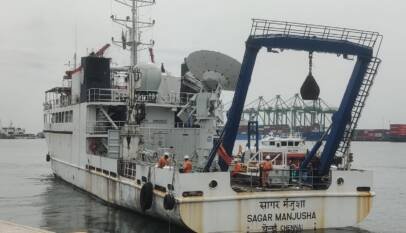
ISRO Successfully Tests Indigenous Ship-Borne Tracking System for Gaganyaan Mission
New Delhi, July 2026 : The Indian Space Research Organisation (ISRO) has successfully validated …