In An Effort To Strengthen US-South Korea Ties, Colby Emphasised In Countering China.

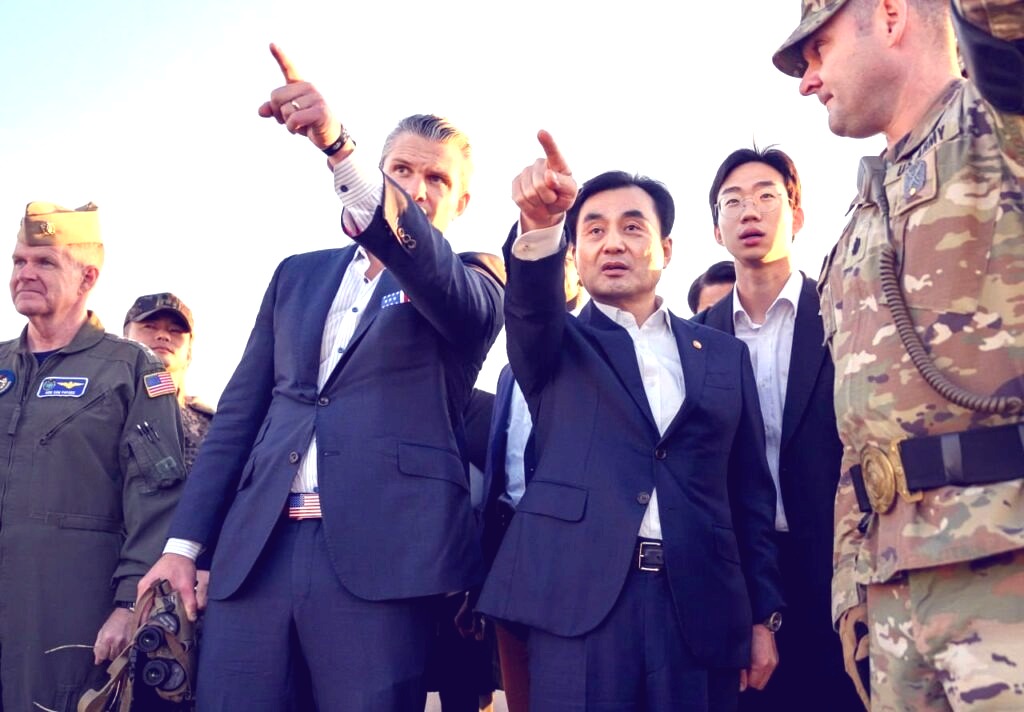
Seoul; February 2026: US Under Secretary of Defence for Policy Elbridge Colby emphasised countering the People’s Republic of China (PRC) during his visit to South Korea as part of efforts to expand the US Forces Korea (USFK) mission to include contingencies involving the PRC. Colby said on January 26th, that the US Indo-Pacific strategy is focusing on deterrence by denial in the First Island Chain (FIC) and emphasised the development of resilient forces in Japan, the Philippines, and the Korean peninsula. Colby has further commented that the US goal is to convince the PRC that aggression across the FIC is an unattractive option. While emphasising further that the Trump administration’s alliance policy prioritises “shared responsibility” over “one-sided dependence”, and praised South Korea as a “model ally” for increasing its defence spending. The Lee Jae Myung administration is increasing South Korean defence spending by 7.5%, approximately 44.8 billion US dollars, in fiscal year 2026. Most noticing Colby did not mention North Korea during his speech.
The USFK supports the operations of the Combined Forces Command (CFC), which is the United States-South Korea command headquarters. The CFC’s primary objective is to deter and defeat, if necessary, outside aggression against South Korea.
The USFK force structure, mainly consisting of combat brigade teams optimised for land operations, reflects a peninsular focus and lacks the maritime capabilities essential for FIC contingencies. Colby did not reaffirm US extended deterrence during the visit, unlike past visits by senior US defence officials. North Korea may interpret the absence of this reaffirmation as the United States weakening its resolve to defend South Korea.
North Korea reportedly launched four short-range ballistic missiles (SRBM) on 27th January 2026 to test its advanced 600 mm multiple-launch rocket system (MLRS), possibly to signal disapproval of US-South Korean diplomatic engagement, reinforce North Korean self-reliance prior to the Party Congress, and demonstrate North Korean missile enhancements to Russia. North Korean state media announced that Workers’ Party of Korea (WPK) General Secretary Kim Jong Un and his daughter Kim Ju Ae oversaw the missile test.
North Korean media have reported that the launch was meant to test the effectiveness of an “advanced large-caliber rocket system” with a new “autonomous precision guided flight system”. On the otherside, South Korean military experts suggested that the system is meant to counter GPS jamming and increase precision firepower. According to North Korean media reports the country has fired four missiles, which struck Alsom Island in the East Sea/Sea of Japan after flying 358.5 km (222.8 miles). However, the South Korean Joint Chiefs of Staff and Japanese Ministry of Defence only detected two missiles, however, which flew 350 km and 340 km respectively. The MLRS can strike the military assets within the Seoul metropolitan area, including Camp Humphreys, which is the USFK headquarters.
The missile launch may be part of North Korea’s reaction to US Under Secretary of Defence Elbridge Colby’s visit to Seoul. It has been observed that Kim Jong Un’s attendance at military exercises and missile launches often occur around the time of US-South Korean engagements and thus represent Pyongyang’s reaction to the US and South Korean deterrence coordination. Kim Jong Un could use the missile launch as an opportunity to emphasise internal cohesion and self-reliance. The North Korean President has commended the scientists responsible for the MLRS launch and emphasised the achievements of North Korea’s indigenous military technology sector. His propaganda efforts concerning the military typically highlight major weapons systems in order to show North Korean military might and suggest that North Korea can independently defend itself.
The diversification and development of North Korea’s weapon systems could also assist Russia in its war in Ukraine. Ukrainian military intelligence first announced in December 2024 that North Korean missiles struck Ukrainian territory. Ukrainian intelligence identified approximately 60 out of the 194 Russian ballistic missiles launched in 2024 as North Korean KN-23s. North Korea’s increased efficiency, based on sophisticated missile systems and continuous testing, could result in an increased number of North Korea missiles striking Ukraine.
The South Korean Ministry of Unification (MOU) and some lawmakers from the ruling Democratic Party (DP) are backing legislation to expand MOU influence over the Lee Jae Myung administration’s North Korea policy. 18 DP lawmakers proposed the Act on the Support for the Peaceful Use of the Demilitarised Zone (DMZ) Law, in August 2025. The bill would grant the MOU authority over the use of the DMZ, including measures to override provisions of the Armistice Agreement, if necessary.[20] The DP has introduced the DMZ Law in three separate National Assembly sessions as of January 2026.
The United Nations Command (UNC) currently has authority over the DMZ under Article 1, Paragraph 9 of the Korean War Armistice Agreement. The UNC stated on January 28th that the DMZ Law violates the Armistice Agreement. It is highly unusual for the UNC, which typically avoids direct political statements, to openly express concerns with a proposed South Korean bill. MOU Minister Chung Dong-young dismissed the UNC opposition on the same day, stating that legislation remains the authority of the National Assembly, regardless of UNC opposition, signaling MOU support for the bill. Chung has reiterated his position on January 29, saying that the DMZ Law does not violate the Armistice Agreement.
In an apparent takedown Chung likely aims to increase the MOU’s authority over the Lee administration’s North Korea policy. The MOU’s recent efforts, such as restoring the no-fly zone over the military demarcation line, attempting to place the Institute for National Unification under MOU jurisdiction, and expanding civilian exchanges with the North, may reflect an intensified push to increase MOU authority.
The South Korean Ministry of National Defence (MND) and Ministry of Foreign Affairs have voiced concerns about the bill. The MND stated that domestic policy changes lacking consultation with the UNC would confuse and negatively impact US-South Korean coordination. The UNC Military Armistice Commission has overall authority over access to the DMZ and the Demarcation line under the accord.
South Korea considers the Armistice Agreement to be customary international law, although South Korea was not a signatory. The UNC commander received transfer of operational control from South Korean President Rhee Syngman in 1950 during the Korean War, which means that the Armistice Agreement effectively holds the same legal weight as South Korean domestic law.
Team Maverick.


Trump Declares Strait of Hormuz Reopened Under US Protection, Imposes Full Blockade on Iranian Shipping
Washington, July 2026 : US President Donald Trump on Tuesday announced that the Strait of …
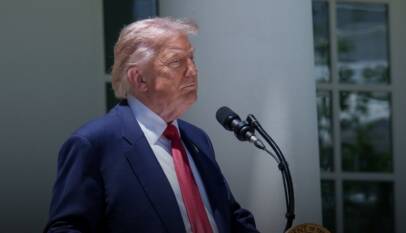
Trump Declares Strait of Hormuz Reopened Under US Protection, Imposes Full Blockade on Iranian Shipping
Washington, July 2026 : US President Donald Trump on Tuesday announced that the Strait …