Japan Votes in Crucial General Election as Ruling Coalition Seeks to Retain Power

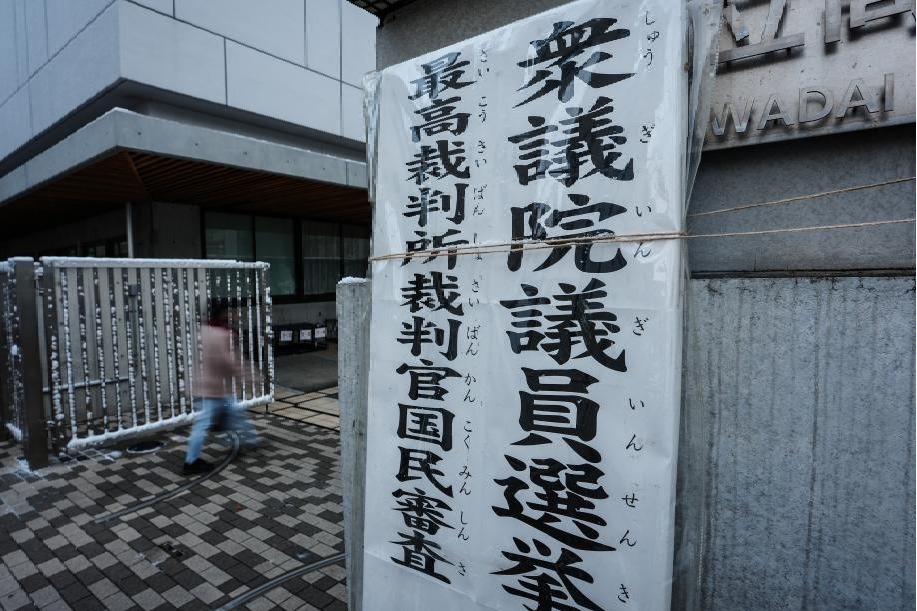
Tokyo, Feb 8 : Voting began across Japan on Sunday morning in a high-stakes general election that will determine the future of Prime Minister Sanae Takaichi’s administration. A total of 1,284 candidates are contesting 465 seats in the House of Representatives, the powerful lower chamber of the Japanese parliament.
The central question before voters is whether the ruling coalition led by the Liberal Democratic Party (LDP) and its ally, the Japan Innovation Party, can secure a majority and continue in power, or whether opposition forces will gain enough seats to block the coalition’s mandate. According to reports, polling stations nationwide will close at 8 p.m. local time, with vote counting expected to continue late into the night.
Of the total 465 seats, 289 members will be elected from single-member constituencies, while the remaining 176 will be chosen through proportional representation across 11 regional blocs. This mixed electoral system often makes outcomes difficult to predict, particularly when voter sentiment is divided.
Pre-election surveys conducted by major Japanese media outlets have suggested that the ruling coalition is on course to retain a majority in the lower house. However, the newly formed opposition grouping, the Centrist Reform Alliance — launched by the Constitutional Democratic Party of Japan in partnership with Komeito, a former LDP ally — has reportedly struggled to maintain its pre-election momentum. A Kyodo News poll indicated that the alliance may lose seats compared to its strength before the election.
Despite these projections, analysts caution that the outcome remains uncertain. Opinion polls have highlighted a sizeable proportion of undecided voters, raising the possibility of late swings in closely fought districts. Additionally, lingering controversies surrounding alleged slush fund scandals linked to the LDP continue to cloud the ruling party’s prospects and could influence voter behaviour.
Prime Minister Takaichi called the snap election on January 23 by dissolving the lower house — a move that marked the first such dissolution at the opening of a regular parliamentary session in six decades. She has publicly stated that she would resign if the ruling coalition fails to secure a majority.
Her decision to dissolve parliament drew criticism from opposition parties, who accused her of prioritising political strategy over governance, particularly delaying the passage of an initial budget for the 2026 fiscal year beginning in April.
This is Japan’s first lower house election to be held in February since 1990. Severe snowfall along parts of the Sea of Japan coast has raised concerns about transportation disruptions and safety, factors that could dampen voter turnout in affected regions.
(The content of this article is sourced from a news agency and has not been edited by the Mavericknews30 team.)







Suryavanshi’s 17-Ball Blitz Powers Rajasthan Royals to Dominant Win Over CSK
Guwahati, March 2026 : A sensational knock by Vaibhav Suryavanshi powered the Rajasthan Ro…

Suryavanshi’s 17-Ball Blitz Powers Rajasthan Royals to Dominant Win Over CSK
Guwahati, March 2026 : A sensational knock by Vaibhav Suryavanshi powered the Rajasthan Royals …