North Korea’s Defence Unit Flagged With Secret Scandals.

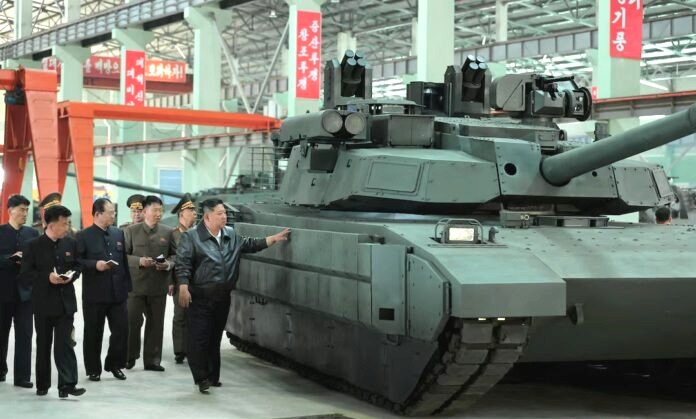
Pyongyang; February 2026: North Korea’s 91st Capital Defense Corps, known as Training Camp 91, is facing fresh scrutiny after a defense ministry inspection found widespread failures to secure classified documents and communication equipment, compounding earlier findings that the unit’s commanders had misused funds.
“Training Camp 91 got in trouble when it was caught up in a storm-like inspection, which revealed that it had been lazy with managing and protecting military secrets,” a source in South Pyongan province who requested anonymity for security reasons told Daily NK recently. “The defense ministry slammed the unit when it found holes in their security, with the unit failing to systematically manage military secrets and even the commanders displaying a lax security consciousness.”
Inspectors found numerous instances in which Training Camp 91 left level 2 and level 3 classified documents on desks in plain view rather than locked in safes with double locks. They also found that some commanders had left access codes for communication equipment on their monitors or desks when they left work, in direct violation of standing security orders.
Inspectors further discovered that commanders had begun storing lecture and study materials from superiors carelessly, despite long-standing regulations requiring secure storage of such materials.
“Having received reports of the issues found in the inspection, the defense ministry could not hide its disappointment that things were still this bad, despite repeated warnings about security at every meeting,” the source said. The authorities had previously taken immediate action whenever problems emerged, elevating violations into political and ideological matters and punishing those responsible.
Defense ministry warns of punishment up the chain of command. What has angered the defense ministry most was that nobody at Training Camp 91 appeared to recognize a problem existed, despite the continuous, everyday nature of the failures.
“The latest incident directly demonstrates how lax the military has become”, the source said. “The defense ministry noted that stronger measures are needed”.
The ministry strongly emphasized that strict adherence to military secrecy and security protocols was a basic military necessity, warning that forces lacking this discipline suffer complete defeat on the battlefield. It warned that not even high-ranking generals would escape punishment if found responsible, and ordered that inspections of Training Camp 91 would continue until secrecy and security adherence were deemed perfect.
Training Camp 91 is a key unit in the defense of Pyongyang, responsible for guarding the capital and protecting the nation’s leadership. Given the strategic nature of its role, authorities regard the lax discipline uncovered during the inspection as more than simple workplace negligence — viewing it instead as a serious security gap. The fallout from the inspection is unlikely to dissipate soon.
Scrutiny Pertinent To The 91st Capital Defense Corps –
An analysis of a database from a North Korean smartphone application shows that Pyongyang has far more medical facilities than anywhere else in the country. The analysis suggests that North Koreans in rural areas struggle to receive proper medical care. The list was last updated in 2023, only includes facilities registered for app users. It can’t be considered a comprehensive list of all medical facilities in North Korea.
Still, the database makes clear that North Korea’s medical infrastructure is concentrated in Pyongyang, revealing the medical imbalance between the capital and the provinces.
The largest concentration of medical facilities is in Pyongyang’s Central District, home to 37 facilities altogether, 01 hospital, 28 pharmacies, 06 pharmaceutical plants and 02medical research labs. Other capital districts with large numbers of medical facilities are Pyongchon (34), Taedonggang (32), Mangyongdae (31) and Potonggang (29).
In contrast, no hospitals or pharmacies are listed for 55 counties that represent around half of the cities and counties in the database. That confirms the stark disparity in medical infrastructure between Pyongyang and the provinces.
Also striking is the fact that 08 districts of Pyongyang, including Jung, Pyongchon and Taedonggang, have both pharmaceutical research facilities and production facilities. Mangyongdae, in particular, hosts 11 pharmaceutical plants and three medical research labs, suggesting that the district is the center of the North Korean medical industry.
The close proximity of pharmaceutical research and production appears aimed at maximizing the efficiency of both. Having new medications produced at factories near the labs where they were developed is presumably an effort to create synergy between human and material resources, while shortening the timeframe from development to production.
In addition, the database includes the email and home addresses of facility representatives. All the emails have the domain @pt.net.kp, with “kp” being North Korea’s top-level domain, “net” signifying a network-related organization and “pt” denoting North Korea’s Ministry of Posts and Telecommunications.
Consequences Of Defense Ministry’s Inspection –
The defense ministry’s Bureau 1215 “is conducting an inspection of the entire border in the four northern provinces adding that this effort completes the five-year plan to completely seal the border that was announced during the Eighth Party Congress.
The first priority for bureau members during the inspection is landmines. They’re verifying whether actual minefields match those shown on their maps, checking for missing or overlapping minefield sections, and ensuring minefields have been properly maintained and cleared of vegetation.
“Units overseeing minefields with uncertain locations or poor documentation have been warned they’ll bear full responsibility if accidents occur. Officials in those units are nervous because mine locations often don’t match the maps”.
Inspectors also discovered that high-voltage wires can’t operate continuously in some areas due to frequent power outages or outdated equipment, so technicians are completely replacing the power systems. Specifically, double-layer high-voltage wires and alarm detection sensors have been installed on a trial basis in areas where the river separating North Korea from China is less than 10 metres wide, making border crossings easier.
Most surveillance cameras were installed in 2021. Inspectors found that many are already broken or disconnected from their storage systems, prompting an emergency order to first replace some equipment with cheaper Chinese-made alternatives and add heat sensors along certain border stretches. However, in areas particularly vulnerable to border crossings: Hoeryong and Onsong in North Hamgyong province, Hyesan and Samsu in Ryanggang province, and Manpo in Jagang province, where the bureau has ordered that surveillance cameras be replaced with the latest models. As surveillance tightens in regions where border crossings have been common, local residents feel increasingly uncomfortable.
“Officers from units where border crossings have occurred are being investigated all the way down to company commanders, with no exceptions. It’s gotten so bad that people are saying army officers have it tougher than party officials. Even within army units, an atmosphere of tension and fear prevails due to the intensive inspections, with military personnel calling it a “de facto wartime inspection”.
Team Maverick.







Final US Section 301 Measures on Forced Labour: India Placed in Lower Tariff Tier at 10%
The United States Trade Representative (USTR) announced on 23rd July 2026 the final measur…

Final US Section 301 Measures on Forced Labour: India Placed in Lower Tariff Tier at 10%
The United States Trade Representative (USTR) announced on 23rd July 2026 the final measures …