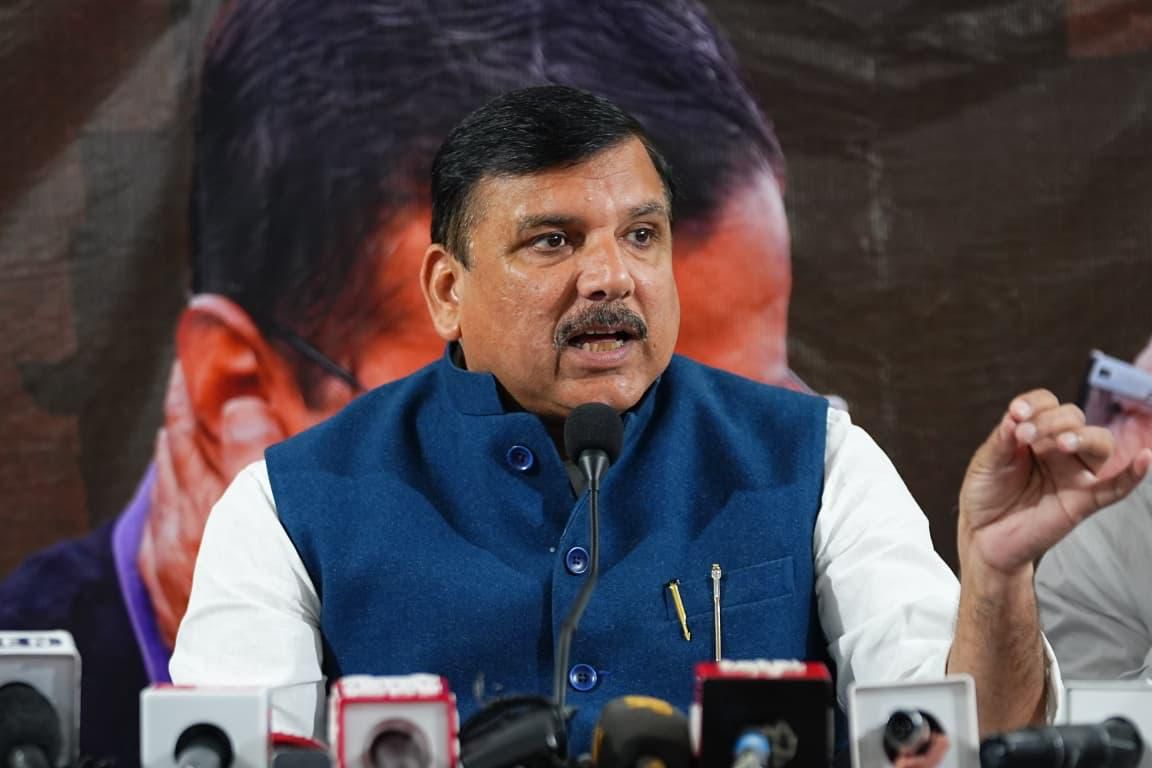
BJP Government Sacks 112 Employees of Prepaid Taxi Scheme: Sanjay Singh

- Employees worked tirelessly for 40 years to make the prepaid taxi scheme profitable: Sanjay Singh
- Government will also remove the remaining 38 employees; where will they go at this age?: Sanjay Singh
- Centre must reinstate all employees and absorb them into its new scheme: Sanjay Singh
- Government promised not to terminate jobs, but rendered us unemployed without notice: Shehnaz, employee
New Delhi, February 2026 : Senior leader and MP of the Aam Aadmi Party, Sanjay Singh, launched a sharp attack on the BJP-led central government over the termination of 112 employees associated with the prepaid taxi scheme in Delhi. He said these employees had worked relentlessly for nearly four decades to make the scheme successful and profitable, yet were abruptly removed from service. He warned that the remaining 38 employees would also be dismissed soon, leaving them with no livelihood at an advanced age. Singh demanded that the central government immediately reinstate all employees and absorb them into its new scheme.
Addressing a press conference at the AAP headquarters on Wednesday, Sanjay Singh said the prepaid taxi concept was introduced by the Delhi Police in 1986 with the objective of ensuring passenger safety. Under the system, prepaid taxi booths were established and passenger journeys were monitored to ensure safe drop-offs. Delhi Police collected a service charge from passengers, which was sufficient to cover employees’ salaries and the entire maintenance of the scheme.
He further stated that around 150 employees, who were paid approximately ₹850 per day, worked day and night to make the scheme a milestone. Due to their hard work, the prepaid taxi scheme accumulated a fixed deposit of nearly ₹10 crore, clearly proving it was a profitable initiative. Despite this, the Delhi Police and the Union Home Ministry decided to restructure the scheme and operate it through an app-based model, sidelining the very employees who built it from the ground up.
Sanjay Singh said that 112 such foundational employees have already been removed, and the remaining 38 face imminent termination, leaving their future uncertain. He appealed to the Union Home Minister and the Commissioner of Delhi Police not to push these long-serving workers and their families toward starvation. Many of them are aged between 50 and 60 years, and forcing them out now is like pushing them into a dark abyss, he said. He also pointed out that the Department of Personnel and Training (DoPT) had issued directions between 1993 and 1996 for their regularisation.
During the press conference, an employee said repeated representations to authorities over the years went unheard, and that termination letters were issued from February 22 under the pretext of revenue generation, despite claims that the scheme was run on a no-profit-no-loss basis.
Employee Shehnaz, who worked as a clerk at a prepaid counter, said they were assured during cooperative taxi training that they would not be removed and would work alongside digital systems. However, they were dismissed overnight without notice. She added that employees are daily wage earners with no pension or benefits, and even during the COVID-19 period they continued working, losing two colleagues to the virus without any compensation to their families. “We want justice and reinstatement,” she said.
Another employee recalled that since 1986, despite High Court and Supreme Court directions on classification and ‘equal pay for equal work’, justice was denied. He questioned the basis of a newly announced ₹300 crore budget when earlier expenses were met from the scheme’s own revenues.




Shivakumar Meets Sonia, Rahul and Priyanka Gandhi Amid Karnataka Cabinet Discontent
New Delhi, June 2026 : Karnataka Chief Minister D.K. Shivakumar on Wednesday met senior Co…

Shivakumar Meets Sonia, Rahul and Priyanka Gandhi Amid Karnataka Cabinet Discontent
New Delhi, June 2026 : Karnataka Chief Minister D.K. Shivakumar on Wednesday met senior …