
EastInvest Facility A New Platform To Boost Support For EU Regions Most Affected By The War In Ukraine.

Brussels; February 2026: The European Commission on 26th February 2026, would be hosting the launch of a new initiative to provide easier access to lending support to EU Member States bordering Russia, Belarus and Ukraine. This initiative, titled “EastInvest” is at the core of the strategy for the EU’s eastern regions bordering Russia, Belarus and Ukraine adopted last week by the Commission to help these regions tackle the challenges they face in the wake of Russia’s war of aggression against Ukraine.
The EastInvest Facility will be a dedicated financing platform for EU eastern regions, bringing together the European Investment Bank (EIB) Group, the European Bank for Reconstruction and Development, the Nordic Investment Bank, the Council of Europe Development Bank, and national promotional banks from the 09 concerned Member States: Finland, Estonia, Latvia, Lithuania, Poland, Slovakia, Hungary, Romania, and Bulgaria. It will make it easier for private and public project promoters in EU eastern regions to access loans and advisory support to boost their economies, develop trade and enhance security. The 04 participating financial institutions estimate that the Facility will provide at least €28 billion in private and public investments in those regions.
The establishment of a dedicated platform will allow for better coordination among the relevant investors, ensure high complementarity and synergies of their interventions in the eastern border regions. EastInvest will also serve to coordinate lending and advisory support, including to local public authorities, in the eastern border regions. It will address investment needs identified in the development strategies of the regions bordering Russia, Belarus and Ukraine through targeted lending support by the participating institutions.
The Facility will be launched at a high-level event hosted by Executive Vice-President Rafaelle Fitto, in Brussels, where the EIB and the other international financial institutions and national promotional banks will sign the Facility declaration of intent. The event, which will be opened by the President of the European Commission, Ursula von der Leyen, will bring together the President of the EIB, Nadia Calviño, as well as high-level representatives from the nine concerned countries who will discuss the challenges and opportunities inherent to securing prosperity for Europe’s eastern border regions. Participants include the Prime Ministers of Estonia, Kristen Michal, Lithuania, Inga Ruginienė, Latvia, Evika Siliņa, and Romania, Ilie Bolojan, as well as the President of the European Investment Bank, Nadia Calviño.
Background – The EU regions bordering Russia and Belarus have faced the brunt of disruptions from Russia’s war of aggression, experiencing severe trade impediments, population decline from border closures, and sanctions impacts. In response, the EU has extended political, technical, and financial support to these regions to enhance infrastructure, economic resilience, defence capabilities, and employment opportunities, though ongoing conflict highlights the need for further aid.
The Commission’s Communication adopted on 18th February 2026 details strategies to address and support these eastern regions’ specific needs. It coordinates efforts across various levels, emphasising both challenges and regional assets. Initiatives like the Eastern Flank Watch and European Drone Defence aim to boost resilience, while economic growth is encouraged through the EastInvest facility and partnerships with the World Bank. Local strengths are utilised by integrating Baltic electricity networks and developing hydrogen resources. Efforts to improve connectivity focus on digital advancements and transport links, and demographic challenges are met with education-to-employment pathways and community initiatives like the Media Resilience Programme.
Raffaele Fitto, Executive Vice-President for Cohesion and Reforms, have reiterated, “Investing in the regions bordering Russia, Belarus and Ukraine means investing in Europe’s security, stability, cohesion and competitiveness. With the EastInvest Facility, we will strengthen the social and economic resilience of these territories, places where people live, work and build their future. This is an important step, but our commitment does not stop here. We will continue to work with tailor-made solutions and cohesion policy, to support these communities and ensure they remain strong, vibrant and competitive”.
Nadia Calviño, President of the European Investment Bank have asserted, “The fight for Europe’s future is, at its core, a fight for our values, for peace and security, for equal opportunities, for social and territorial cohesion, for vibrant communities and innovative economies. The EIB Group is determined to play its full part in building a safer and more resilient Eastern border, and powering Europe”.
COHESION POLICIES –
On 18th February 2026 – Executive Vice-President Fitto on the Communication on Eastern border regions have clearly affirmed:
Today, the Commission presents a Communication on the EU’s eastern regions bordering Russia, Belarus and Ukraine.
Let me start with one very clear message:
- These are not only national borders. They are European borders.
- They are the eastern frontier of the European Union.
- And what happens there concerns all European
The EU has more than 3,500 km of land borders with Russia and Belarus, and almost 1,500 km with Ukraine, plus 600 km bordering the maritime Black Sea basin also shared with Ukraine and Russia.
This Communication addresses the specific challenges faced by people and communities living in these regions.
For these regions, more than anywhere else in Europe, there is a clear before and after 24 February 2022.Since the start of Russia’s war of aggression:
- Places that were once built for normal daily life — for cross-border shopping and tourism — are now used for security, dual-use activities, logistics, drones and emergency support
- trade patterns have shifted;
- growth has slowed;
- inflation has been higher;
- depopulation pressures have intensified.
Many communities face a combination of higher insecurity, weaker economic activity and demographic decline.
Supporting these regions is therefore not only technical, but a political responsibility.
How the Communication was prepared
This is neither a starting point nor the end of a process, but an important political step.
It builds on a concrete and collective effort:
- First, missions on the ground. I personally visited these Member States — not only their capitals, but also the border areas. Reaching these places is not easy, but it means truly understanding the reality faced by the communities living there. During each mission, I met citizens, local actors and those directly affected by the new security and economic situation.
- Second, exchanges with national, regional and local authorities.
- Third, stakeholder consultations held directly in the border regions, because this is the best way to understand real needs and not theoretical ones.
- Fourth, a dedicated conference in Poland, bringing together ministers and regions concerned.
- Fifth, a very close cooperation across the Commission Cabinets.
The Communication is built with the territories, starting from their lived experience.
A clear message emerged: security and defence are a precondition, but regions also need investment, services, connectivity and economic prospects.
In short: they ask for the right to stay – the possibility to live and work where they belong.
What the EU has already done –
With the mid-term review we have shown that cohesion policy can adapt to new needs, and the results I will present in the coming weeks will confirm this trend.
For the first time, cohesion resources have also been used without controversy and on a voluntary basis to support defence-related investments through dual use infrastructure such as transport networks and hospitals.
The mid-term review introduced priorities directly relevant for these regions: reallocating resources towards security and resilience, while respecting the nature of cohesion policy and using the dual-use approach.
All of this is voluntary and fully respects the specific characteristics and choices of each Mem er State.
The MTR also recognised the specific situation of those regions through:
- higher pre-financing, and
- higher co-financing rates.
Member States have already used this flexibility extensively, including for:
- defence-related industries,
- military mobility,
- civil preparedness,
- critical infrastructure and emergency shelters.
However, pressure continues to increase, and the situation continues to evolve.
Five priority areas for further action –
The Communication therefore proposes action in five priority areas, combining cohesion policy with other EU tools:
First, security and resilience: We aim to address persistent hybrid threats and security gaps, strengthen preparedness and resilience, protect critical infrastructure and improve military mobility.
Second, growth and regional prosperity: These regions are often perceived as high-risk, making investment more difficult.
We therefore propose to establish EastInvest, a dedicated financing facility with the EIB Group, international financial institutions and national promotional banks. The aim is more accessible, coordinated and locally adapted financing, including for municipalities.
Third, leveraging local strengths: These regions possess strong assets, industry, agriculture, forestry, research capacity, skills and natural resources. Our approach is not only about compensation; it is about turning resilience into opportunity through innovation, energy solutions, the bioeconomy and new value chains.
Fourth, connectivity: Connectivity is essential for both security and growth. We will focus on transport, energy and digital links within the EU and, where relevant, with partners. At the local level, this means access to services, jobs and reliable digital infrastructure, including in rural areas.
Fifth, people: Resilience depends on strong communities. We will support attractiveness through quality services, education and skills, healthcare and care services, support for young people and community preparedness. Ultimately, this is about safeguarding the right to stay.
Implementation approach –
Across all five areas, the guiding principle is a place-based approach and multi-level governance.
- Challenges differ between regions bordering Russia and Belarus and those bordering Ukraine.
- Solutions must therefore be tailored, not one-size-fits-all.
- The Commission will work closely with Member States, regions and municipalities, building on existing instruments and preparing for the future.
In conclusion we are sending one core message: these are not only national borders – they are European borders. They are the EU’s eastern frontier, and what happens there concerns all Europeans.
Let me finish announcing that this work will be followed by a high-level conference on 26 February. I thank the President Von Der Leyen for accepting to open the high-level conference. Prime Ministers and Ministers from the Member States concerned will attend.
During the event, the declaration of intent to establish the EastInvest Facility will be signed by the participating financial institutions.
This Communication is not the end of the process. We will continue working with, and for these regions.
Team Maverick.






Shivakumar Says Congress United, Assures Women Will Get Cabinet Berth
Bengaluru, Aug 2026 : Karnataka Chief Minister D.K. Shivakumar on Monday sought to dismiss…
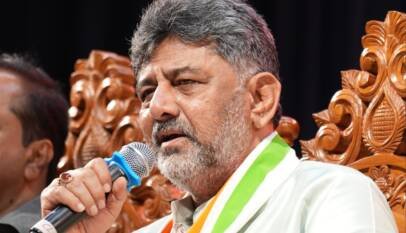
Shivakumar Says Congress United, Assures Women Will Get Cabinet Berth
Bengaluru, Aug 2026 : Karnataka Chief Minister D.K. Shivakumar on Monday sought to dismiss …