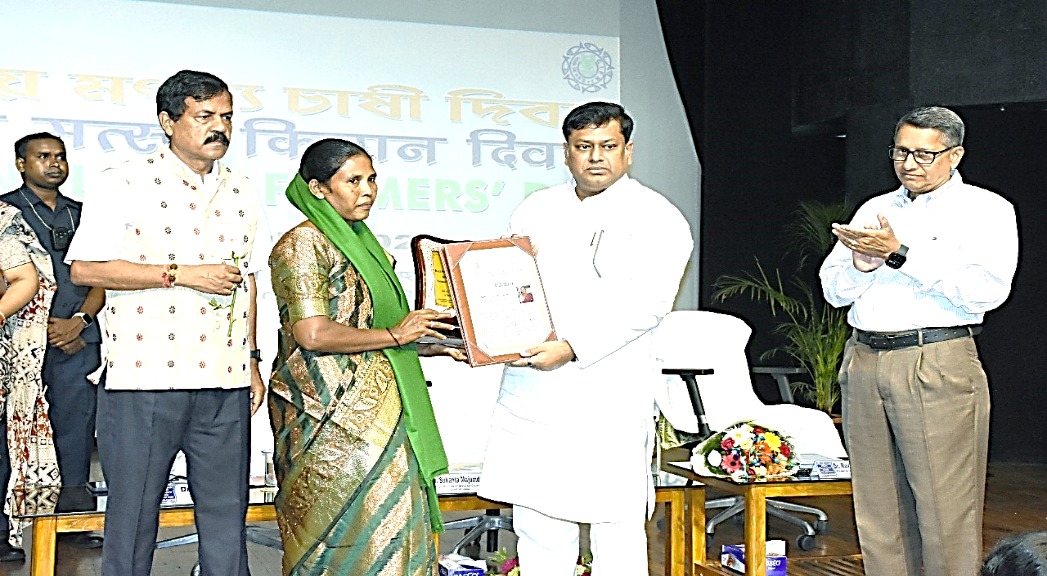
Smiling Fisher for Viksit Bharat – A Day of Recognition and Honour at CIFRI

July 25 : The ICAR–Central Inland Fisheries Research Institute (CIFRI), Barrackpore, celebrated National Fish Farmers Day 2025 with great enthusiasm at its headquarters on July 10. The day commemorated the historic success of the induced breeding technique pioneered by Prof. Hiralal Chaudhury and his team at Angul Fish Farm, Cuttack on July 10, 1957 by the then Central Inland Fisheries Research Station, which is now the ICAR-Central Inland Fisheries Research Institute (ICAR-CIFRI), Barrackpore, an innovation that ignited India’s first Blue Revolution.
The event witnessed the presence of Hon’ble Chief Guest Dr. Sukanta Majumdar, Union Minister of State for Education & Development of North Eastern Region, Government of India and honoured guests Dr. Ravishankar C.N., Former Director & Vice-Chancellor, ICAR-CIFE, Mumbai and Prof. Kallol Paul, Vice Chancellor, Kalyani University, WB. The gathering included 120 fishers and farmers, including 27 women, along with entrepreneurs, researchers, and NGO representatives.
Seventeen progressive fish farmers including four women fishers from eight states—West Bengal, Bihar, Jharkhand, Chhattisgarh, Assam, Kerala, Karnataka, Gujarat, and Uttar Pradesh—were felicitated for their exemplary contribution to the inland fisheries sector.
In his address, Dr. Majumdar urged fish farmers to adopt modern technologies developed by CIFRI and utilise schemes like PMMSY (Pradhan Mantri Matsya Sampada Yojana) to enhance fish production. He emphasised the importance of science-backed practices in making the fisheries sector a cornerstone of India’s economic and nutritional security.
Dr. B. K. Das, Director, ICAR-CIFRI, highlighted the institute’s ongoing research in improving productivity in reservoirs and wetlands, river restoration, sustainable development goals (SDGs) and environmental flow requirements. He called upon award-winning farmers to share their experiences with fellow stakeholders to help in uplifting rural livelihoods. Dr. Das also mentioned that at present the thrust of the institute is to increase the production and productivity of medium and large reservoirs and wetlands as well as river restoration protocols, including the environmental flow requirement for open water fisheries under natural resource management mode.
India’s fisheries sector is currently experiencing rapid growth, with a record production of 18.42 million tons in 2024–25, up from 0.7 million tonnes in 1950–51, positioning the country as the second-largest fish producer globally. The sector contributes about 1.09% to the national GDP and over 7% to agricultural GDP, moving confidently towards the goal of a Second Blue Revolution with a target of 22 million tonnes of production. India with its vast and diverse aquatic systems in the forms of rivers (29,000km), estuaries (2,00,000 ha), wetlands (3,50,000 ha) and ponds (22,00,000 ha), offers tremendous scope for increasing the production and productivity of fish from India.
The programme, which began with a floral tribute to Prof. Hiralal Chaudhury and, served as a platform for dialogue between fishers, scientists, entrepreneurs, and policymakers. The celebration reinforced the collective vision of a prosperous inland fisheries sector aligned with the national goal of Viksit Bharat—a developed India.
Team Maverick




Punjab Kings Beat Gujarat Titans by 3 Wickets in Last-Over Thriller
Delhi, March 2026 : In an exciting match of the Indian Premier League 2026, Punjab Kings d…

Punjab Kings Beat Gujarat Titans by 3 Wickets in Last-Over Thriller
Delhi, March 2026 : In an exciting match of the Indian Premier League 2026, …