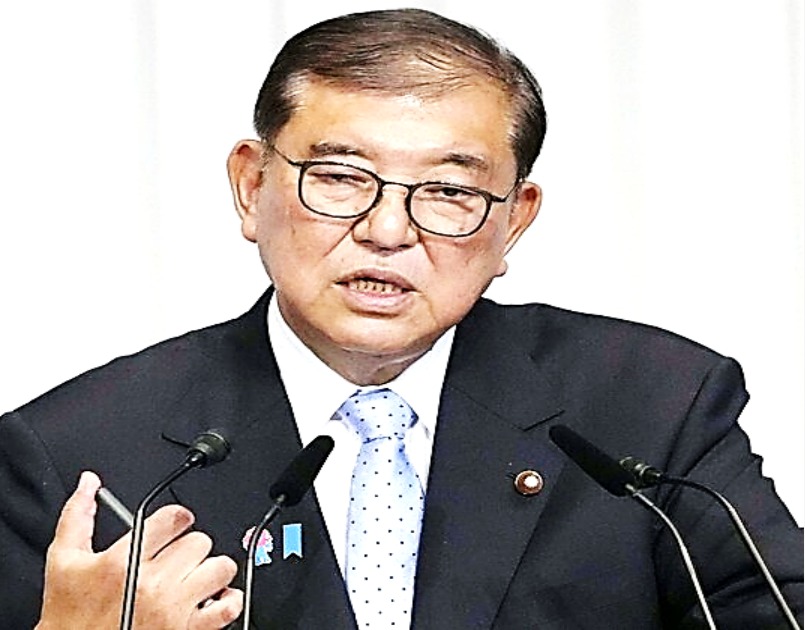
Japanese Prime Minister Ishiba vows to stay on to avoid stalemate after poll defeat.

Japanese Prime Minister Shigeru Ishiba on Monday said he will continue to remain in office to avert a “political stalemate,” even as the ruling coalition lost its majority control in both chambers in parliament following a crushing House of Councillors election defeat. Deepening Ishiba’s woes, the LDP’s worst election outcome in years triggered calls from his own party for his resignation and prompted an emboldened opposition bloc to question the premier’s decision that showed “no regard to the will of the people”.
Ishiba, who heads the ruling Liberal Democratic Party, also underscored the need for leadership continuity at a time of “national crisis”, as households reel from high prices and as Japan continues negotiations with the United States ahead of steep tariffs set to be imposed by President Donald Trump from 01st. August, 2025. “The path ahead is a thorny one. I will conduct state affairs by deepening discussions with other parties even more carefully than before“, Ishiba told a press conference at the LDP headquarters in Tokyo, a day after Sunday’s upper house election.
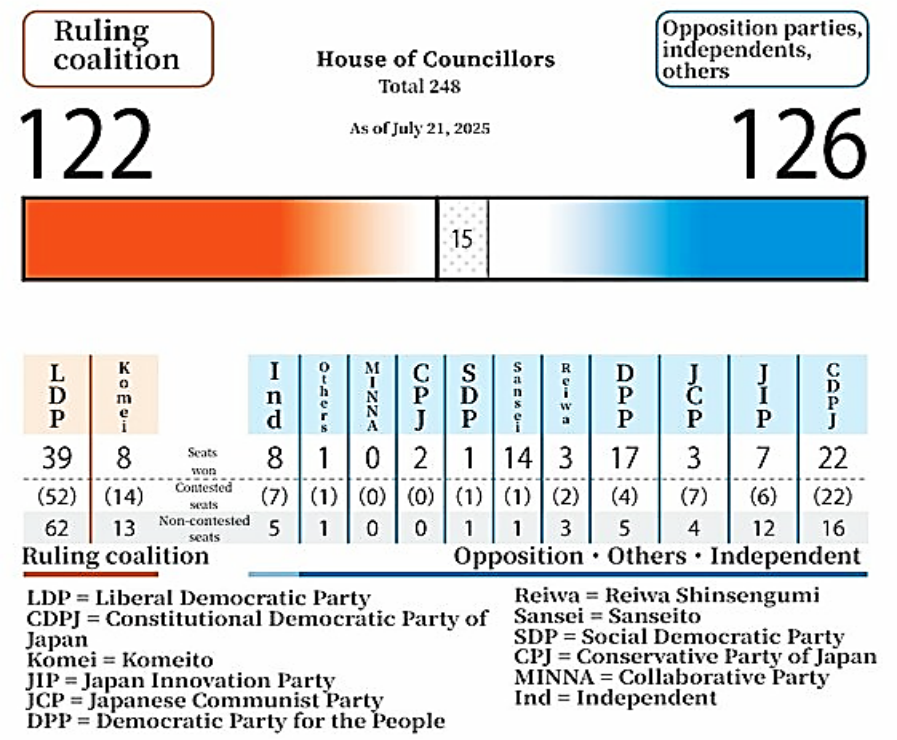
The latest election setback will raise the prospects of political deadlock without opposition support, as the upper house, although less powerful than the House of Representatives, is still important to smoothly enact laws and advance policies. The LDP and Komeito failed to clear the majority threshold in the 248-member upper house, a hurdle seen as relatively low. After Sunday’s election, the total number of seats the ruling camp holds fell to 122 from 141.
Asked about the possibility of expanding the ruling coalition of the LDP and Komeito party to include other opposition forces, Ishiba ruled that out “for now” but expressed his willingness to discuss “how the new politics should work. We are facing a severe situation that can be described as a national crisis. In that environment, what is most important is to avoid a political stalemate“, Ishiba told the press conference.
The 68-year-old veteran LDP lawmaker also acknowledged his “heavy responsibility” for the election outcome, but said, “I will fulfill my responsibility for the people” who made the LDP the largest force in parliament. Ishiba has reiterated that he has no such immediate plan in changing the LDP’s leadership in the wake of the election setback. But he added he will consider whether to reshuffle the line-up of LDP executives when their current terms end in September, as well as a revamp of his Cabinet.
With his premiership not yet a year old, it hangs in balance amid uncertainty over whether his decision will win backing from ruling party members. Among the LDP members voicing discontent, Shoji Nishida, a veteran member who retained his seat in the latest election, called Ishiba’s decision not to quit is “outrageous”.
Nishida is close to former economic security minister Sanae Takaichi, who lost to Ishiba in the party presidential race last year. Both of them are known for their hawkish views.
On the flipside of the LDP’s loss, opposition forces — the Democratic Party for the People and the right-leaning fringe party Sanseito — gained in strength. The DPP, like other opposition parties, called for reducing the consumption tax to mitigate the pain of inflation and vowed to boost people’s incomes.
DPP leader Yuichiro Tamaki said Ishiba must present “a clear vision” if he intends to continue as prime minister. “He is not taking the voters’ verdict in the election seriously,” he told reporters.
Sanseito, meanwhile, was seen as a wild card, garnering support from relatively young voters who apparently resonated with its populist and nationalistic agendas, including its “Japanese First” push to limit the intake of foreigners in Japan. Its surge in popularity came at the expense of a drop in LDP support from conservatives.
Ishiba said his party will look into why it faced a “harsh verdict” from the public in detail, while admitting that it failed to win voter support for its efforts to tackle inflation and the issue of foreign residents. “When (other parties) present policies that focus intensively on certain areas, it happens that our party cannot follow with policies that can similarly stand out“, he said.
The DPP now has 22 seats, up sharply from 09 before Sunday’s election, and Sanseito increased its share from 02 to 15, a level that enables it to submit bills that do not involve budgetary matters in the upper chamber.
In a blow to Ishiba, the leaders of the DPP, the major opposition Constitutional Democratic Party of Japan and the Japan Innovation Party took a similarly negative stance on joining the ruling coalition.
After the race, the CDPJ maintained its 38 seats, and the JIP secured 19 seats, up from 18.
“Is he still going to remain as prime minister with no regard for the will of the people? Voters won’t be convinced“, CDPJ chief Yoshihiko Noda told a press conference.
Upper house members serve six-year fixed terms, unlike those in the lower house, which can be dissolved by the prime minister. Half of the upper house seats are contested every three years to avoid a complete turnover. The government and the ruling camp are arranging for parliament to convene an extraordinary session on 01st. August, according to a senior member of the ruling coalition.
Voter turnout stood at 58.51%, higher than the 52.05% recorded in the previous upper house election in 2022. A record 26 million people casting during the early ballots, which took place in the middle of a three-day weekend.
Team Maverick






Shivakumar Says Congress United, Assures Women Will Get Cabinet Berth
Bengaluru, Aug 2026 : Karnataka Chief Minister D.K. Shivakumar on Monday sought to dismiss…
Shivakumar Says Congress United, Assures Women Will Get Cabinet Berth
Bengaluru, Aug 2026 : Karnataka Chief Minister D.K. Shivakumar on Monday sought to dismiss …