Indo – China Visa Freeze Partialed as diplomatic tensions thaw.

As the two most populous nation are persistently clamoring for more tourists, which has observed a severe recession during the last five years due to escalating tensions and bilateral embargoes. Now that looks set to finally change as previous fractious relations between the two Asian giants finally begin to thaw.
India henceforth will issue tourist visas for Chinese citizens for the first time in five years, allowing nationals from its neighboring country to freely visit each other, marking a significant reset in relations after a deadly border clash sent ties into a deep freeze. It is from Thursday, July 24th., Chinese citizens can apply for tourist visas to India, the Indian embassy in Beijing have reiterated.
This “positive news” is in the “common interests of all parties”, China’s foreign spokesperson Guo Jiakun said. “China is willing to maintain communication and consultation with India to continuously improve the level of facilitation of personnel exchanges between the two countries”.
Relations were deeply strained in June 2020, when a brutal hand-to-hand battle in the Galwan Valley left at least 20 Indian and four Chinese soldiers dead. Both nations maintain a heavy military presence along their 2,100-mile (3,379-kilometer) de facto border, known as the Line of Actual Control (LAC) – a boundary that remains undefined and has been a persistent source of friction since their bloody 1962 war. The 2020 clash in the disputed region between Indian Ladakh and Chinese-controlled Aksai Chin marked the first deadly confrontation along India and China’s disputed border in more than 40 years.
Tensions escalated in the aftermath. India banned multiple Chinese apps, heightened scrutiny of Chinese investments and direct air routes between the two neighbours were cancelled. Both countries had shut their borders to foreign tourists due to the Covid-19 pandemic, but visa restrictions continued even as global travel began to resume.
China had lifted tourist visa restrictions for Indian nationals in March after Beijing and New Delhi announced they would work to resume direct air travel. Now India’s reciprocal move is seen as a welcome move by many.
India’s decision to remove visa restrictions is the latest in a string of steps taken by New Delhi and Beijing to reset ties after Chinese leader Xi Jinping met with Indian Prime Minister Narendra Modi on the sidelines of the BRICS summit in Russia last October.
In January, India and China agreed to resume direct commercial flights and Beijing recently agreed to reopen Mount Kailash and Lash Manasarovar in western Tibet to Indian pilgrims for the first time in five years.
Earlier this month, India’s foreign minister S. Jaishankar met with his Chinese counterpart Wang Yi in Beijing, where the two “took note of the recent progress made by the two sides to stabilize and rebuild ties, with priority on people-centric engagements”, according to a statement from the Indian foreign ministry.
There has been a “gradual normalisation of the India-China relationship”, reiterated Harsh V. Pant, foreign policy head at the New Delhi-based Observer Research Foundation think tank. “There is a certain recalibration happening from both ends. But this is also a reflection that India faces a unique challenge in managing China”, he added.
Despite the ongoing tensions, India is still economically dependent on China and sees “a possibility of building an economic partnership” while making its red lines clear, Pant said.
Team Maverick







PM Modi Receives Grand Welcome in Jakarta as Indonesia Visit Begins with Special Honours
Jakarta, July 2026: Prime Minister Narendra Modi arrived in Jakarta on Monday afternoon on…
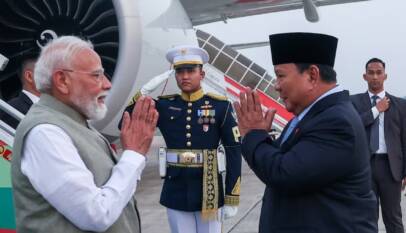
PM Modi Receives Grand Welcome in Jakarta as Indonesia Visit Begins with Special Honours
Jakarta, July 2026: Prime Minister Narendra Modi arrived in Jakarta on Monday afternoon on …