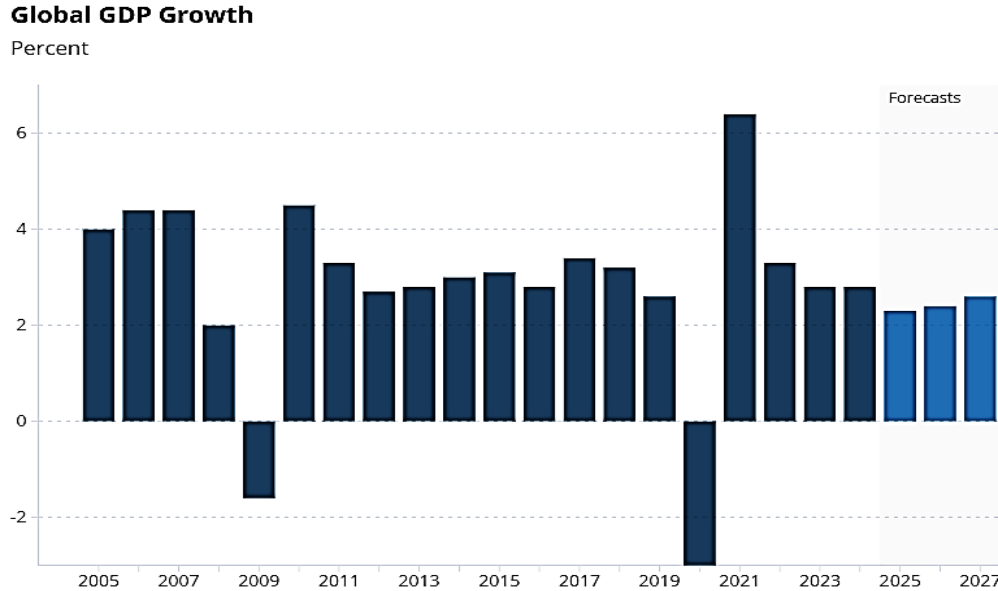
World Bank forecasts a Global GDP of 2.5% – 3.0% for the period 2025 – 2027.

Only six months ago, a “soft landing” appeared to be in sight: the global economy was stabilising after an extraordinary string of calamities both natural and man-made over the past few years. However, that moment has passed. The world economy today is once more running into turbulence. Without a swift course correction, the harm to living standards could be deep.
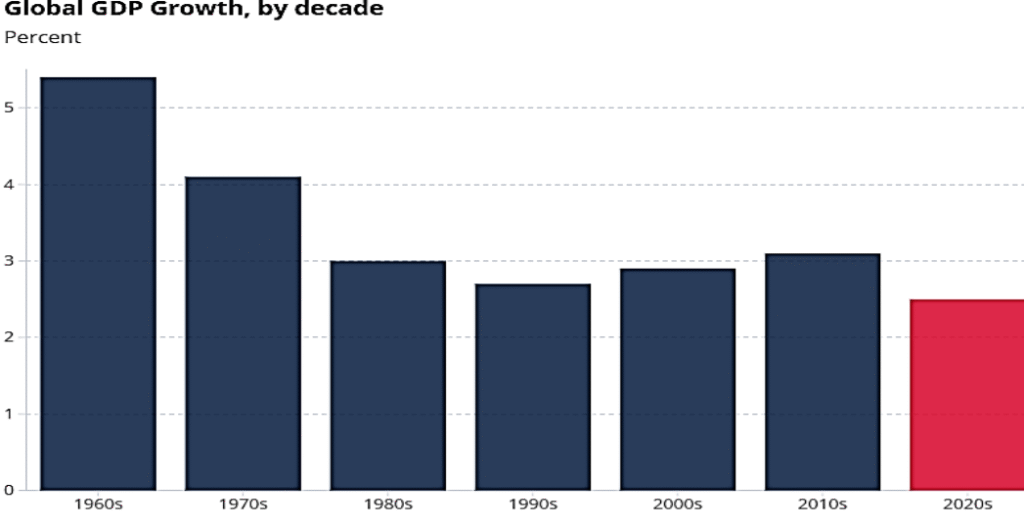
International discord, about trade, in particular, has upended many of the policy certainties that helped shrink extreme poverty and expand prosperity after the end of World War II. This year alone, World Bank’s (WB) forecasts indicate the upheaval will slice nearly half a percentage point off the global gross domestic product (GDP) growth rate that had been expected at the start of the year, cutting it to 2.3%. That’s the weakest performance in 17 years, outside of outright global recessions. By 2027, global GDP growth is expected to average just 2.5% which is the slowest pace of any decade since the 1960s.
This grim predicament did not arrive by stealth. It has been advertising itself for at least a decade. Growth in developing economies has now been ratcheting downward for three decades in a row, from an average of 5.9 percent in the 2000s to 5.1 percent in the 2010s to 3.7 percent in the 2020s. That happens to track the declining trajectory of growth in global trade, which has fallen from an average of 5.1 percent in the 2000s to 4.6 percent in the 2010s to 2.6 percent in the 2020s. Investment, meanwhile, has been growing at a progressively weaker pace. But debt is piling up.
Most developing economies today tend to have far higher tariffs than high-income economies. If their goal is to accelerate growth, their best course of action will be to lower tariffs with respect to all trading partners. Converting preferential trade agreements, mainly involving tariffs, into “deep trade agreements” that span the full range of cross-border regulatory policies could also juice GDP growth. Developing economies also have a crucial role to play in restoring a fully functional, rules-based trade system, specifically through the World Trade Organisation. Predictability cuts trade costs, which in turn boosts GDP growth.
The Global GDP growth is exceptionally feeble, not only from year-to-year but also decade-to-decade.
Global GDP Growth Year wise:






Google AI Data Center Project Launched in Visakhapatnam, Set to Transform Andhra Pradesh’s Tech Landscape
Visakhapatnam, April 2026 : In a landmark development for Andhra Pradesh’s digital future,…

Google AI Data Center Project Launched in Visakhapatnam, Set to Transform Andhra Pradesh’s Tech Landscape
Visakhapatnam, April 2026 : In a landmark development for Andhra Pradesh’s digital future, the …