Sushila Karki Sworn In as Nepal’s First Woman Prime Minister Amid Political Upheaval

Former Chief Justice Sushila Karki has been sworn in as Nepal’s prime minister, becoming the country’s first woman to hold the post. Her appointment follows days of deadly anti-corruption protests that toppled the previous government, leaving at least 51 people dead and plunging the Himalayan nation into crisis. Backed by a youth-led protest movement and endorsed by the president and army chief, Karki will lead an interim government tasked with holding parliamentary elections within six months.
Kathmandu, Sept 2025 — Nepal’s political landscape shifted dramatically this week as Sushila Karki, the country’s former chief justice and a trailblazing figure in its judiciary, was sworn in as prime minister on Thursday. Her appointment comes at a moment of national turmoil, following violent anti-corruption protests that forced Prime Minister KP Sharma Oli from office and left more than 50 people dead in the worst unrest since the abolition of the monarchy in 2008.
Karki, 73, took the oath of office at a brief ceremony in the presidential palace, presided over by President Ram Chandra Paudel and attended by diplomats, senior officials, and a few former leaders. Dressed in a red sari, she recited the traditional pledge: “I, Sushila Karki, take an oath in the name of the country and the people to fulfill my duty as the prime minister.”
President Paudel congratulated her warmly, saying: “Congratulations! We wish you success, wish the country success.” Karki bowed repeatedly, palms pressed together in the traditional greeting, but refrained from making a speech, reflecting the solemnity of the moment.
A Country in Crisis
Nepal, a Himalayan nation of 30 million, was thrown into chaos earlier in the week when security forces attempted to crush rallies led by young activists protesting against corruption and government mismanagement. The unrest spiraled into violence that saw parliament, government buildings, and even a five-star hotel set ablaze.
By Monday, at least 51 people had been killed, including 21 protesters, as police opened fire on crowds. On Tuesday, demonstrators stormed jails, leading to the escape of more than 12,500 inmates. According to police spokesperson Binod Ghimire, most of them remain at large. Armed mobs looted weapons, with the army later recovering more than 100 rifles that had been seized by protesters.
The scale of the violence forced Prime Minister KP Sharma Oli to resign abruptly. His whereabouts remain unknown. In the vacuum that followed, the military stepped in to restore order, imposing a strict curfew and clearing the streets of demonstrators by Wednesday.
The Rise of a Reluctant Leader
Into this tense environment stepped Sushila Karki, a figure respected for her independence and integrity. Known as Nepal’s first woman chief justice (2016–2017), she built her career by challenging corruption and standing firm against political pressure.
Her selection as interim leader was far from ordinary. With the country on edge, army chief General Ashok Raj Sigdel and President Paudel initiated two days of frantic negotiations with political representatives and members of the youth-led protest movement known collectively as “Gen Z.”
Gen Z activists, who had coordinated protests through the online platform Discord, surprised many by rallying around Karki. Thousands voted in digital forums to endorse her as their candidate for prime minister. For many young Nepalese, she represented both a break with the corrupt establishment and a trustworthy figure capable of steering the country toward elections.
“It is a moment of victory… finally the power vacuum has ended,” said Amrita Ban, one of the protesters in Kathmandu.
On Instagram, the youth group Hami Nepal declared: “We did it. Honour the lives of those who sacrificed themselves for this moment.”
Mandate for an Interim Government
Officials confirmed that Karki has been appointed to lead an interim administration tasked with conducting parliamentary elections for the House of Representatives within six months. If the timetable holds, Nepalis will return to the polls by March 2026.
The urgency reflects not only political instability but also mounting economic distress. Nearly 20 percent of young people aged 15–24 are unemployed, according to the World Bank, and GDP per capita stands at just $1,447. Protests were triggered in part by a controversial ban on social media, seen by many as an attempt to silence dissent, but they quickly tapped into long-standing frustrations about corruption and governance failures.
A Career Defined by Integrity
Karki’s reputation as a principled figure dates back decades. Born in 1952 in the industrial city of Biratnagar, she studied political science in India before earning her law degree in Kathmandu. She began practicing law in 1979, quickly gaining recognition for taking on difficult cases.
In 2012, as a Supreme Court justice, she helped jail a sitting government minister for corruption — a groundbreaking decision in Nepal’s struggle against graft. Later, as chief justice, she famously resisted political efforts to appoint a police chief she deemed unsuitable. The government attempted to impeach her in retaliation, a move the United Nations condemned as “politically motivated.” She survived the challenge and retired in 2017 with her reputation intact.
Her tenure also saw a landmark ruling in 2017, when three soldiers were sentenced to 20 years in prison for the wartime killing of a teenage girl — one of the rare convictions for atrocities committed during Nepal’s decade-long Maoist insurgency (1996–2006).
“Her integrity has never been in doubt, and she is not someone who can be intimidated or easily influenced,” said Anil Kumar Sinha, a former Supreme Court colleague. “She is courageous and not swayed by pressure.”
Symbol of Change
For many in Nepal, Karki embodies both continuity and transformation. She is the country’s first female prime minister, a milestone in a society where women long faced barriers in law, politics, and public life. Yet she follows in the footsteps of Bidya Devi Bhandari, who served as Nepal’s ceremonial president from 2015 to 2023.
In past speeches, Karki has called openly for youth leadership in politics. “We see corruption everywhere but we don’t speak. Now we need the youth to speak up, take the lead, and stand in elections,” she said earlier this year. “What I have seen in the last 35 years does not work. I am 100 percent in favour of youth coming forward.”
Her remarks now resonate powerfully with the young protesters who helped elevate her to Nepal’s highest office.
Challenges Ahead
Despite the celebratory mood among Gen Z activists, Karki faces daunting challenges. Restoring stability, ensuring accountability for the violence, and preparing credible elections in six months will test her political skills and resilience.
Nepal’s fragile democracy has long struggled with instability. Since the abolition of the monarchy in 2008, governments have changed frequently, often paralyzed by factional disputes. The legacy of the Maoist conflict continues to haunt the nation, with many perpetrators of wartime abuses still unpunished.
The international community will also be watching closely. Nepal sits strategically between India and China, both eager to influence its political trajectory. The coming months will determine whether Karki can chart an independent course while stabilizing the domestic scene.


Houthis Claim Drone Shootdown as Red Sea Tensions Continue to Escalate
Sanaa, July 2026 : Yemen’s Houthi movement on Sunday claimed it had shot down a Saud…
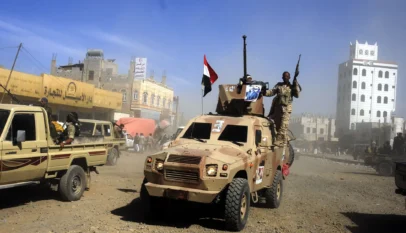
Houthis Claim Drone Shootdown as Red Sea Tensions Continue to Escalate
Sanaa, July 2026 : Yemen’s Houthi movement on Sunday claimed it had shot down …