Cyberattack on Collins Aerospace Disrupts Major European Airports, Causes Delays and Cancellations

London, Sept 2025 : A cyberattack on a key provider of airline check-in and boarding systems triggered widespread disruption across several European airports on Saturday, including London’s Heathrow, the continent’s busiest hub. The incident led to delays, flight cancellations, and long queues as airports scrambled to switch to manual operations.
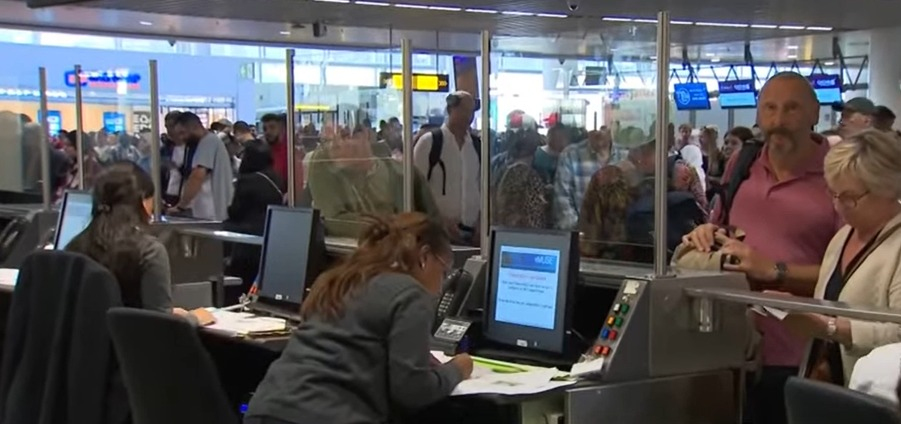
The target of the attack was Collins Aerospace, a global supplier of airport and airline IT systems and a subsidiary of RTX Corporation. Heathrow Airport confirmed it had warned passengers of potential delays as Collins dealt with what it described as a “cyber-related disruption.”
Other major airports, including Brussels and Berlin, also confirmed they were affected. In separate statements, they reported that automated check-in and baggage drop services were offline, forcing airlines to rely on slower manual systems.
“The impact is limited to electronic customer check-in and baggage drop and can be mitigated with manual operations,” RTX said in an emailed statement, adding that engineers were working urgently to restore full service.
Brussels Airport said the incident began late Friday and had a “large impact on the flight schedule.” By Saturday afternoon, 10 flights had been cancelled, and most departing flights were delayed by at least one hour. Passengers were urged to reconfirm travel with their airlines before arriving at the airport.
Berlin Airport issued a similar warning, noting longer waiting times at check-in counters. Frankfurt Airport, Germany’s largest, reported no impact, while Zurich Airport also said it had not been affected.
Airlines sought to reassure passengers. Delta Air Lines said it had implemented a workaround to minimise disruption and expected only minimal delays. EasyJet, one of Europe’s largest low-cost carriers, reported that its flights were operating as scheduled and did not expect further impact. Ryanair and British Airways owner IAG did not immediately respond to requests for comment.
Meanwhile, Poland’s Deputy Prime Minister and Digital Affairs Minister, Krzysztof Gawkowski, confirmed there were no indications of threats to Polish airports. In the UK, Transport Minister Heidi Alexander said she was receiving regular updates on the situation.
While the attack did not directly compromise passenger safety, the forced reliance on manual systems significantly slowed airport operations. Cybersecurity analysts noted that the incident underscores the growing vulnerability of global aviation infrastructure to cyber threats, especially given the sector’s dependence on interconnected digital systems.
Airports and airlines are continuing to monitor the situation closely as Collins Aerospace works to restore normal operations.
Team Maverick.







Bulgaria Wins EUROVISION 2026.
Vienne, Austria; May 2026: In the most surprising finale of the megaevent EUROVISION 2026,…

Bulgaria Wins EUROVISION 2026.
Vienne, Austria; May 2026: In the most surprising finale of the megaevent EUROVISION 2026, …