NASA’s X-59 QueSST Conducts Maiden Flight.

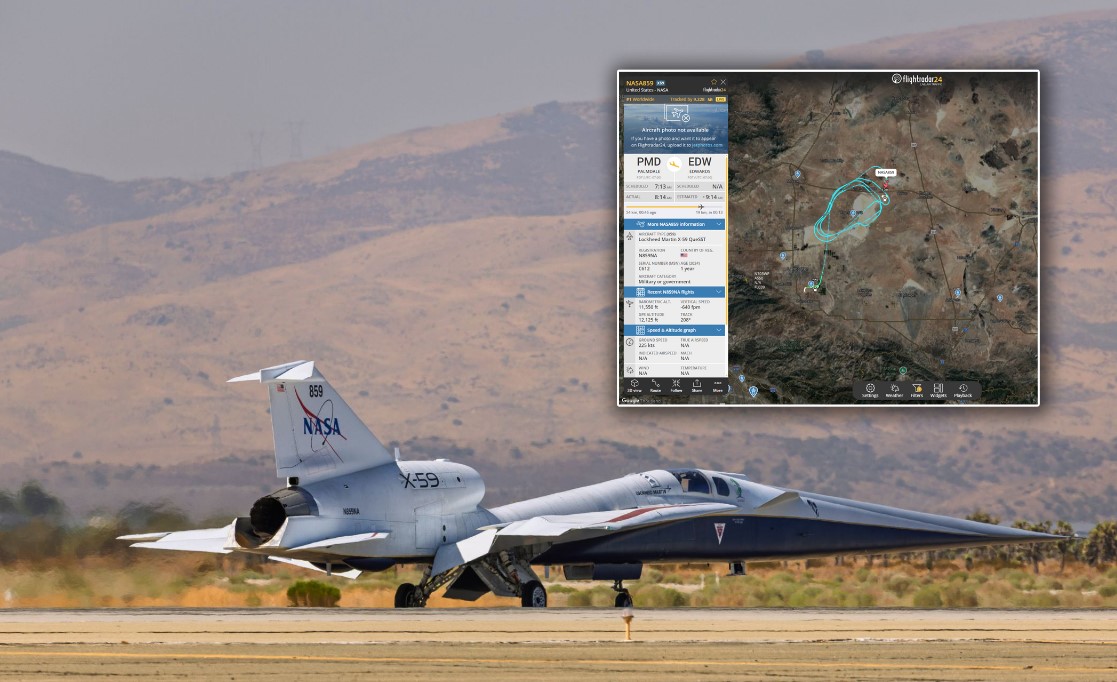
Oct 2025 : After some scrubbed attempts, NASA’s X-59 QueSST flew for the first time from Air Force Plant 42 in Palmdale on October 28th, 2025. In a landmark milestone for aeronautical research, NASA’s experimental X-59 QueSST (Quiet Super Sonic Technology) conducted its maiden flight today. The aircraft, designed and built by Lockheed Martin’s Skunk Works at the Air Force Plant 42 in Palmdale, California, will be used to pave the way for the return of supersonic airliners.
The sortie has been planned to check critical onboard systems, as well as verifying system integration, handling qualities, avionics, instrumentation. The first flight also allows for the new aircraft to move from Palmdale to NASA’s Armstrong Flight Research Center at the nearby Edwards Air Force Base. After take-off, the aircraft rapidly climbed to the top of Flightradar24’s ‘most tracked’ aircraft list with tens of thousands of people following the maiden flight.
This milestone now marks the transition from ground testing to airborne operations in NASA’s push toward quiet supersonic flight. The data gathered from the X-59 flights will help the FAA and beyond the border regulators evaluate potential changes to existing rules, prohibiting civilian supersonic flight over land.
In fact, the FAA is preparing to replace the decades-old ban with new noise-based certification standards. This follows the White House’s executive order in June 2025 which directed the FAA to repeal the ban to allow overland supersonic flights for civilian aircraft.
On October 27th, the QueSST was named as 2025’s ‘Coolest Thing Made in California – since the sleek, futuristic-looking aircraft, which is being built and tested at Lockheed Martin’s famed Skunk Works facility in Palmdale, is designed to reduce the sound of a sonic boom to a gentle thump“, according to a CMTA statement. The development has the potential to remove one of the greatest hurdles to widespread implementation of faster-than-sound travel.
From the outset, the mission was designed to remain comfortably within subsonic boundaries. Rather than chase speed or altitude records, the emphasis was on verifying system integration, handling qualities, avionics, instrumentation, and structural behaviour under real aerodynamic loads.
NASA had already said last month that the first flight would take the form of a lower-altitude loop at about 240 mph (210 knots) and reach around 12,000 feet, with an approximate duration of one hour. The test team is mapping every step from taxi and takeoff to cruising and landing, and, during subsequent test flights, the X-59 will go higher and faster, eventually exceeding the speed of sound.
Throughout the first and the subsequent flights, the X-59’s Flight Test Instrumentation System (FTIS) will collect and transmit audio, video, data from onboard sensors, and avionics information. The pilot and ground team will also monitor engine response, aerodynamic handling, control authority, air data systems, telemetry integrity, and system redundancy. “We record 60 different streams of data with over 20,000 parameters on board”, said Shedrick Bessent, NASA X-59 instrumentation engineer. “Before we even take off, it’s reassuring to know the system has already seen more than 200 days of work”.
Behind the X‑59’s advanced systems is a dedicated team of engineers, technicians, and safety and quality assurance experts. Central to this team is the crew chief, responsible for maintaining the aircraft and ensuring it is fully ready for flight.
“I try to always walk up and shake the crew chief’s hand”, previously said Nils Larson, NASA X‑59 lead test pilot. “Because it’s not your airplane, it’s the crew chief’s airplane, and they’re trusting you with it. You’re just borrowing it for an hour or two, then bringing it back and handing it over”. Meanwhile, NASA has reiterated that for the first flight, Larson would indeed be borrowing the aircraft from Matt Arnold of Lockheed Martin and Juan Salazar from NASA.

The X‑59 is equipped with multiple systems designed specifically to protect the pilot. Its life support system delivers oxygen to compensate for low atmospheric pressure at altitudes around 55,000 ft, while also powering Larson’s G‑Suit. As another safety layer, the aircraft features an ejection seat and canopy adapted from a U.S. Air Force T‑38 trainer, outfitted with essentials such as a first aid kit, radio, and water.
“All these systems form a network of safety, adding confidence to the pilot and engineers as we approach first flight. There’s a lot of trust that goes into flying something new. If the engineers trust the aircraft and I trust them, then I’m all in”, Larson asserted.
What it Achieved –
In NASA’s words, the first flight “kicks off a first phase of flight testing focused on verifying the aircraft’s airworthiness and safety”. Although modest in performance envelope, the first flight is important for several critical validations. Among these are engine behaviour, control surface responsiveness and authority, stability and handling behaviour under predicted aerodynamic loads.
Other important validations will involve the landing, one of the most critical phases of flight. This is especially true as the X-59 has an elongated nose which makes up for a third of the jet’s total length.
The nose is a crucial part of the X-59, designed to control the aerodynamic pressure waves, leading to quieter sonic booms. However, this also reduces the visibility, and the aircraft has been equipped with the Xternal Vision System (XVS), which adds a number of cameras replacing a forward cockpit window.
The path to flight involved several key steps, as we covered previously here at The Aviationist. In January 2024, we reported on the X-59 rollout at Lockheed Martin’s Skunk Works in Palmdale. Later, in November 2024, we covered the engine test milestone, when the X-59’s propulsion system was powered for the first time.
Following rollout and engine testing, the program conducted “low-speed taxi tests” beginning in July 2025, validating steering, braking, and stability on the ground in preparation for flight. Additional ground operations included high-speed taxi until early this month.
On the modelling side, advanced computational approaches were also used to simulate various aspects and systems. Some of these were also tested in live conditions, like the XVS which was tested on NASA’s Beechcraft King Air UC-12B.
Team Maverick







End of an Era: Cristiano Ronaldo Bids Farewell to the FIFA World Cup After a Record-Breaking International Career
Dallas, July 2026 : One of football’s greatest chapters came to a close on Tuesday a…

End of an Era: Cristiano Ronaldo Bids Farewell to the FIFA World Cup After a Record-Breaking International Career
Dallas, July 2026 : One of football’s greatest chapters came to a close on …