How Do Economies Navigate Sustainability Trade-offs?

The Sustainable Trade Index (STI) 2025 reveals a global economy in transition, where traditional pathways to prosperity through trade are being reshaped by mounting pressures across economic, societal, and environmental dimensions. It highlights not only the leaders in sustainable trade but also the diversity of strategies being employed by STI economies. Some prioritise robust infrastructure and open markets, while others focus on strengthening labour protections, addressing income inequality, or investing in environmental safeguards. Through this lens, the Index provides valuable insights into the broad spectrum of approaches and trade-offs that define the quest for sustainable trade.
In this year’s report, we identify three foundational trade-offs that now define the sustainable trade landscape:
1. Efficiency vs. Autonomy: Efficiency is the long cornerstone of global trade. It relies on openness, specialisation, and tightly integrated value chains. However, in a world where geopolitical risks and policy volatility are increasing and shifting constantly, autonomy has gained traction. Economies are reconsidering what they trade, with whom and under what conditions. Such trade-offs can be visualised using STI indicators on trade liberalisation and tariff barriers.
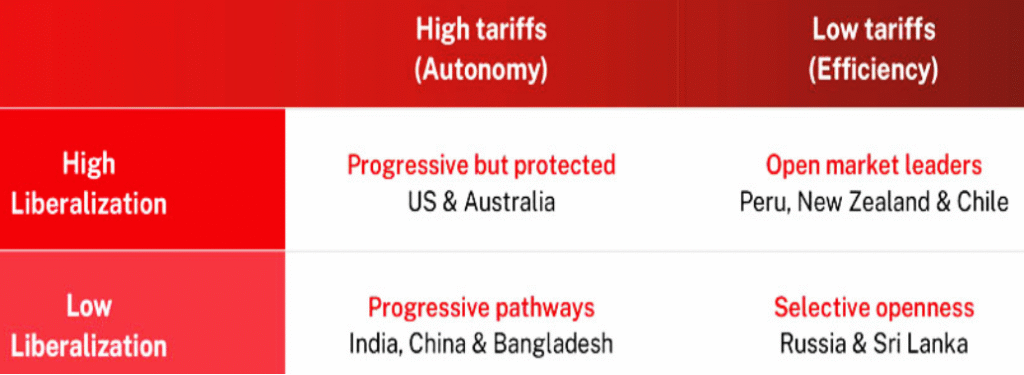
These are four models of strategic trade alignment based on STI indicators on trade liberalisation and tariffs:
Open market leaders (high liberalisation, low tariffs): Economies like Chile, New Zealand, and Peru embrace open trade and global integration with both low tariff barriers and strong institutions.
Progressive but protected (high liberalisation, high tariffs): Economies such as the US and Australia maintain open systems but protect key sectors.
Protectionist pathways (low liberalisation, high tariffs): Nations like Bangladesh, China, and India use trade policy as a tool for industrial development, maintaining control over their pace of integration to support domestic development goals.
Selective openness (low liberalisation, low tariffs): Economies such as Russia and Sri Lanka maintain relatively low formal barriers, such as tariffs, but their overall trade liberalisation remains limited.
2. Short-term profitability vs. Long-term social cohesion: Economic openness without due consideration of social inclusion has created a challenge a one in which trade, increasingly becomes associated with rising inequality, exploitation of vulnerable workers, and political instability. Many economies prioritise rapid economic growth and export competitiveness, often at the expense of social inclusion. This approach can boost GDP but also deepen inequality and erode job security. Some aspire to invest in social foundations to ensure trade benefits are more equitably distributed, accepting slower growth for greater long-term stability. Others remain caught between these priorities, striving to balance profitability with social cohesion amid fiscal and institutional constraints.

These are four models of how economies navigate the trade-off between income and social cohesion using data on GDP growth per capita and social mobility:
Balanced growth (high profitability, high social cohesion): Economies like Singapore and South Korea achieve both high growth and inclusion, though rising inequality remains a risk.
Growth first (high profitability, low social cohesion): Economies such as Bangladesh and India focus on rapid export-led development but often lag in social protections.
Mature developed (low profitability, high social cohesion): Nations like Australia, Japan, and New Zealand prioritise social cohesion with robust safety nets, but face slower growth.
Struggling economies (low profitability, low social cohesion): Economies such as Ecuador, Mexico, and Pakistan struggle with both low growth and limited inclusion.
3. Climate ambition vs. Development sovereignty: The Paris Agreement marked a pivotal moment in the global approach to sustainable trade, but by 2025, the strategies adopted by nations have become more polarised than unified. Advanced economies are shifting from aspirational climate targets to enforceable regulations, implementing instruments such as sustainable sourcing requirements and rigorous environmental due diligence laws. However, for many emerging and developing economies, these regulatory shifts are often perceived as forms of “green protectionism”. This growing divide underscores the ongoing tension between climate ambition and development sovereignty, highlighting the need for more inclusive frameworks that recognise diverse national priorities while collectively advancing sustainability goals.
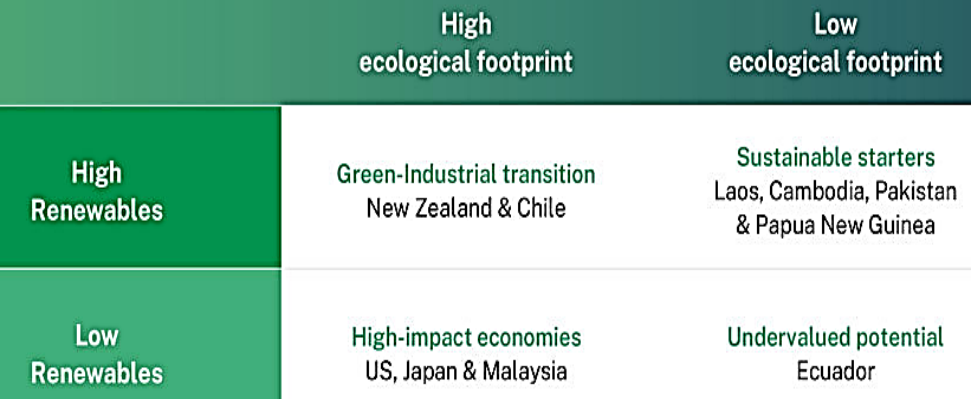
These are four models of how economies manage climate and development needs, illustrated using indicators on ecological footprint and renewable energy adoption:
Green-industrial transition (high renewables, high ecological footprint): Economies like New Zealand and Chile are integrating the use of renewable energy to manage the moderate to high ecological impacts of their advanced consumption patterns and trade exposure.
Sustainable starters (high renewables, low ecological footprint): Laos, Cambodia, Papua New Guinea, and Pakistan maintain low ecological footprints and high renewable energy use, mostly due to limited industrial development and lower economic complexity.
High-impact economies (low renewables, high ecological footprint): Some industrialized economies like Japan, Malaysia, and the US, face high ecological impacts and low renewable energy use, making large-scale decarbonization a key challenge for their green transition without undermining industrial competitiveness.
Undervalued potential (low renewables, low ecological footprint): Ecuador currently has low ecological footprint and limited renewable energy use, reflecting a modest industrial base. This provide considerable opportunity for Ecuador to pursue green growth by integrating renewables into its development strategy.
The STI highlights the structural balances each economy has to navigate between environmental urgency, national development needs, and global competitiveness. This approach uncovers the distinct sets of policy choices each economy at different development stages and institutional capacities make, providing policymakers, businesses, and civil society with a framework to understand the difficult trade-offs of policy decisions and their potential implications for sustainable development in an interconnected world.

Team Maverick








Shivakumar Says Congress United, Assures Women Will Get Cabinet Berth
Bengaluru, Aug 2026 : Karnataka Chief Minister D.K. Shivakumar on Monday sought to dismiss…
Shivakumar Says Congress United, Assures Women Will Get Cabinet Berth
Bengaluru, Aug 2026 : Karnataka Chief Minister D.K. Shivakumar on Monday sought to dismiss …