Canada – India Mineral Partnership.

Both Canada and India have announced plans on 13th November, 2025 to promote long-term partnerships in critical minerals and clean energy as Canada’s trade minister concluded a 03 days visit to India.
They will also explore cooperation in aerospace. The visit came as both countries seek to diversify trade partnerships against the backdrop of U.S. tariffs and as they reset their bilateral relationship.
At the invitation of India’s Minister for Commerce and Industry Mr. Piyush Goyal, the Honourable Canadian Minister of Export Promotion, International Trade and Economic Development, Mr. Maninder Sidhu, undertook an official visit to India from 11th to 14th November 2025.
Pursuant to the direction provided by the Prime Ministers of the two countries during their bilateral meeting on the sidelines of the G7 meeting in Kananaskis, Canada, as well as the Foreign Ministers Joint Statement: “Renewing momentum towards a stronger partnership” of 13th October 2025 which identified trade as the cornerstone of bilateral economic growth and resilience, the two Trade Ministers held the 07th edition of the Ministerial Dialogue on Trade and Investment (MDTI).
The Ministers reaffirmed the strength and continuity of the Indo Canadian economic partnership and reiterated their commitment to deepening bilateral cooperation through sustained dialogue, mutual respect, and forward-looking initiatives.
The Ministers noted robust growth in bilateral trade in goods and services which reached US$ 23.66 billion in 2024, with merchandise trade valued at nearly US$ 8.98 billion, a substantial 10% increase over the previous year. The Ministers reaffirmed the strength and resilience of the bilateral economic partnership and emphasised the importance of continued engagement with the private sector to unlock new opportunities for trade and investment.
They welcomed the steady expansion of two-way investment flows, including notable Canadian institutional investment in India and the growing presence of Indian firms in Canada, which together support tens of thousands of jobs in both economies. The Ministers committed to maintain an open, transparent, and predictable investment environment and to exploring avenues for deeper collaboration across priority and emerging sectors.
The Ministers also noted strong complementarities between India and Canada across strategic sectors driving sustainable growth and innovation and offering new opportunities for trade. Recognising that these areas would require separate domain-level engagement between relevant stakeholders on both sides, the Ministers:
- Agreed to encourage long-term supply chain partnerships in critical minerals and clean energy collaboration essential for energy transition, and new-age industrial expansion.
- Agreed to identify and expand investment and trading opportunities in aerospace and dual-use capabilities partnerships, leveraging Canada’s established presence in India and the growth of India’s aviation sector.
- Recognising the importance of supply chain resilience, the Ministers exchanged views on global developments and reflected on lessons from recent disruptions.
- Underscoring the relevance of strengthening resilience in critical sectors, including agriculture, and highlighted the need for diversified and reliable supply chains as essential for supporting long‑term economic stability.
The Ministers expressed satisfaction with the progress made in strengthening bilateral economic engagement and reaffirmed their shared commitment to elevate the economic partnership in consolidating global developments and evolving supply chain and trade dynamics. They emphasised the importance of maintaining momentum in the bilateral dialogue and supporting people-to-people ties, which provide a strong foundation for the partnership.
The Ministers agreed to sustained ministerial engagements with the trade and investment community in both Canada and India early next year. They agreed to remain in close communication as they consider next steps and concluded by acknowledging the constructive and forward-looking discussions held in New Delhi.
Bilateral Relationship –
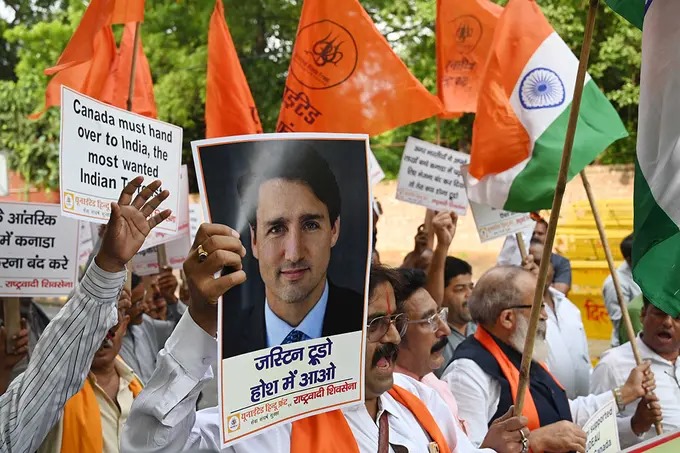
It was on 23rd September, 2023 – relations between the two major economies received a jolt when Canadian Prime Minister Justin Trudeau’s had alleged that the Indian government assassinated a Sikh independence activist, Hardeep Singh Nijjar, on Canadian soil.
The implications of Canada’s allegation remained explosively volatile because:
First, it suggests that today’s Indian government is confident enough in its international standing to take such a momentous step. A democracy assassinating the citizen of another democracy, and on the latter’s own soil, is no small action.
Second, if Prime Minister Trudeau releases credible evidence for his allegations, the assassination will give many of India’s partners pause, even if they do not publicly side with Canada. As a potential justification for the killing, Indians online and in local media have likened their government to that of Israel, another partner country of the West that protects against terrorist threats through political assassinations abroad. But some experts are also drawing comparisons to President Vladimir Putin’s Russia, which would be a much more fraught parallel for India.
Finally, the allegations, particularly if proved true, put the United States in a very tough spot. The United States has spent the last decade strengthening its partnership with India. At the same time, Canada is a North Atlantic Treaty Organization (NATO) ally and a friendly neighbour. Moreover, there is a significant population of Indian-origin citizens, including Sikhs, in the United States. Refraining from taking sides may not be a sustainable long-term policy for the United States Government.
Nijjar was a member of the Khalistan movement; Supported by a minority of Indian Sikhs, the Khalistan movement is a separatist and identity movement that advocates, among other things, for carving out an independent Sikh homeland from the Indian state of Punjab.
While it has historical roots, the movement reached its zenith in the 1970s and 1980s, when militant Sikhs led by preacher Jarnail Singh Bhindranwale took up arms against the Indian government and conducted a campaign of brutal violence that killed thousands of innocent people.
In 1984, the clash between the government and the Khalistanis came to a head when Bhindranwale and his followers infiltrated in the Golden Temple, which is Sikhism’s holiest site in Amritsar, Punjab, and fortified it. They were flushed out by the government in a mission called “Operation Bluestar”, in which the army stormed the temple and killed Bhindranwale and many of his followers.
In retaliation, Prime Minister Indira Gandhi, who had authorised the mission, was assassinated by her own Sikh bodyguards. Her murder led to riots in India, and thousands of Sikhs were killed in and around New Delhi by gangs of vigilantes.
In recent years, the Pakistani government and its Inter-Services Intelligence (ISI) agency have been accused of keeping the movement alive. As the reception in India of Nijjar’s assassination shows, the threat of a revitalised Khalistan movement and the prospect of reigniting interreligious violence has united Indians across the political spectrum in support of the Indian government.
Although it is true, to be hard to recover from this. Canada-India relations have always been fraught on the issue of Khalistan and Sikh Canadians’ support for the movement. India has for years accused Canada of harbouring Sikh terrorists and turning a blind eye to the activities of its Sikh citizens.
In 1985, an Air India flight from Montreal to New Delhi was bombed by Canada-based Sikh terrorists, killing all 329 people, mostly Indian Hindus, on board. After a Canadian investigation, most of the accused were acquitted. Nijjar himself had been wanted under India’s Terrorist Act for his involvement in many cases, including a 2007 movie theatre bombing in Punjab and the 2009 murder of a Sikh Indian politician Rulda Singh.
Despite repeated requests from the Indian government, the Canadian government had not charged him or handed him over, and critics have argued that it has not cracked down adequately on his financing networks. The Indian government has also been concerned about threats made against Indian diplomats in Canada and the lack of official action against those who made the threats. The Indian government has particularly accused Trudeau of needing the support of a Sikh political base in Canada, which is eventually home to the largest population of Sikhs outside of India, and therefore being soft on Sikh terrorism.
Team Maverick





Jesus Backs Cristiano Ronaldo, Takes Charge as Portugal Coach Until 2030
Lisbon, July 2026 : Newly appointed Portugal head coach Jorge Jesus has thrown his full su…

Jesus Backs Cristiano Ronaldo, Takes Charge as Portugal Coach Until 2030
Lisbon, July 2026 : Newly appointed Portugal head coach Jorge Jesus has thrown his …