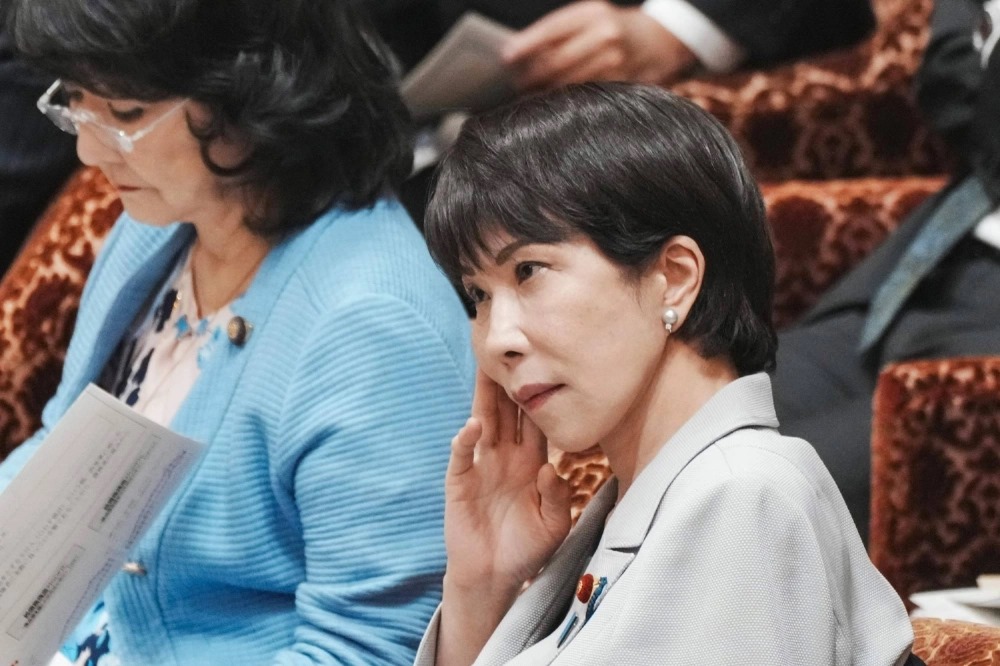
Japan’s Takaichi Ma’am Maimed amidst Financial Turmoil.

The “Sell Japan” sentiment took a day off on Friday – 21st November 2025, as the top finance official, Finance Minister Satsuki Katayama warned of currency intervention against a rapidly sliding yen, and as a massive economic stimulus package came in within expectations and below the worst-case scenario. “The government will take appropriate action when necessary to address excessive volatility or disorderly movements in the foreign exchange market, including speculative activity”, Finance Minister Satsuki Katayama told reporters on Friday.
A massive ¥21.3 trillion ($136 billion) stimulus package was approved by the Cabinet of Prime Minister Sanae Takaichi on the same day. It’s the largest stimulus package since the pandemic, although it’s smaller than it might have been, with some legislators earlier pushing for ¥25 trillion of support. The ¥21.3 trillion ($136 billion) package approved by the Cabinet includes ¥17.7 trillion of spending, ¥2.7 trillion in tax breaks and ¥900 billion in special account spending, Kazuaki Nagata reports.
Being the first economic package under the Takaichi administration, championing “responsible and proactive fiscal policy” to fight inflation and increase investment in critical industries and technologies. “Although the Takaichi administration is calling it ‘responsible expansionary fiscal policy’, it seems that the market only perceives it as simply ‘expansionary fiscal policy’”, cited Noriatsu Tanji, Chief Bond Strategist at Mizuho Securities.
The economic package is also expected to include initiatives to facilitate investment in a number of key industries and technologies, such as artificial intelligence, semiconductors and shipbuilding. At the same time, the Yen has been falling in recent weeks. It is trading at about ¥157 to the dollar, in comparison to ¥148 in early October. Japan’s 10-year government bond yield has been rising partly due to concerns over possible increases in debt issuance. On Thursday, it rose to the 1.8% level for the first time since 2008.
Aimed at fighting inflation and increasing investment in critical industries, the package includes a plan to give ¥20,000 per child to households and the scrapping of a gasoline surcharge. By highlighting the ¥20,000 addition, the LDP apparently hopes to gain support from opposition parties for a supplementary budget to finance the economic package. The call for an addition to child support allowances is meant for single-parent households. Meanwhile, the main opposition Constitutional Democratic Party of Japan has submitted its proposals, including providing ¥20,000 per child, to Chief Cabinet Secretary Minoru Kihara.
On Wednesday, Kobayashi also met with his counterpart from the Democratic Party for the People, Makoto Hamaguchi, who reiterated the DPP’s request to raise the minimum taxable income level to ¥1.78 million. The two agreed to hold working-level talks on this matter this week. Hamaguchi also requested the continuation of subsidies to curb oil prices after the gasoline tax surcharge is abolished.
Meanwhile, what is apparent is the fact that markets have lost their enthusiasm for new Prime Minister Sanae Takaichi recently, with about $127 billion wiped off the value of Tokyo-listed stocks last week and sharp declines in the yen and government bonds. Tech stocks were also hit hard Friday as fears over an AI bubble weighed on the market. While consumers have reason to cheer her for embarking on the biggest round of extra spending since the pandemic, investors are worried that Japan may be spending beyond its means. They are also expressing concerns that the Bank of Japan looks less likely to increase interest rates soon to tamp down inflation.
Some large asset managers have begun targeting weaknesses in in Japan’s debt market, and the yen has continued to languish, making it the worst-performing major currency against the dollar since Takaichi won the leadership of the Liberal Democratic Party in early October. The yen has lost over 5% of its value against the dollar since Takaichi was elected President of the ruling Liberal Democratic Party, and currently sits around ¥157 to the greenback, raising talk that the Finance Ministry might step in, perhaps sooner than many expect, a member of the government’s economic growth panel suggested Sunday.
While consumers may cheer the biggest round of extra spending since the pandemic, investors are worried that Japan may be spending beyond its means. Some are even raising the specter of an unruly capital flight reminiscent of the turmoil that nearly broke the U.K. bond market in 2022.
Sanae Takaichi’s spending plans have sent Japan’s bonds and currency tumbling, raising the specter of an unruly capital flight reminiscent of the turmoil that nearly broke the U.K. bond market in 2022, according to Deutsche Bank’s global head of currency research.
Japanese government bonds are falling at the same time as the yen, reflecting concerns that the new prime minister’s stimulus plans, amid a dovish stance by the Bank of Japan, will worsen the country’s fiscal health. That’s worrying George Saravelos, who compared the correlated market moves with the 2022 U.K. crisis. At the time, the pound slumped to a 37 years low and the gilts market nearly collapsed after then Prime Minister Liz Truss’s unfunded tax-cut plans spooked investors.
Team Maverick






Hockey Junior Men’s Nationals: Rajasthan, Telangana, Puducherry Shine in Coimbatore
Coimbatore, July 2026 : Hockey Rajasthan, Telangana Hockey and Le Puducherry Hockey regist…

Hockey Junior Men’s Nationals: Rajasthan, Telangana, Puducherry Shine in Coimbatore
Coimbatore, July 2026 : Hockey Rajasthan, Telangana Hockey and Le Puducherry Hockey registered impressive …