Libya Cracks Down On Illegal Bitcoin Mining Amid Rapid Sector Growth.

Tripoli; December 2025: Libyan authorities have intensified their crackdown on cryptocurrency mining amid a booming yet legally ambiguous sector that has made the country a regional leader.
In November 2025, prosecutors charged nine individuals operating Bitcoin mining equipment inside a steel factory in Zliten, sentencing them to three years in prison and ordering the confiscation of their machinery and the return of illegally generated profits. However, the Zliten bust was not an isolated incident.
In April 2024, authorities in Benghazi confiscated more than 1,000 mining devices reportedly generating $45,000 per month. A year earlier, security forces arrested 50 Chinese nationals and seized an estimated 100,000 devices in one of the largest cryptocurrency raids on the continent.
Despite a 2018 Central Bank of Libya ban on cryptocurrency transactions over concerns of money laundering and terrorism financing, the operations persist. Libya has even emerged as the top Arab and African nation in Bitcoin mining, a rise attributed largely to low electricity costs.
In 2021, the war-torn North African nation accounted for approximately 0.6% of the global Bitcoin hash rate, surpassing several European nations. Experts say that because electricity costs as low as $0.004 per kilowatt-hour, Libya is one of the cheapest places on earth to mine digital currency.
According to Nadia Mohammed, a Tripoli-based legal expert, most mining endeavours are hidden in fortified compounds, their heat signatures masked by concrete, while operators bet that cheap electricity and institutional chaos will keep them one step ahead of authorities.
Currently it is 07 years following the Central Bank’s 2018 ban, no comprehensive legislation has followed, leaving operators, prosecutors, and ordinary citizens navigating a legal labyrinth.
“Libyan law has not explicitly criminalised mining“, Nadia Mohammed informed the Press Reporters. “The counter-terrorism law and the cybercrime law address some of these issues indirectly, but mining itself is not an inherently criminal act. The distinction matters“, Nadia said, adding that what usually lands miners in court is not the act of generating cryptocurrency but the constellation of offences that often accompany it, such as “illegal electricity consumption, importing banned equipment, or deploying proceeds for illicit purposes such as money laundering. The Central Bank should be issuing permits and authorisations to regulate this activity, not leaving it in a vacuum“, she added.
A 2022 decree from the Ministry of Economy banned the importation of mining equipment, yet devices continue to flood the market. Courts have handed down prison sentences, yet new operations have started bolstering in a sharp contrast in what the authorities could have disband.
The cybercrime law defines cryptocurrency as “a monetary value stored on an electronic medium, paid in advance, not linked to a bank account, and widely accepted by parties other than the issuer”, a definition that acknowledges digital currency’s existence, without determining whether mining it is legal or not.
Ayoub al-Awjali, an economic researcher, argued that the legal ambiguity reflects a deeper failure of governance. “The problem is that mining operates entirely outside the state’s framework. Before we even discuss regulation, we must ask, is this activity happening within the state’s purview or beyond it? Right now, it is beyond it, and that affects everything from energy policy to national security“.
Libyan Prime Minister Abdul Hamid Dbeibah has previously stated that illegal cryptocurrency mining wastes between 1,000 and 1,500 megawatts of electricity per operation, enough to power hundreds of thousands of homes in a country where blackouts are a daily reality.
On the other side, Mohammed al-Fawzi, director of the transfers department at the General Electricity Company of Libya, said mining operations consume upwards of 2,000 megawatts per transaction, a staggering draw on infrastructure already buckling under the weight of illegal connections, theft, and years of neglect.
“The electricity company suffers from significant instability because of illegal connections to shops, homes, and markets. Add to that the theft of power lines and pylons by individuals and organised gangs. All of this has affected the network’s capacity“.
According to estimates, cryptocurrency mining consumed roughly 02% of Libya’s national electricity output, approximately 0.855 terawatt-hours annually, energy diverted from hospitals, schools, and the daily lives of ordinary Libyans. “The spread of digital currency mining in Libya is a direct result of cheap electricity and the deteriorating security situation across most regions“, he added.
For some, the question is not whether to ban cryptocurrency mining, but how to bring it into the fold.
Al-Awjali pointed to Decree 333 from the Ministry of Economy prohibiting mining equipment imports as evidence that the state recognises the activity’s significance, but argued that prohibition alone is insufficient.
“The state must regulate these operations and pass legislation that governs them directly. This could become a source of national income, especially since it represents one of the most important modern technologies that could help develop the economy and employ young people“.
Saleh Jadoula, director of systems at Unity Bank, described cryptocurrency mining as an inherently dangerous activity in the Libyan context. “There is no clear legal framework governing this process, and it is entangled with suspicions of money laundering and terrorism financing“, he said.
An estimated 54,000 Libyans, or 1.3% of the population, owned cryptocurrency as of 2022, a figure analysts believe has grown substantially given 88% internet penetration by early 2024.
Jadoula called for the Central Bank to issue even stricter legislation and regulations governing both mining and trading. “The demand in Libya for digital currencies is active and growing rapidly. It needs urgent regulation, particularly because it is concentrated among young people and attracts them disproportionately“.
Team Maverick.







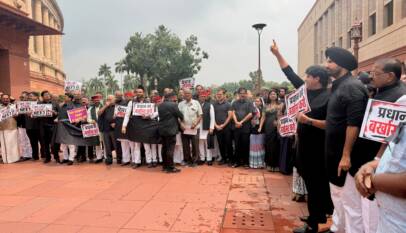
Opposition MPs Wear Black in Parliament, Intensify Protest Over Police Action on Student Demonstrators
New Delhi, July 2026 : A day after dramatic protests outside Prime Minister Narendra Modi’…
Opposition MPs Wear Black in Parliament, Intensify Protest Over Police Action on Student Demonstrators
New Delhi, July 2026 : A day after dramatic protests outside Prime Minister Narendra …