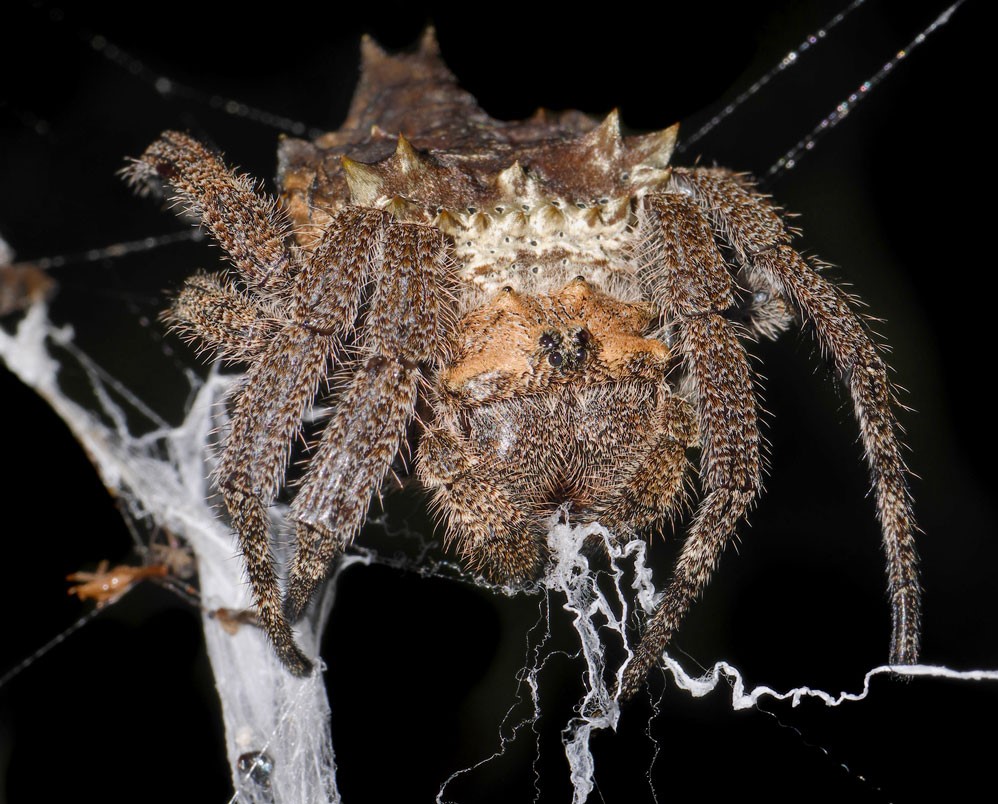
The Strongest Spiderweb On Earth Is Spun Only By Females.

December 2025: Bark spiders are some of nature’s best engineers. They spin webs that stretch across entire rivers in Madagascar; their silk is stronger than steel, and the toughest on Earth. But only females craft the mightiest webs, according to a new study.
Researchers have posed three hypotheses:
- H1, constrained silk production hypothesis;
- H2, sexually decoupled silk production hypothesis;
- H3, body size selection pressure hypothesis;
The three hypothesis were then tested by investigating the mechanical properties of MA silk among size classes and sexes in two Caerostris species from Madagascar, C. darwini Kuntner & Agnarsson, 2010 and C. kuntneri Gregorič & Yu, 2025. It was found that only large females produce exceptionally tough silk with higher initial stiffness, while juvenile females and all males produce inferior silks. These results imply ontogenetic plasticity in Caerostris silk production and support the third hypothesis. And, in some cases, the female spiders’ silk was more than twice as strong as that of their male counterparts, the team found.
This biological marvel stems from the trait that adult females are more than three times the size of males on average. Whereas spiderlings and males can live on small insects such as beetles and moths, the substantial stature of females requires bigger, stronger webs to capture larger prey such as dragonflies.
Spider silks vary in amino acid composition among species due to differences in both gene sequence and expression. Thus, metabolic costs to synthesize silks may vary due to differences in the costs of synthesizing different amino acids. However, the proline rich silks produced by orb-weaving spiders are also among the toughest silks. Because larger insect prey present disproportionally higher kinetic energy (Dudley 2002), which should challenge web performance, it is therefore possible that evolutionary transitions to larger body sizes in web-building spiders result in selection pressure to either evolve tougher, but also costlier, MA silk, or specialize on lower-energy prey. While there is considerable variability in MA silk toughness across species, interspecific shifts to tougher MA silk are documented as body size increases among different species of spiders.
Through ontogeny, individual spiders increase several hundred times in body mass, while adjusting their web size and architecture accordingly (Eberhard 2020). Importantly, spiderlings prey on smaller insects that are predicted to challenge silk performance less than larger adult spiders that face selection pressures to capture large, fast-flying prey. Moreover, some orb-weaving species, including those in the genus Caerostris, exhibit extreme sexual size dimorphism, with adult females 10–100× heavier than males. This suggests differences between the sexes in silk performance because adult males do not face the same selection pressures as giant females.
Spider silk has been used in many different applications, including tissue engineering. In ancient times, spider silk was used to stop bleeding, where it served as an astringent. The first clinical use of spider silk was in the 18th century, when it was used for suturing, whereas nowadays the application of silk as a biomaterial has been widely studied due to its excellent biocompatibility, high toughness, and ability to support tissue growth, especially for bone and ligament tissues.
On the contrary, Silk is one of the toughest natural materials and its fibres exhibit high strain at failure and very high mechanical strength. Since its natural collection is limited, fabrication of the recombinant spider silk protein has begun. Consequently, this technology has enabled modern biomedical applications. All its excellent properties (very good mechanical characteristics, excellent biocompatibility, low density, and biodegradation) have shown high potential in tissue engineering. The major clinical application of silk is in silk sutures, with a rather limited number of clinical uses in other medical applications, such as in cosmetics, wound dressing, breast reconstruction, and the treatment of gynaecological conditions.
For musculoskeletal tissue regeneration (bone and cartilage tissue engineering), silk-based biomaterials offer a unique combination of properties and possibilities of molecular-level modifications and tailoring to the specific tissue scaffold. Damage to the cartilage or degenerative conditions have influenced millions of patients, and in many cases joint replacements are the only possible treatments. However, these traditional treatments do not regenerate cartilage, just relieve patients of pain, unlike novel biomaterials with silk fibroin that can mimic the tissue structure and promote cartilage regeneration and new tissue growth. Ligament tissue regeneration is complex and still under research, whereas silk-based materials show great promise.
Structure and Properties of Spider Silk –
Spidroin proteins, composed of an N-terminal domain, repeated motifs, and a C-terminal domain, determine the hierarchical structure of spider silk. Although Spidroin I and II are believed to be the main silk proteins [42], the identification of more than 20 silk genes suggests that the number of Spidroin in silk glands is higher than anticipated.
The primary amino acids in spider silk are glycine, alanine, and serine. The method of forced spinning has revealed that the microstructure and tensile behaviour of spider silk fibres are influenced by the silking force exerted on the dope. Furthermore, the strength of spider silk is highly dependent on the size and orientation of the nanocrystals. Rheological properties of natural silk are complex and shear thinning governs the behaviour of the fibre during the spinning process. On the other hand, ion electro diffusion governs silk electro gelation, the formation of a gel structure from an aqueous silk fibroin solution with the presence of electricity.
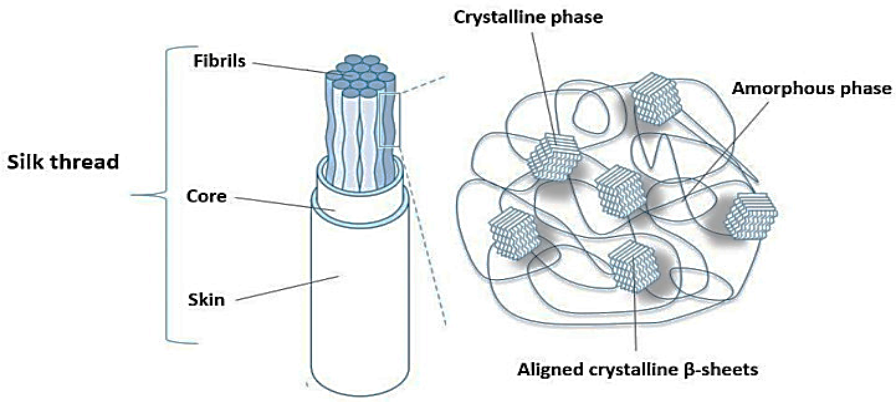
The microstructure of silk fibres is semi-crystalline, as shown in the below-depicted figure, due to the presence of two phases: crystalline and amorphous (non-crystalline), as shown in. The nanocrystalline phase is a result of the specific polypeptide secondary structure. Namely, in places with a high concentration of the amino acid alanine (polyalanine regions), several antiparallel β-sheets will form and group. These sheets are networked in an amorphous phase rich in glycine. Weak hydrogen bonds are responsible for the superiority of this biopolymer in terms of its mechanical properties. SEM and AFM imaging revealed that the silk thread (with a diameter of 4–5 μm) consists of many silk fibres with diameters in a range of 40–80 nm.
Spiders are cold-blooded organisms (poikilotherms) that can spin silk fibres with very high mechanical strength and toughness. The temperature in their environment affects the speed of spinning of the web, and thus its mechanical and structural properties. Likewise, silk varies widely in composition, depending on the specific source (spiders produce silk using seven different types of glands).
Depending on life needs, spiders produce seven silk types, largely due to the various silk glands located at the rear end of the abdomen. These types have different properties depending on whether they serve as a shelter, a means of catching prey, or as a particular thread the spider uses to escape in case of danger. Among them, “dragline” silk has been investigated in the most detail.
Within the Major Ampullate (MA) gland, there are distinguishing four regions:
- The “tail” zone, which is responsible for the synthesis and secretion of spider web proteins;
- Lumen (bag) used for protein accumulation;
- Fibre alignment channel;
- Output for final fibre production.
As proteins travel from the lumen along the channel, they undergo elongation, promoting hydrophobic and hydrogen-bonding interactions. This is followed by the alignment of the proteins in the solution, resulting in stiffer and stronger fibres. Finally, the cobweb, excreted in liquid form, hardens very quickly in contact with air.
Different types of spider silk (fibres) –
Major Ampullate Silk: is produced in the main ampullary glands. These fibres serve to allow escape from predators. Also, they are used for the web’s outer rim and spokes. In this way, the other threads can be attached to them. They have a strength five times greater than steel and three times greater than Kevlar.
Minor Ampullate Silk: is produced in the secondary ampullary glands. It has a role in the spiral formation of the network. Unlike MA fibres, it does not contain proline. Also, it has a reduced content of glutamate.
Flagelliform Silk: Capture-spiral (flagelliform) silk is produced in the flagelliform glands. It is used for catching prey.
Tubiliform Silk: Tubiliform (cylindriform) silk is produced in the tubiliform (cylindriform) glands. It is used for protective egg sacs.
Aciniform Silk: is produced in the aciniform glands. It is a wrapping silk used for the immobilisation of prey.
Pyriform Silk: is produced in the pyriform glands. It functions like a glue, and connects the web to different materials.
Aggregate Silk: is made in the aggregate glands. It produces aqueous gluey substances, making the capture threads sticky.
Team Maverick.







India Ensures Safe Return of Over 3.75 Lakh Citizens Amid West Asia Conflict: PM Modi
New Delhi, March 2026 : Narendra Modi on Monday said that more than 3,75,000 Indians have …

India Ensures Safe Return of Over 3.75 Lakh Citizens Amid West Asia Conflict: PM Modi
New Delhi, March 2026 : Narendra Modi on Monday said that more than 3,75,000 …