In 2024 United States Have Spent 3.4% of its GDP On Defence.

Washington; December 2025: The most common metric for understanding a nation’s investment in defence is funding levels as a percentage of Gross Domestic Product. Using data from the Stockholm International Peace Research Institute (SIPRI), it has been established that the United States spent 3.4% of its GDP on defence in the last fiscal year of 2024, which is a relatively a low amount for the nation. That said, with spending levels at nearly a trillion dollars, the United States invests more in defence than any other nation.
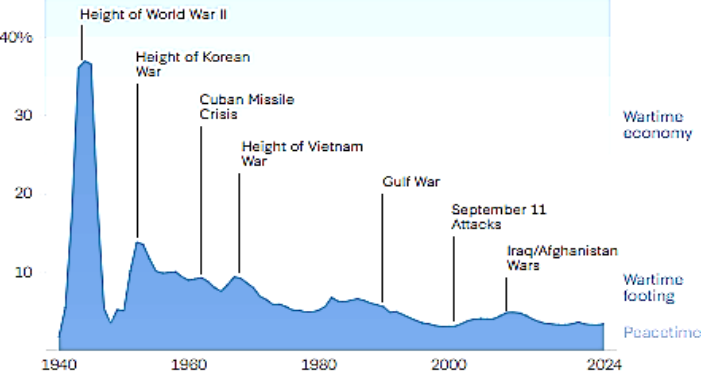
Overlaying a spectrum of economies provides a rough illustration of how levels of spending correlate with what type of economy. World War II very clearly triggered a wartime economy, and the Korean War briefly spiked to very high levels. Throughout the Cold War, the United States was on a wartime footing, highlighting the importance of deterrence against the Soviet threat. Since that time, the United States has spent in a more peacetime fashion, managing the defence industrial enterprise through acquisition programs. The attacks on September 11, 2001, and Operations Enduring Freedom and Iraqi Freedom drove an increase in spending, albeit not at the percentage of GDP as seen during the Cold War.
In his November 2025 speech on acquisition reform at the National Defense University, Secretary Pete Hegseth highlighted the goal of putting the industrial base on a “wartime footing”: “We are not just buying something. We are solving life and death problems for our war fighters. We’re not building for peacetime. We are pivoting the Pentagon and our industrial base to a wartime footing”.
Building off this speech, the Pentagon’s new Acquisition Transformation Strategy calls for the department to “put the entire acquisition system and the industrial base on a wartime footing with the urgency and mandate to accept more risk, transition from a culture of compliance to one of speed and execution, and rapidly tackle the strategic challenges facing the nation“, an agenda also highlighted in the new National Security Strategy. The call to action is clear, but what does wartime footing actually mean, and what implications does this have for the industrial base?
A wartime footing is defined as “the condition of being prepared to undertake or maintain war”, with the goal of being prepared to fight and win a war, or to deter one from starting. This requires some level of government planning, resource allocation, and prioritised military production.
Given that the U.S. industrial base is overwhelmingly comprised of private sector firms, the Department of Defense (DOD) has recently designated the Department of War, further relying on incentives, procurement reforms, investment, and targeted authorities, including tools like long-term contracts, subsidies, workforce training, and Defense Production Act (DPA) powers, rather than coercion or commandeering of industries. By contrast, a wartime economy occurs when the state directly shapes production, labour allocation, and consumption, and where consumer priorities are subordinated to the needs of the state.
A peacetime economy occurs where military spending is at a predictable level to support production and innovation, but where military production is one economic sector among many. And a nonmilitary economy is one where the state dedicates no or very limited resources to the military and to defence production, a situation enjoyed by very few nations.
U.S. Defense Spending as a Percent of GDP, 1940–2024 –
SIPRI reports that:
- Ukraine has dedicated 34% percent of its GDP to defence in 2024, clearly spending at a wartime economy level in its existential fight for survival against Russia.
- Russia’s 2024 defence spending is estimated at 7.1% percent, but exact numbers are difficult to determine and likely substantially higher, and this number may not capture the extensive Chinese support of the Russian industrial base. Russia’s state policies expanding support of defence, including repurposing production lines from civilian products, suggest that they are in a wartime economy as well.
- Israel dedicated 8.8% of its 2024 GDP to defence, with that investment showing the blurred line between a wartime economy and an economy on a wartime footing, since Israeli civilian production is continuing and not all of its economy is geared toward defence production.
- Poland’s 4.2% spending has doubled in the last 10 years as it is building to a wartime footing in response to Russia’s aggression in Ukraine.
Other countries have seen defence spending rise substantially in recent years, but some do not spend on defence at all.
Team Maverick.






Djokovic Outlasts Auger-Aliassime in Record Wimbledon Thriller, Storms into 15th Semi-final
Score: Novak Djokovic bt Felix Auger-Aliassime 7-6(10), 3-6, 6-3, 6-7(4), 7-6(10-4) London…

Djokovic Outlasts Auger-Aliassime in Record Wimbledon Thriller, Storms into 15th Semi-final
Score: Novak Djokovic bt Felix Auger-Aliassime 7-6(10), 3-6, 6-3, 6-7(4), 7-6(10-4) London, July 2026 …