United States Navy And Marine Corps Use New T7 Robots To Defuse Bombs And IED Threats.

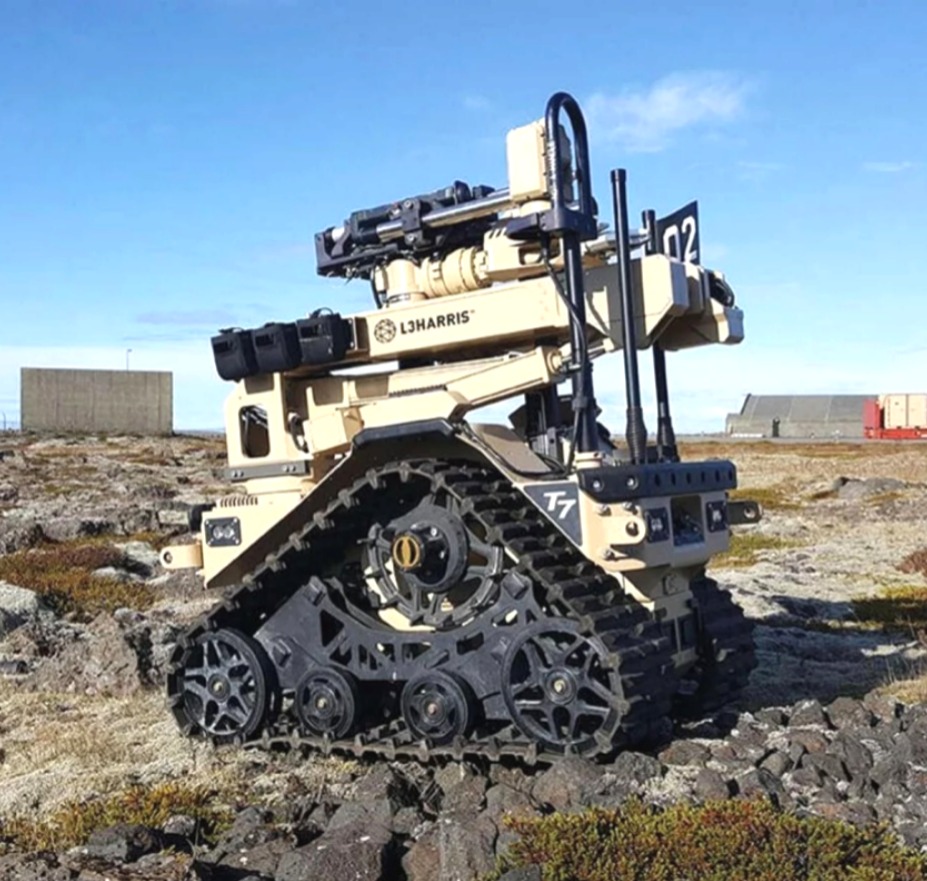
Washington DC; January 2026: U.S. company L3Harris Technologies announced on January 14th, 2026, that the U.S. Navy alongside U.S. Marine Corps have selected 34 large T7 unmanned ground vehicles to enhance explosive ordnance disposal missions, with deliveries beginning in 2026 under a multi-year contract that also includes operator training. For the naval services, the purchase is less about a niche EOD upgrade and more about hardening expeditionary forces against the explosive hazards that increasingly shape access, tempo, and political risk in littoral operations.
The T7 is a heavy, tracked robot built to do the work that used to force technicians into the lethal “last meters”. In its baseline configuration, it weighs about 710 lb and runs for more than 08 hours, depending on the task, powered by 12 BB-2590 batteries. Mobility is designed for real-world clutter rather than test pads: skid-steer tracks, stair climbing, and slope performance beyond 45 degrees, with lateral stability on 30-degree side slopes. That matters in ships’ ladders and brow areas, rubble-strewn ports, bus terminals, and the tight passageways that define both terrorism response and sabotage defence.
Where the Navy and Marines get their tactical payoff is the manipulator and sensing suite. The arm reaches roughly 2.2 m horizontally and about 3.1 m vertically, lifting more than 113 kg near the chassis and over 27 kg at full extension, a key distinction when an operator must precisely place charges, pull a suspect package from a vehicle, or manipulate a heavy disruptor at awkward angles.
L3Harris pairs that reach with force-sensing at the gripper, an integrated non-conductive wire cutter, and support for up to four disruptors including two large types used to defeat IED initiators or neutralise explosive fills from standoff. The camera set is built for “no surprises” work: driving cameras front and rear, four corner cameras, a 30x zoom pan-tilt-zoom mast, plus a zoomable gripper camera and optional mid-arm view for close manipulation inside trunks, under seats, or through windows.
Just as important, the T7 is engineered for contested electromagnetic conditions that EOD teams increasingly assume by default. Its radios are specified for line-of-sight control beyond 1,000 metres, and non-line-of-sight control beyond 300 metres, and the robot is EMI-shielded for use alongside active jammers. That is not a brochure detail. In an environment where remote detonation, commercial triggers, and improvised command links coexist with friendly counter-remote-control jamming, being able to jam aggressively without blinding your own robot changes the risk calculus for commanders deciding whether to halt a convoy, cordon a pier, or keep an airfield open.
So why are the naval services buying now? The simplest answer is that explosive threats are again a strategic problem, not a counterinsurgency footnote. For Marines building small, distributed nodes under Expeditionary Advanced Base Operations, explosive hazards can cripple resupply points, beach exits, and command posts faster than direct fire, while also imposing a political cost if casualties occur early in a crisis. For the Navy’s expeditionary and shore-side missions, IEDs and unexploded ordnance remain the tool of choice for coercion, sabotage, and proxy warfare around ports and chokepoints, precisely where U.S. forces would surge logistics and protection assets. The EABO concept explicitly frames operations in the shadow of adversary range, precision, and capacity advantages, which makes rapid clearance and freedom of manoeuvre in austere sites a prerequisite, not a luxury.
The U.S. already fields capable robots for this mission set, but they have been uneven across services and often optimised for a different era. Marine EOD units have long employed systems such as the PackBot family and the TALON series for inspection and device handling, proving the value of ground robots in deployed environments. Yet those legacy classes trade lifting power, reach, and advanced manipulation for portability, and they were frequently paired with procedures that still left technicians closer to the hazard than today’s force-protection expectations allow.
The Air Force’s experience with T7 helps explain what the Navy and Marines are buying into: an enterprise shift from “robot as accessory” to “robot as primary tool”. In 2021, the Air Force awarded an $85 million, 10 years IDIQ contract for the T7 to replace the long-serving ANDROS F6A, citing modularity that enables rapid subassembly swaps instead of time-consuming part-level repairs, alongside broader capability growth. That sustainment angle matters to naval expeditionary units operating far from depot support, where a down robot can be a mission kill.
With higher lift capacity, longer reach, richer camera coverage, and operator aids like haptic force feedback and manipulation presets, teams can complete more “renders safe” actions remotely, spend less time repositioning for line of sight, and push the technician’s decision point farther from the device. In a future fight where EOD is demanded at multiple dispersed sites simultaneously, the T7’s combination of standoff, robustness, and training-backed commonality with allied users in the U.K. and Australia also signals coalition interoperability as a quiet but deliberate design requirement.
T7 Robotics Snapshot:
| Weight | 710 lbs (322 kg) (with arm and batteries installed) |
| Dimensions (L x W x H) | 47.3 x 27.6 x 45.7 in (120.1 x 70.1 x 116.1 cm) |
| Power | 8+ hour runtime (depending on task); 12 BB-2590 batteries |
| Speed | 4.5 mph (7 kph) |
| Mobility | Skid steer track system; Climbs stairs and slopes over 45°; Traverses lateral slopes over 30° |
| Cameras | 2 driving cameras (front, rear);PTZ mast camera with 30x zoom; Zoomable gripper camera and optional mid-arm camera; 4 fender-mounted corner cameras |
| Radio | LOS range: 3300+ ft (1000+ m); NLOS Range: 1000+ ft (300+ m) |
| Environmental | -4°F to +140°F (-20°C to +60°C) operational; EMI-shielded for use with active jammers; Maximum fording depth: 10 in (25.4 cm); IP56 sealed |
Team Maverick.





Suryavanshi’s 17-Ball Blitz Powers Rajasthan Royals to Dominant Win Over CSK
Guwahati, March 2026 : A sensational knock by Vaibhav Suryavanshi powered the Rajasthan Ro…

Suryavanshi’s 17-Ball Blitz Powers Rajasthan Royals to Dominant Win Over CSK
Guwahati, March 2026 : A sensational knock by Vaibhav Suryavanshi powered the Rajasthan Royals …