Trump Targets NATO Allies at WEF, Questions Burden-Sharing and Ukraine War Costs

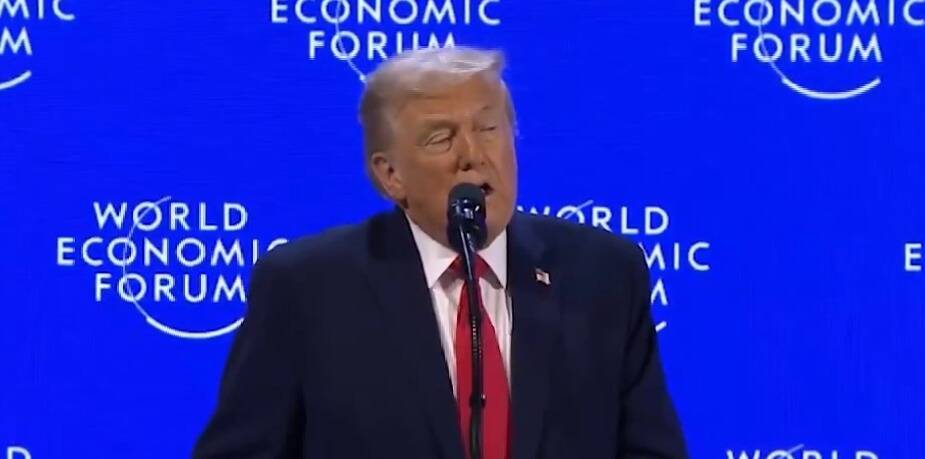
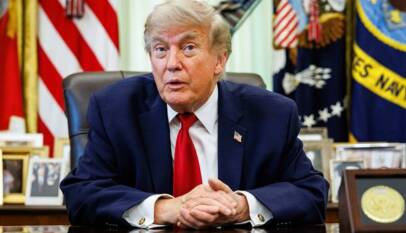
Davos Jan 2026 : US President Donald Trump on Wednesday launched a sharp and wide-ranging critique of America’s traditional allies, European leaders and NATO member states, accusing them of relying excessively on US military power and financial support while failing to shoulder their fair share of responsibility for their own defence. Speaking at the World Economic Forum (WEF) annual meeting in Davos, Trump argued that the imbalance has persisted for decades and has been further exposed by the ongoing war in Ukraine, which he said has placed a disproportionate burden on Washington.
Addressing a gathering of European and global leaders, Trump said the United States has long been treated “very unfairly” by NATO. He contended that while Washington continues to underwrite Europe’s security, many alliance members have consistently fallen short of agreed defence commitments. “We give so much and we get so little in return,” Trump said, reiterating his long-held view that NATO’s structure heavily favours Europe at the expense of American taxpayers.
Trump went on to claim that NATO, in its current form, would not exist without his intervention during his earlier term as president. According to him, years of warnings and pressure forced alliance members to finally take defence spending seriously. “You wouldn’t have NATO if I didn’t get involved,” he said, adding that he compelled member countries to dramatically increase their military budgets after what he described as years of neglect and non-compliance.
He recalled that for a long time, most NATO countries failed to meet even the earlier benchmark of allocating two per cent of their gross domestic product to defence. Trump asserted that his hardline stance fundamentally changed the conversation within the alliance. “They didn’t pay the two, and now they’re paying the five,” he said, suggesting that he pushed allies toward defence spending levels that were once considered politically and economically unrealistic.
Raising questions about mutual commitment within the alliance, Trump openly doubted whether European allies would come to America’s aid if the United States were attacked. “We’ll be there for them 100 per cent,” he said. “I’m not sure that they’d be there for us.” The remark underscored his broader argument that NATO’s principle of collective defence has, in practice, operated largely in one direction.
Turning to the war in Ukraine, Trump said the conflict “should have never started” and blamed it on leadership failures that followed the end of his previous presidency. He argued that the war has imposed enormous financial and strategic costs on the United States while delivering limited tangible benefits to American interests.
Trump claimed that Washington has already spent staggering sums to support Ukraine and bolster NATO’s eastern flank. “Biden had given Ukraine and NATO $350 billion, staggering, some $350 billion,” he said, questioning the rationale behind such levels of spending when the United States is geographically distant from the conflict. “We’re separated by a big, beautiful ocean,” he remarked, contrasting America’s position with Europe’s proximity to the war.
He also expressed frustration over what he described as a lack of appreciation from European partners for America’s contributions. “What does the United States get out of all of this work, all of this money, other than death, destruction and massive amounts of cash going to people who don’t appreciate what we do?” Trump asked, framing the conflict as a costly endeavour with little return for Washington.
Describing the war in stark humanitarian terms, Trump referred to it as a “bloodbath,” citing heavy casualties on both sides. He said tens of thousands of soldiers have been killed month after month, stressing the human cost of continued fighting. “These are souls. These are young people,” he said, arguing that the scale of loss alone should compel world leaders to push harder for an end to the conflict.
Trump said his primary motivation in engaging with the Ukraine issue was to stop the war. “It’s the only reason I’m interested in doing it,” he said, adding that he believed both Russian President Vladimir Putin and Ukrainian President Volodymyr Zelensky were open to negotiations. “I believe I’m dealing with President Putin, and he wants to make a deal. I believe I’m dealing with President Zelensky, and I think he wants to make a deal,” he said, projecting himself as a potential broker of peace.
The US President repeatedly argued that the war in Ukraine benefits Europe far more than the United States. “I’m helping Europe. I’m helping NATO,” he said, while questioning why Washington continues to bear the largest share of the financial and military burden. According to Trump, Europe’s dependence on US support reflects a broader pattern of imbalance in transatlantic relations.
Expanding his criticism, Trump accused European nations of exploiting the United States economically and militarily for decades. He warned that such arrangements would no longer be tolerated under his leadership. “We’re not going to subsidise the whole world,” he said, signalling a more transactional approach to alliances and security commitments.
Recounting private conversations with European leaders, Trump said he had used the threat of punitive tariffs to force compliance on defence and trade issues. “You’re going to do it fast,” he said he told one leader, warning of tariffs of up to 25 per cent or even 100 per cent on exports if demands were not met. He framed such measures as part of a broader national security strategy.
“This is also national security we’re talking about,” Trump said, adding that without US military protection, many countries would face threats they “wouldn’t believe.” He reiterated that America has historically paid for Europe’s safety while receiving little in return, claiming this imbalance only began to shift after he took office.
While reaffirming that the United States would stand by its allies, Trump ended with a warning that American patience is not unlimited. “We’ll be there for them,” he said, “but I don’t know that they’d be there for us.”
Team Maverick.


NCC Holds Cyclothon 2026 to Mark 79th Independence Anniversary
The National Cadet Corps (NCC) organised Cyclothon 2026 on August 02, 2026 in New Delhi to…
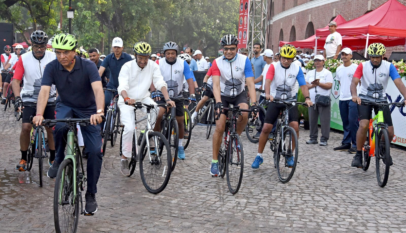
NCC Holds Cyclothon 2026 to Mark 79th Independence Anniversary
The National Cadet Corps (NCC) organised Cyclothon 2026 on August 02, 2026 in New …