United States Issues Guidelines On EBOLA.

Washington DC: May 2026: The Department of State, in close coordination with the Centres for Disease Control and Prevention (CDC) — the lead agency for the U.S. Government response, is continuing to mount a rapid and comprehensive response to the Ebola outbreak in the Democratic Republic of the Congo (DRC) and Uganda. We want to thank our implementing partners on the frontline, who are working closely with our forward deployed personnel, as well as host governments and international partners who are leading the response in their host countries and working closely with us to support an integrated response, implement travel restrictions to stop the spread of the virus, ensure the safety and security of affected Americans.
Protecting Americans –
The Trump Administration has no higher priority than the safety of Americans around the world. The Department of State continues to operate our dedicated, 24/7 consular hotline in order to maintain constant communication with affected Americans by providing real-time security updates and critical health information. Americans who need assistance abroad can reach us at +1-202-501-4444, or 888-407-4747 (from the United States/Canada).
The Department’s consular officers are in direct contact with and working tirelessly to provide support to the small number of Americans who are at high risk, including those who have been potentially exposed to Ebola and who are following CDC guidance.
In close coordination with interagency partners, the Department is monitoring the situation and evaluating all available avenues to assist those with potential exposure. Our priority remains ensuring that affected citizens have access to necessary medical resources and accurate health guidance. The Department is offering transportation to safe locations to Americans affected by the outbreak.
The Department activated a dedicated Ebola Response Task Force, integrating expertise across the Department’s Bureau of Global Health Security and Diplomacy (GHSD), Bureau of Disaster and Humanitarian Response (DHR), Bureau of Consular Affairs (CA), Bureau of Medical Services (MED), the CDC, and additional interagency partners. The Task Force is led by senior experts with direct experience managing prior Ebola outbreaks, including the 2014 and 2018 responses, ensuring immediate operational readiness and proven leadership.
The Department released a Worldwide Caution regarding Public Health Arrival Restrictions and Enhanced Ebola Screening. The caution states that all Americans who were in the Democratic Republic of the Congo (DRC), Uganda, or South Sudan within 21 days of arrival in the United States must enter through designated airports for enhanced screening measures implemented by the Department of Homeland Security (DHS) and the CDC in response to the Ebola outbreak. Travelers should consult the CBP website for the most up to date list of designated airports regarding arrival.
The Department created a dedicated Ebola information page on state.gov where Americans can find the latest consular information regarding the Ebola outbreak: https://travel.state.gov/en/international-travel/travel-advisories/global-events/ebola.html.
Supporting the Regional Response –
The U.S. government continues to move aggressively to contain the Ebola outbreak at its source in order to protect the American people and prevent further international spread. To accomplish these objectives, the Department has committed significant financial assistance, deployed technical experts, and expanded bilateral operations in the impacted regions.
DART Deployment: A Disaster Assistance Response Team (DART) and GHSD experts are on the ground in the DRC and Uganda, providing elite disaster response expertise, technical and programmatic support, operational leadership, and real-time field coordination. This team was mobilized within four days of the first case notification, the fastest-ever DART deployment for a U.S. Ebola response. The DART team is working closely with existing CDC and Department assistance personnel, as well as diplomats in our Embassy, to coordinate with local authorities and partner organizations.
Expanding Bilateral Health & Humanitarian Assistance: The Department has already provided $32 million in bilateral assistance to key existing partners on the ground, including the International Medical Corps (IMC); UNICEF; MedAir; the International Organization for Migration (IOM); the World Food Program (WFP); FHI360; and Samaritan’s Purse. This additional funding is supporting high-impact, life-saving interventions on the ground. These include rigorous border screening, aggressive contact tracing, direct patient care, the execution of safe and dignified burials, and the rapid logistical transport of vital personal protective equipment (PPE). We have already delivered an initial 50 tons of critical medical supplies to affected areas in the DRC, with an additional 100 tons of supplies en route.
Supporting the United Nations & Multi-Lateral Response: Building on our landmark partnership with the United Nations Office for the Coordination of Humanitarian Affairs (OCHA), the Department is leveraging OCHA’s pooled fund vehicles to drive global coordination, rapidly resource the integrated global response, and support holistic humanitarian interventions that will help mitigate the virus’ impacts. As of May 23, 11 projects have already begun operations in Ebola-affected areas with U.S. funding to OCHA.
$50 Million Specialised Emergency Response: As part of our commitment to build the first up to 50 clinics in the affected areas, we will provide $50 million in immediate funding to OCHA’s emergency response fund, which will work with host governments to catalyze their response efforts. This rapid funding will ensure critical time-sensitive projects are funded.
Country Pooled Fund: As part of our broader work with OCHA on flexible, efficient pooled funding for humanitarian project, we have expedited the full obligation and field-deployment of $300 million announced as part of our $1.8 billion for OCHA’s global pooled fund activities last week. This funding will create a flexible war chest to support holistic humanitarian and logistics support for key partners as the response grows and evolves.
Working Closely with Local Governments: Building on our signed America First Global Health Strategy bilateral arrangements with the governments of the DRC and Uganda, we are coordinating closely with local health authorities and leveraging investments made through those arrangements in global health security capacity building and cooperation. We are also reviewing support requests from host government on their costed response plans and anticipate providing significant U.S. support for national response efforts.
Accelerating Diagnostic & Treatment Capabilities: The Department is actively collaborating with American private sector companies and international actors to rapidly scale up diagnostic testing capacities on the ground to enable swift detection and containment. We are also working with American private sector companies to support efforts to test and deploy the most promising existing anti-viral treatments for this rare strain of the Ebola virus.
Team Maverick.







PM Modi Receives Grand Welcome in Jakarta as Indonesia Visit Begins with Special Honours
Jakarta, July 2026: Prime Minister Narendra Modi arrived in Jakarta on Monday afternoon on…
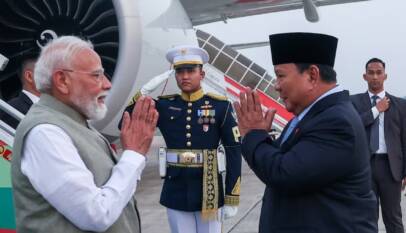
PM Modi Receives Grand Welcome in Jakarta as Indonesia Visit Begins with Special Honours
Jakarta, July 2026: Prime Minister Narendra Modi arrived in Jakarta on Monday afternoon on …