India-US Ties Enter New Strategic Phase as Jaishankar Pushes Critical Minerals Agenda After Trade Breakthrough

Washington, Feb 4: Just days after President Donald Trump and Prime Minister Narendra Modi unveiled a landmark trade agreement, External Affairs Minister S. Jaishankar began a high-profile visit to the United States on February 3, signalling that the India–US economic partnership is moving into a deeper and more strategic phase, with critical minerals emerging as a central pillar of cooperation.
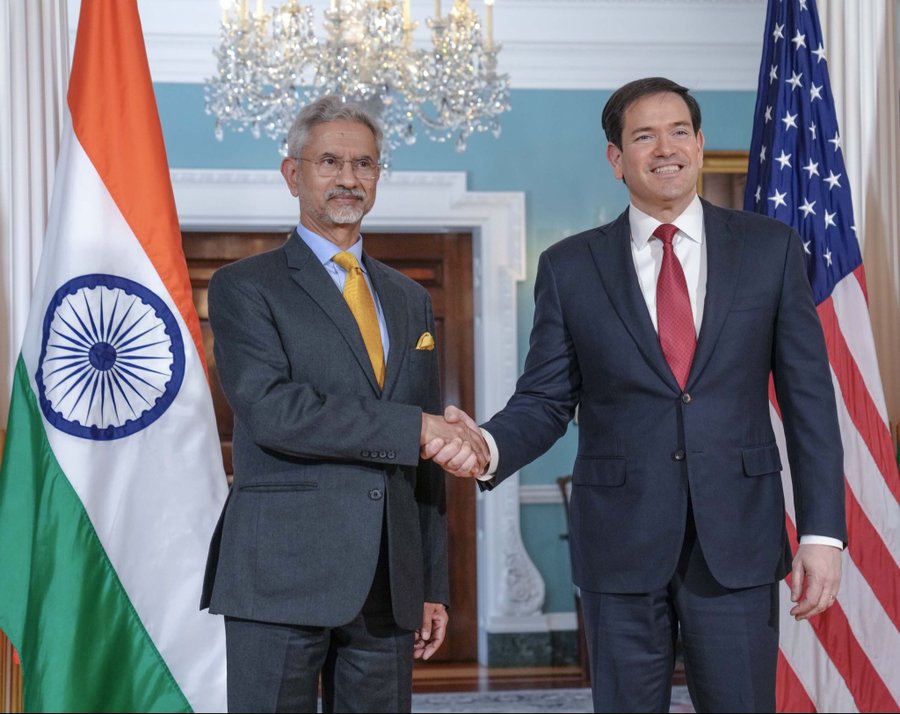
Jaishankar’s three-day visit, from February 2 to 4, featured back-to-back meetings with key members of the Trump administration, including Treasury Secretary Scott Bessent and Secretary of State Marco Rubio. The discussions reflected a shared determination to expand engagement well beyond traditional trade, encompassing energy security, nuclear power, defence collaboration, advanced technology and resilient supply chains.
The timing of the visit was significant. It came just a day after President Trump announced a breakthrough trade deal with India following talks with Prime Minister Modi. Under the agreement, reciprocal tariffs on Indian goods were cut from 25 per cent to 18 per cent with immediate effect. The move has been widely welcomed as a major boost for Indian exporters, particularly in sectors such as manufacturing, pharmaceuticals, renewable energy equipment and clean technology.
Officials in New Delhi and Washington see the agreement as a foundation for broader economic integration. Beyond tariff reductions, the deal is expected to expand market access, ease regulatory barriers and create conditions for stronger industrial cooperation. Jaishankar linked the trade breakthrough to India’s domestic priorities, including job creation, industrial expansion and the government’s flagship “Make in India” initiative.
Jaishankar began his engagements in Washington with a meeting with Treasury Secretary Scott Bessent, which officials described as crucial to translating the political agreement into workable policy. The talks were seen as a key step in finalising the operational details of the trade deal announced earlier in the week.
Posting on X after the meeting, Jaishankar said he had a “useful discussion” on advancing economic partnership and strategic cooperation. According to officials familiar with the talks, the focus was on trade facilitation, market access and regulatory coordination, with an emphasis on ensuring smooth and timely implementation of the new agreement.
Later in the day, Jaishankar met Secretary of State Marco Rubio, with both sides placing strong emphasis on critical minerals and long-term strategic cooperation. In a formal readout issued on February 3, the US State Department said that Rubio and Jaishankar discussed formalising bilateral cooperation on the exploration, mining and processing of critical minerals.
The statement noted that both leaders welcomed the trade deal reached between Trump and Modi and underlined the importance of the world’s two largest democracies working together to unlock new economic opportunities while advancing shared energy security goals. The discussions also reaffirmed a commitment to expanding cooperation through the Quad, with both sides agreeing that a stable and prosperous Indo-Pacific remains central to their shared interests.
Jaishankar said the talks covered a wide spectrum of issues, including bilateral ties as well as regional and global developments. He highlighted multiple pillars of the India–US partnership, ranging from trade and energy to nuclear cooperation, defence, critical minerals and advanced technology. Both sides, he said, agreed on the need for early meetings of institutional mechanisms to accelerate progress on shared priorities.
Rubio, in his own post, said the discussions focused on critical minerals cooperation and “unlocking new economic opportunities,” while welcoming the India–US trade agreement as a significant step forward in bilateral relations.
The growing emphasis on critical minerals reflects deepening strategic concerns in both capitals over heavy global dependence on a limited number of suppliers, particularly China. These minerals are essential for defence manufacturing, advanced electronics, electric vehicles and clean energy transitions, making their supply chains a matter of national security.
The State Department has indicated that Rubio intends to mobilise international partners to strengthen and diversify global supply chains for critical minerals. In this context, the United States is hosting its first-ever Critical Minerals Ministerial in Washington DC on Wednesday, bringing together officials from more than 50 countries to improve coordination and reduce vulnerabilities. Jaishankar is scheduled to participate in the ministerial as part of his visit.
US Interior Secretary Doug Burgum has said that around 30 countries are keen to join a proposed coalition aimed at reducing dependence on China for mineral supplies, with at least 20 more expressing strong interest. India is seen as a key partner in this effort, given its geological potential, growing industrial base and strategic alignment with the US.
Officials on both sides view Jaishankar’s Washington visit as a clear signal that the India–US partnership is broadening beyond traditional trade and defence ties. By pairing a major trade deal with a concerted push on critical minerals, New Delhi and Washington are aligning commercial interests with long-term strategic goals, reinforcing their partnership as both an economic and geopolitical anchor in the Indo-Pacific.
Team Maverick.



Jesus Backs Cristiano Ronaldo, Takes Charge as Portugal Coach Until 2030
Lisbon, July 2026 : Newly appointed Portugal head coach Jorge Jesus has thrown his full su…

Jesus Backs Cristiano Ronaldo, Takes Charge as Portugal Coach Until 2030
Lisbon, July 2026 : Newly appointed Portugal head coach Jorge Jesus has thrown his …