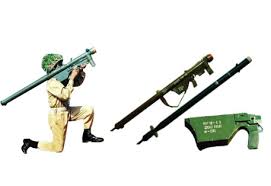
World Defence Show, Riyadh: Pakistan Showcase ANZA Mk-III Shoulder Fired Missile For Low Altitude.

Riyadh; February 2026: Pakistan has showcased its ANZA Mk-III shoulder-fired air-defence missile at the World Defence Show in Riyadh yesterday on 09th February 2026, emphasising low-altitude protection against helicopters and drones. The display highlights how modern conflicts are driving renewed demand for affordable, man-portable air defence systems that can counter low-cost aerial threats.
Presented as a complete firing post with launch tube and gripstock, the system was staged beside larger strike-missile displays, a deliberate contrast that underscored the exhibitor’s message: modern air defence starts at the lowest tier, where helicopters, loitering munitions, and drones exploit terrain and radar shadows to penetrate defended airspace at very low altitude.
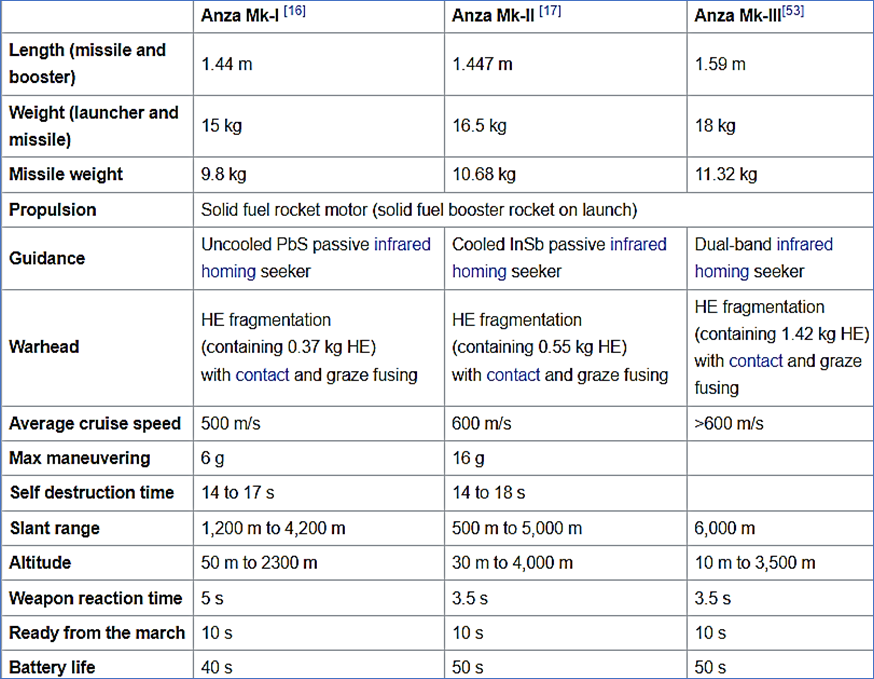
ANZA Mk-III sits in the 6 km class of man-portable air-defence systems (MANPADS), built for rapid “shoot, relocate, survive” engagements. The launcher-and-missile assembly weighs about 18 kg, and the missile itself roughly 11.3 kg, with an overall launcher length of around 1.59 m, placing it squarely in the one-soldier carry category while still remaining practical for two-man teams with a spotter and security element. The missile is credited with a maximum engagement altitude of roughly 10 m to 3,500 m and a top speed above 600 m/s, with a short reaction time cited at about 3.5 seconds, all of which matters when the target is a fast pop-up helicopter or a fixed-wing aircraft crossing a valley line at low level.
Guidance is described as dual-band infrared homing, a key discriminator in an era where flares are cheap, ubiquitous, and increasingly scripted into aircraft defensive suites. Army Recognition’s technical data on the ANZA family also lists a high-explosive fragmentation warhead in the Mk-III category, with contact and graze fusing, and the Riyadh display literature highlighted updated digital electronics and a proximity-fuze approach intended to improve lethality when a perfect direct hit is not guaranteed.
The Mk-III story is best understood as the latest step in a long, pragmatic Pakistani program that tracks the evolution of Chinese-origin MANPADS designs, moving from early-generation concepts toward seekers and counter-countermeasures suited to modern battlefields. The program reflects a pattern seen in several countries that sought to build domestic capacity in this segment by leveraging licensed production and transferred technical foundations rather than starting from a clean-sheet design.
Public timelines widely report the series moving from Mk-I fielding in the early 1990s, to Mk-II upgrades, and then to Mk-III production announced in the mid-2000s, with industrial stewardship shifting over time toward Pakistan’s export-facing defence marketing structures. For Army Recognition’s audience, the implication is straightforward: the ANZA Mk-III is less a “new invention” than a maturation program aimed at tightening seeker performance, engagement envelopes, and usability at the squad and platoon level.
Operationally, the system’s value is tactical and positional. A country can use ANZA Mk-III to harden airbases, ports, ammunition points, and manoeuvre corridors by placing small teams on likely aircraft ingress routes, forcing attackers to climb, detour, or expend countermeasures early. In a layered defence, MANPADS teams serve as the final tripwire inside the minimum range of medium-range surface-to-air missiles and behind terrain-masking that defeats radar line-of-sight. The same teams can be truck-mounted for convoy air defence, or dispersed as pop-up ambush elements when intelligence indicates hostile rotary-wing activity.
In practice, this is where modern conflicts have pushed investment: not every threat warrants an expensive interceptor, but a shoulder-fired missile positioned at the right choke point can deny an entire low-altitude approach lane. The dual-band infrared concept is especially relevant against aircraft that rely on flare patterns and flight profile changes to break lock, although very small quadcopter-class drones can remain difficult targets for any heat-seeker due to weak signatures and clutter.
On users and exports, Pakistan is the core operator across services, with the ANZA family presented as a domestic answer to the enduring close-in air-defence problem. Beyond Pakistan, open-source reporting and imagery-based investigations have indicated that ANZA variants have appeared outside their original inventory, particularly in conflict zones where stocks of legacy MANPADS have circulated widely over the past decade. These observations underline the system’s portability and the persistent global demand for basic short-range air-defence solutions. Separately, media reporting in recent years has suggested that Pakistan has explored supplying earlier ANZA variants to partner states facing acute air threats, highlighting how demand for shoulder-fired air defence has surged worldwide as drones and low-flying aircraft proliferate.
Against competitors, ANZA Mk-III competes in the same operational niche as the Igla family and Chinese FN-series MANPADS, offering a familiar 6 km-class engagement logic with an emphasis on improved resistance to countermeasures. Where newer Western offerings often differentiate is seeker sophistication and integration ecosystems rather than raw portability alone; modernised systems increasingly stress enhanced fusing and broader target sets, and some have moved toward heavier missiles or tripod-based solutions that trade one-soldier agility for longer reach and higher confidence against small, low-signature targets. Pakistan’s pitches ANZA Mk-III remains as an affordable, tactically agile answer for states that need credible low-altitude denial now, and want a MANPADS inventory that can be trained, sustained, and fielded at scale without building an entire high-end air-defence architecture first.
As per Pakistani defence official sources, the Anza-III is the advanced form of Anza-MK-I and Anza-MK-II. The basic difference between them is that the first and second Sam Missiles were portable and could be fired from shoulder. While the new version Anza-III is fired by a mobile or fixed launcher.
Pakistan claims to finish the Indian dominance of Indian Akash missile. All the missiles of Anza series have been successfully developed by Kahuta Research Laboratories of Pakistan. Furthermore, the official source has claimed that the earlier variant Anza-MK-I had shot down Indian MiG-21 and MiG-27 fighter jets in Kargil Sector on May 26, 1999
Team Maverick.






IPL 2026 Opener: Royal Challengers Bengaluru Crush Sunrisers Hyderabad by Six Wickets
Bengaluru, March 28: Defending champions Royal Challengers Bengaluru (RCB) kicked off thei…

IPL 2026 Opener: Royal Challengers Bengaluru Crush Sunrisers Hyderabad by Six Wickets
Bengaluru, March 28: Defending champions Royal Challengers Bengaluru (RCB) kicked off their IPL 2026 …