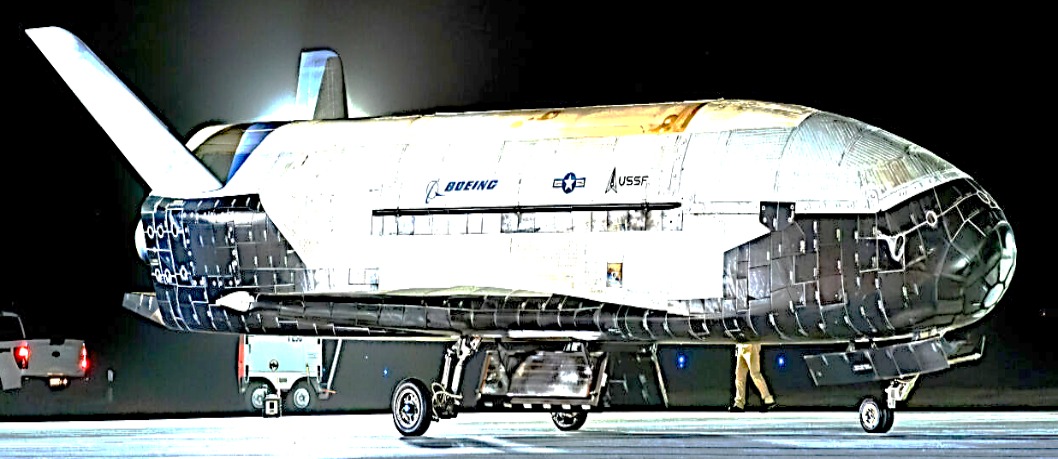
Boeing Prepares Secretive X-37B for the 8th. Mission With Quantum Sensor, Laser Communication Test.

United States Space Force’s X-37B orbital test vehicle (OTV) is under preparation for its next mission, scheduled to launch next month from Kennedy Space Center in Florida. The deployment comes six months after the robotic spacecraft’s seventh flight as part of a seclusive program between the Department of Defense and NASA.
August’s lift-off will focus on the experimental testbed’s capability to host a powerful quantum sensor and a high-bandwidth laser communications link between satellites. The US Space Force will use the results to help shape future space systems. The quantum sensor, labelled as “the highest performing quantum inertial sensor ever tested in space”, will guide the X-37B’s navigation without GPS, paving the way for future missions to reach the moon and beyond.
“OTV-8’s laser communications will mark an important step in the US Space Force’s ability to leverage proliferated space networks as part of a diversified and redundant space architecture”, explained General Chance Saltzman, chief of space operations at the US Space Force.
The X-37B is a small, unmanned spaceplane launched by rockets such as the Atlas V or SpaceX’s Falcon 9. It could orbit Earth for long periods of time and land like a conventional aircraft. Most of the X-37B’s missions are classified, but past activities suggest that the Pentagon uses the OTV to test advanced space technologies and support the development of future reusable systems and military space capabilities. The X-37B OTV measures 29 feet (9 meters) long, has a wingspan of 14 feet (4 meters), and is powered by gallium arsenide solar cells with lithium-ion batteries. It weighs 11,000 pounds (4,990 kilograms), and travels at approximately 17,500 miles (28,164 kilometres) per hour, and has a recorded operational endurance of 908 days.
Publicised experiments have included solar power transmission, exposing materials to the space environment, deploying small satellites, demonstrating orbital manouvering and mission flexibility, and validating extended spaceflight. Since its inauguration in 2010, the X-37B has spent over 4,200 days in space.
As reiterated in the beginning of this news, robotic spacecraft’s seventh flight; readers must be apprised, that – The X-37B Orbital Test Vehicle-7 (OTV-7), the U.S. Space Force’s dynamic unmanned spaceplane, successfully deorbited and landed at Vandenberg Space Force Base, California, on March 07th., 2025 at 02:22 a.m. EST.
X-37B’s Mission 7 was the first launch on a SpaceX Falcon Heavy Rocket to a Highly Elliptical Orbit. While on orbit, Mission 7 accomplished a range of test and experimentation objectives intended to demonstrate the X-37B’s robust manoeuvring capability while helping characterise the space domain through the testing of space domain awareness technology experiments.
The successful completion of the novel aerobraking manoeuvre demonstrated the agile and flexible capabilities the X-37B provides the United States Space Force. Drawing on decades of lessons learned from previous space missions, this technique involves the use of atmospheric drag over the course of multiple passes to change orbits while expending minimal fuel.
“Mission 7 had broken new ground by showcasing the X-37B’s ability to flexibly accomplish its test and experimentation objectives across orbital regimes. The successful execution of the aerobraking manoeuvre underscores the U.S. Space Force’s commitment to pushing the bounds of novel space operations in a safe and responsible manner”, said Chief of Space Operations General Chance Saltzman.
While in orbit, Mission 7 tested space domain awareness technology experiments that aim to improve the United States Space Force’s knowledge of the space environment. These technologies are critical to the U.S. Space Force’s ability to conduct space operations in an increasingly congested and contested environment of space, to the benefit of all users of the domain. After aerobraking to a Low Earth Orbit and completing its test and experimentation objectives, Mission 7 successfully performed its deorbit and landing procedures.
Commenting on Mission 7’s achievements, the X-37B Program Director, Lieutenant Colonnel Blaine Stewart stated, “Mission 7’s operation in a new orbital regime, its novel aerobraking manoeuvre, and its testing of space domain awareness experiments have written an exciting new chapter in the X-37B program. Considered together, they mark a significant milestone in the ongoing development of the U.S. Space Force’s dynamic mission capability”.
The Seventh Mission had remained on-orbit for over 434 days.
Team Maverick







Shafali Verma Powers India to Dominant Five-Wicket Win Over Bangladesh in Women’s T20 World Cup
Manchester, June 2026 : Opener Shafali Verma produced a dazzling batting display as India …

Shafali Verma Powers India to Dominant Five-Wicket Win Over Bangladesh in Women’s T20 World Cup
Manchester, June 2026 : Opener Shafali Verma produced a dazzling batting display as India …