Thailand Faces Fresh Political Turmoil as Acting PM Moves to Dissolve Parliament

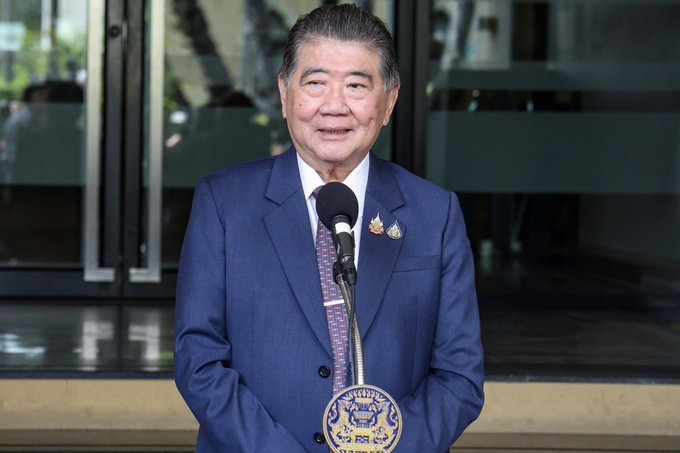
Thailand’s political landscape was thrown into renewed uncertainty on Wednesday after acting Prime Minister Phumtham Wechayachai submitted a decree to dissolve parliament. The move followed the ouster of Paetongtarn Shinawatra last week and the opposition People’s Party’s decision to back rival candidate Anutin Charnvirakul for prime minister. The decision could pave the way for fresh elections before the year ends, deepening the country’s ongoing power struggle.
Sept 2025 : Thailand’s fragile political order faced a new upheaval on Wednesday as acting Prime Minister Phumtham Wechayachai moved to dissolve parliament, his party announced, following the dramatic collapse of support for his government’s candidate to lead the country.
The decision came just days after Prime Minister Paetongtarn Shinawatra was dismissed by the Constitutional Court over an ethics violation. Since then, her Pheu Thai Party has been clinging to power in a caretaker capacity while negotiating with the opposition in a bid to maintain control.
However, those talks collapsed when the People’s Party, a powerful opposition bloc, declared its support for conservative businessman and veteran politician Anutin Charnvirakul instead.
Shortly after the opposition’s declaration, Pheu Thai secretary-general Sorawong Thienthong confirmed that the acting prime minister had “submitted a house dissolution decree,” potentially setting the stage for fresh polls before the end of the year.
Legal Uncertainty
The move has already stirred legal controversy. Critics question whether a caretaker administration has the authority to dissolve parliament. Nonetheless, the Thai constitution stipulates that if the king approves dissolution, new elections must be held within 45 to 60 days.
Political analysts argue that a new election may be the only way out of the current stalemate. “It’s likely an election will happen in the next few months,” said Titipol Phakdeewanich, a political scientist at Ubon Ratchathani University. “An election might be the best solution because it’s almost impossible to form a stable government under the current conditions.”
The People’s Party itself had conditioned its support for Anutin on parliament being dissolved within four months, suggesting that even if he were to assume office, fresh elections would follow in the near term.
Anutin’s Rise
Anutin Charnvirakul, heir to a construction engineering fortune, has long been a significant figure in Thai politics. His Bhumjaithai Party pledged its 143 parliamentary seats to his candidacy, describing it as a duty to stabilize the country.
“From this point onward, forming a government is essential,” Anutin told reporters. “We understand the urgency and are seeking ways to resolve the crises.”
Anutin previously held senior positions as deputy prime minister, interior minister, and health minister. In 2022, he oversaw the controversial legalization of cannabis. During the Covid-19 pandemic, however, he came under fire for accusing Westerners of spreading the virus, a comment he later retracted under public pressure.
The Decline of the Shinawatra Dynasty
Pheu Thai, the electoral vehicle of the Shinawatra family that has dominated Thai politics for two decades, now finds itself at a crossroads. Analysts believe its influence is waning, and the move to dissolve parliament reflects its weakening position.
Anutin’s Bhumjaithai Party had once been a key coalition ally of Paetongtarn’s administration. However, tensions over her handling of a border dispute with Cambodia this summer fractured the alliance. That same controversy ultimately led to Paetongtarn’s dismissal by the Constitutional Court.
A Narrow Pool of Leaders
Under Thai law, only those nominated as potential prime ministers in the 2023 general election are eligible for the office. A string of crises and disqualifications has reduced the field to just five viable candidates, heightening the stakes of each political maneuver.
With parliament’s dissolution now pending royal approval, Thailand is bracing for yet another round of political upheaval. For a country that only held elections two years ago, the return to the ballot box could mark either a fresh start—or a continuation of the cycle of instability that has defined its politics for much of the past two decades.

End of an Era: Cristiano Ronaldo Bids Farewell to the FIFA World Cup After a Record-Breaking International Career
Dallas, July 2026 : One of football’s greatest chapters came to a close on Tuesday a…

End of an Era: Cristiano Ronaldo Bids Farewell to the FIFA World Cup After a Record-Breaking International Career
Dallas, July 2026 : One of football’s greatest chapters came to a close on …