Donald Trump’s new Embargo on Science would make the Scientific System starve.

Oct 2025 : It was Vannevar Bush, an engineer and science adviser to President Franklin Roosevelt, who was a firm believer in harnessing science and technology for military gain, and he had developed a method for detecting submarines during World War I and later an analog computer that could analyze ballistic trajectories. During World War II, he was a leader of the Manhattan Project. Bush also had a vision for how scientific progress could bring national prosperity in peacetime. “Advances in science when put to practical use”, a 1945 report of his says asserts that it will create a country with bountiful farm fields and plentiful high-paying jobs alongwith a place where people could “live without the deadening drudgery which has been the burden of the common man for ages past”.
Bush’s vision, articulated in the report Science: The Endless Frontier (Bush 1945), helped create the system (Zimmer 2020) of government research investment that exists today in the United States. Bush pushed for funding the sciences, particularly at universities, believing that the new knowledge created by scientists would lead to economic prosperity, greater national security, and better health.
While the private sector’s share of overall investment in research has been increasing, the government remains a critical supporter of science, especially basic research, which seeks to expand knowledge without the promise of practical applications. In recent years, the federal government has budgeted authorized about $200 billion in spending on research and development, a continuation of years of robust investment that many say has paid economic and other dividends over the post-war decades. The National Institutes of Health (NIH), for example, says that for every dollar it spends, it generates more than double the amount in economic activity. Federal research funding has contributed to major developments that range from GPS to GLP-1 weight loss drugs.
The future of that productive engine of science funding now appears to be under significant threat.
It’s not that the President Donald Trump’s administration doesn’t see the value in scientific investment; Trump has called for bringing about a “Golden Age of American Innovation”, and he has a science adviser keen to see that happen. But in an actions-speak-louder-than-words sense, the administration seems to see less value in the government’s long-standing practices in science funding. The administration has stalled grant application reviews (Kozlov 2025) and slashed funding for disfavored universities. A budget proposal for the next fiscal year envisions cutting the National Science Foundation (NSF) by 56% and NIH by 40%.
Further underscoring the political nature of Trump’s funding scythe, the government has asked Harvard University, a large recipient of research dollars, to audit student and faculty “viewpoint diversity” and to ban students “hostile to American values”. It has cancelled or frozen billions of dollars of government grants and contracts flowing to this premier institution.
For former presidential science adviser John Holdren, Trump’s science policies, far from heralding a golden age, will instead idle what he views as a positive feedback loop between science and technology investment and national health and prosperity. “The system will starve”, he said in a recent interview. “It will run out of fuel for the innovations that continuing economic growth, productivity, job creation, competitiveness, all depend on, not to mention national security”.
John Holdren has attributed the change in scientific investment as tragic, since such investment is quinossential in the nation’s success. However, Holdren was found to be optimistic about the scenario to be rolled back by some combination of the courts and Republicans in the Congress, if they recover a spine and get up off the floor from their supine positions. Once these programs are dismantled, offices and agencies are dismantled, people leave, the programs and the projects can’t reassemble overnight, even if suddenly there are abundance of funds.
As the Trump administration feels that there are too many regulations and that too focused on diversity, Holdren envisage that it is not possible to deregulate spending cuts. According to him the onus is now on the private sector to do all the things that the government doesn’t do or doesn’t fund.
However, the private sector will never do as much fundamental research as the country’s well-being requires, because of the uncertainty in fundamental research about what is to be obtained, how soon can it be obtained, what benefits it’s going to bring, and whether the benefits can be captured by the entity that makes the investment. And hence while the private sector does a bit of fundamental research, they don’t do much, and they’ll never do a lot more, and it’s the fundamental research that provides the seed corn from which applied advances grow. The system will thus starve. It will run out of fuel for the innovations that continuing economic growth, productivity, competitiveness, and job creation all depend on, not to mention national security.
In Trump’s first term, he tried, with every successive presidential budget, to drastically cut R&D across the government, with the exception of the total spending in DOD and DARPA particularly. The only respite was the fact that Congress was not willing to swallow it. And every time the Congress rejected most of the proposed cuts to R&D in the president’s budgets. In his first budget, Trump had tried to slash the funding of NIH and the Congress gave him the finger. The Congress said, we’re going to increase the budget of NIH, because members of Congress understand perfectly well that one of the things that NIH does is it finds cures for the diseases that afflict members of Congress and their families.
With Donald Trump manoeuvering the IRS to investigate Harvard University’s tax status, which is illegal. It’s illegal for the president to try to determine who gets investigated for what by the IRS; alongside threatening Harvard to disarm their right in admitting foreign students. They need to release all of their data on all the enrolled foreign students or they shall be forbidden to admit foreign students to study at Harvard, which is indeed catastrophic. Historically, foreign students have been an enormous source of energy, creativity, productivity, and furthermore, a high proportion of them end up staying in the country, after they finished their studies in the United States. Delving into the trajectories of Nobel Prizes, the number of Nobel Prizes that have been won by immigrants or the sons and daughters of immigrants it’s just mind-boggling.
This lack of empathy has encouraged other countries in opening their doors to the foreign students; Canada, Europe, Australia have already augmented the process of simplification. Of course, it is China, who have already eased the legal formalities backed by better and integrated educational system.
Speaking about economic inefficiency, Holdren raised his concern that by impeding a project in midstream, which with the best review processes in the world and judged worthy of support, cannot realise the benefits that had been hoped for, citing as incredibly inefficient. Then, on top of that, the people who were engaged in that project disassociates. It becomes very hard for the system to absorb all the talented people who have been supported on government funding to find other positions doing what they’re good at doing, doing what they were trained to do. That harm is already happening. It’s not a matter of when will it happen. Though the effects are going to play out over a long period of time, we are discouraging a whole generation of young people from going into science and engineering.
That gap is going to reverberate in the arena of science, technology, and innovation, and therefore in our productivity, our competitiveness, our environment, our health, our national defense. It’s going to reverberate for years.
Holdren reaffirmed that during the Barrack Obama regime, several months before the president’s budget was finalised, the president’s science adviser, the director of the Office of Science and Technology Policy (OSTP) and the Office of Management and Budget (OMB) director, together use to send a letter to all of the Cabinet secretaries and the heads of the free-standing agencies with science and technology responsibilities, and in that letter it would say: “Here are the president’s priorities for science and technology. We want your budgets to reflect those priorities, and the extent to which they reflect those priorities will have some bearing on how much of the money you want you actually get”. And of course, under science and technology-savvy presidents, a lot of thought and interaction use to reflect into that letter about where the major investments were needed to be deployed. What that is been done, and should more needed to be done.
And that letter was taken very seriously by the departments and agencies when they composed their budgets. First of all, they know that in the end, what happens is their budgets get submitted to the OMB and the OSTP and there follows a long process of back-and-forth between the technical staff of the OMB and the technical staff of the OSTP interacting with the agencies to modify their proposals to the president in a way that will improve them. They had a chance to make their case. Maybe the letter was not right; Maybe there are really important things that deserve to be funded. And in the end, there use to be a meeting with the president. And then he was the one to make the final decision, on what’s going to be in there and what’s not.
Then the next step is the president’s budget is submitted to Congress. One has to persuade the Congress to pass as much of it as possible. What happens then? The president’s science adviser and his senior deputies, for months, meet with members of Congress, with their staffs, with the chairmen of the key committees. We testify before those committees to try to persuade them to accept the most important elements of the president’s budget. And by the way, it was true in the Obama administration, and in the case of Clinton administration.
The erstwhile scenario has changed; the administration has fired a very high proportion of the senior scientific and technological talent in the key agencies and replaced them with people whose principal criterion for appointment appears to be that they’ve sworn allegiance to Trump. And in fact, there’s a lot of evidence that in the most senior positions, it was a requirement that the candidate expressed the view that the last election, the previous election, was stolen. That was a requirement in being appointed. One has to be a 2020 election-denier in order to get these appointments.
The other thing that was understood by Obama and made a major feature of the initiatives in his administration was the importance of partnerships across sectors. He demanded partnerships, first of all, within the government, across agencies and between the executive branch and the legislative branch. And secondly, he demanded that we engage, whenever possible, the private sector and the academic sector in initiatives and also, by the way, very often, the NGO [non-governmental organisation] sector. Barrack Obama had councils and task forces on advanced manufacturing, and it was full of the industry’s manufacturing leaders, as well as the leading analysts and manufacturing from academia, and not just the government officials with some stake in manufacturing. In health, he created the BRAIN Initiative. He also had created the combating antibiotic resistance initiative. He created the Precision Medicine Initiative. In every case, the private sector, the hospitals, the research labs, and academia, were full partners. There are no signs of such happenings now. That was a recognition of how this ecosystem of science, engineering, and innovation works. That is that ecosystem works best when there are strong connections among its components.
One of the things Obama liked was the sports analogies, as he believed that it’s hard to win if half of the team is on the bench. And he was engaging women and minorities in science, technology, engineering, and medicine. A large fraction of the country’s talent base is not being effectively used because of lack of access, lack of inclusion, and lack of equity. There’s now a substantial amount of scholarly research that shows that diversity is beneficial in science and technology. And the idea that diversity, inclusion, equity, per se, are bad ideas, which is obviously the stance that the Trump administration holds, demonstrative to be very destructive to the future of this country in these fields.
Team Maverick








Shivakumar Says Congress United, Assures Women Will Get Cabinet Berth
Bengaluru, Aug 2026 : Karnataka Chief Minister D.K. Shivakumar on Monday sought to dismiss…
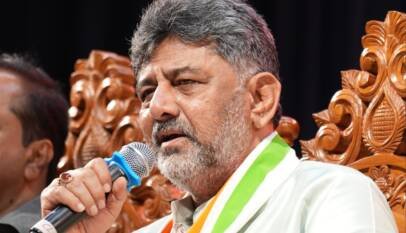
Shivakumar Says Congress United, Assures Women Will Get Cabinet Berth
Bengaluru, Aug 2026 : Karnataka Chief Minister D.K. Shivakumar on Monday sought to dismiss …