Vande Mataram is not just a song, but a mantra of the nation’s consciousness and courage: Yogi Adityanath

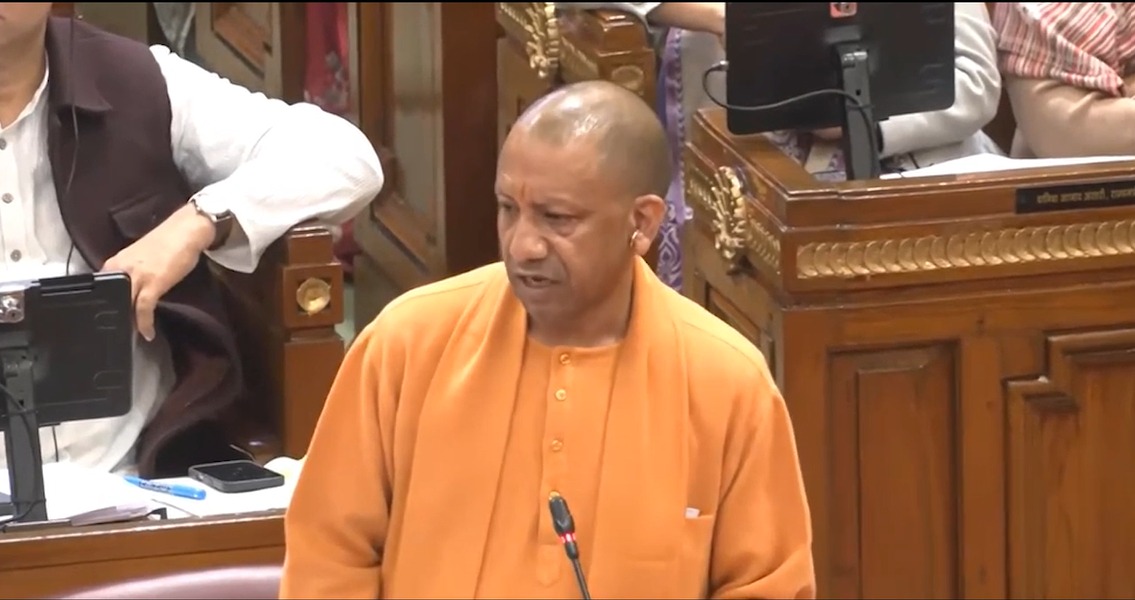
CM Yogi Adityanath inaugurated the special discussion session held in the Legislative Assembly on the completion of 150 years of the national song ‘Vande Mataram’
CM Yogi Adityanath said: Vande Mataram is the proclamation of the soul of the freedom struggle
This is not just poetry, but a medium for the worship of the motherland, cultural consciousness and the expression of nationalism: CM Yogi
Lucknow, December 2025 : A special discussion session was organized in the Uttar Pradesh Legislative Assembly on Monday to commemorate the completion of 150 years of the national song ‘Vande Mataram’. In this discussion session, CM Yogi Adityanath said, “Vande Mataram is not just a song, but a mantra of the consciousness of India’s freedom struggle, the courage of the revolutionaries, and the self-respect of the nation”.
He said, “under the guidance of Prime Minister Narendra Modi, Uttar Pradesh is perhaps the first Legislative Assembly where this historical subject is being discussed in detail”.
According to CM Yogi, this discussion is not merely about the anniversary of a song, but an opportunity to reaffirm our national duties towards Mother India. Respect for Vande Mataram is not just an expression, but it makes us aware of our constitutional values and national responsibilities. It is a symbol of the nation’s soul, struggle, and resolve. According to him, it is not just poetry, but a medium for the worship of the motherland, cultural consciousness, and the expression of nationalism.
CM Yogi Adityanath said, “when ‘Vande Mataram’ was celebrating its silver jubilee, the country was under British rule. After the failure of the First War of Independence in 1857, British rule was at its peak of repression and tyranny. The voice of the people was being suppressed through draconian laws, and torture was being inflicted, but ‘Vande Mataram’ kept the dormant consciousness of the country alive. Even when the country was celebrating its silver and golden jubilees, British rule was still in place. At that time, the platform for advancing the spirit of freedom was the Congress sessions, where Rabindranath Tagore first gave voice to it in 1896. It became a mantra for the entire country”.
CM Yogi also added by saying, “when the centenary of Vande Mataram arrived, the same Congress party that had once given this song, which awakened the soul of the nation, a place on its platform, was in power. However, it then imposed a state of emergency on the country and stifled the Constitution. This was a period in history that cannot be forgotten”.
According to CM Yogi, today, as ‘Vande Mataram completes 150 years’, India, under the leadership of Prime Minister Modi, is moving towards a ‘Viksit Bharat’ with confidence. The dream of Bankim Chandra Chattopadhyay, the immortal creator of the national song, is being realized by the new India. This is why this discussion in the House is timely and significant.
Referring to the First War of Independence in 1857, the Chief Minister said, “the struggle for freedom took place across the country under the leadership of Mangal Pandey in Barrackpore, Shaheed Bandhu Singh in Gorakhpur, Dhan Singh Kotwal in Meerut, and Rani Lakshmibai in Jhansi. In the period of despair that followed the failure of the War of Independence, ‘Vande Mataram’ awakened the dormant soul of the nation”.
Chief Minister also added by saying, Bankim Chandra Chattopadhyay, who was working in the British administration as a Deputy Collector at that time, gave voice to the sentiments of the common people through ‘Vande Mataram’.
According to CM Yogi Adityanath, ‘Vande Mataram’ became a symbol of resistance against the colonial mindset.
He said, “Bharat Mata was not merely a geographical territory, but the sentiment of every Indian. Independence was not politics, but a spiritual pursuit. The lines “Sujalam, Suphalam, Malayaja-Shitalam, Shasyashyamalam Mataram” instilled consciousness in the Indian psyche and embodied the nature, prosperity, beauty, and strength of India”.
The compromise on Vande Mataram was Congress’s appeasement, fueling separatism: CM Yogi
Jinnah politicized the national song, giving it a communal tone: CM Yogi
During a special Assembly discussion on the 150th anniversary of Vande Mataram, Chief Minister Yogi Adityanath held Congress and Muhammad Ali Jinnah responsible for India’s cultural divisions and the eventual partition.
He stated that the compromise on Vande Mataram was not out of respect for religious sentiments, but the first and most dangerous experiment in Congress’s appeasement politics, which fueled separatism.
The Chief Minister noted that while Jinnah was in Congress, Vande Mataram faced no opposition. After leaving Congress, he used the national song as a political tool for the Muslim League, deliberately giving it a communal angle; the song remained the same, only the agenda changed.
CM Yogi said, “On October 15, 1937, Jinnah raised slogans against Vande Mataram in Lucknow, even as Pandit Nehru led Congress. Nehru’s subsequent letter to Subhas Chandra Bose on October 20, 1937, admitted that the issue was to “appease” Muslims. On October 26, 1937, Congress truncated parts of the song under the guise of “harmony,” sacrificing national consciousness.”
He added, “Despite protests by patriots, Congress prioritized vote-bank politics over the nation. By March 17, 1938, Jinnah demanded the song’s complete alteration, and Congress did not resist. This set the stage for growing separatism and the first compromise on cultural symbols, ultimately contributing to India’s partition.”
CM Yogi emphasized that opposition to Vande Mataram was political, not religious. He highlighted that from 1896 to 1922, Congress sessions featured the song without controversy, with support from leaders like Maulana Abul Kalam Azad.
The Chief Minister further explained that Mohammad Ali Jauhar first opposed the song in 1923 during the Khilafat movement, not on religious grounds but for political motivations. While Jauhar left the stage, Congress’s subsequent appeasement became policy. By 1937, only two verses of the song were allowed in Congress sessions, even then, not mandatory, a national surrender, according to CM Yogi.
He also pointed out that the truncated version recognized by the Constituent Assembly in 1950 reflected this legacy of appeasement. Vande Mataram is more than a song; it is the soul of India.
He added, “From the 1905 Bengal Partition movement to the freedom struggle, it inspired morning processions, Satyagrahas, and the final moments of revolutionaries. Rabindranath Tagore called it the soul of India, Aurobindo Ghosh called it a mantra, and it featured on the first tricolor hoisted abroad by Madam Bhikaji Cama. Madan Lal Dhingra’s last words were also Vande Mataram.”
CM Yogi stressed that compromising on the song was an attack on India’s national identity. Even today, divisive forces attempt to weaken the nation’s spirit.
He concluded that Vande Mataram is a pledge to honor, protect, and strengthen the motherland, urging all to learn from past appeasements. He called on everyone to revisit Bankim Chandra Chattopadhyay’s Anand Math and celebrate the 150th anniversary of Vande Mataram as a commitment to India’s future.



Panic Buying Triggers Fuel Chaos Across Hyderabad Amid Rumour-Driven Shortage Fears
Hyderabad, March 2026 : Widespread panic gripped fuel stations across Hyderabad on Wednesd…

Panic Buying Triggers Fuel Chaos Across Hyderabad Amid Rumour-Driven Shortage Fears
Hyderabad, March 2026 : Widespread panic gripped fuel stations across Hyderabad on Wednesday as …