Union Home Minister and Minister of Cooperation Amit Shah inaugurates the first phase of the ‘Museum of Word’ in Kolkata

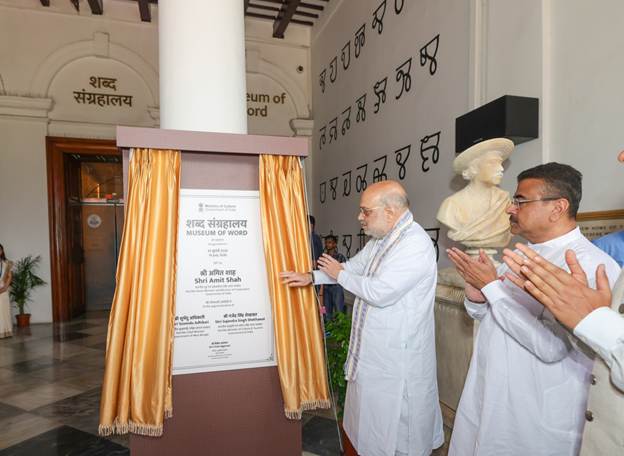
Union Home Minister and Minister of Cooperation Shri Amit Shah today inaugurated the first phase of the ‘Museum of Word’ in Kolkata, the capital of West Bengal. On the occasion, West Bengal Chief Minister Shri Suvendu Adhikari, Finance Minister Shri Swapan Dasgupta, Union Home Secretary, Union Culture Secretary, Director Intelligence Bureau (IB), and several other distinguished dignitaries were present.
Addressing the gathering, Union Home Minister Shri Amit Shah said that today is a momentous day for the languages and culture of the entire nation. Today, this Museum of Words is giving concrete shape to Prime Minister Shri Narendra Modi Ji’s resolve for the cultural renaissance of the nation. Shri Shah said that the expression of the culture of any nation or region is impossible without language, and language itself cannot exist without words born out of human emotions and expression. He said that unless future generations understand that language is formed by words, words emerge from emotions, culture is shaped through language, and culture finds its expression through language, the cultural renaissance of the country cannot be achieved. Shri Shah expressed confidence that this Museum of Words would serve as a powerful medium for carrying the journey of India’s languages, culture, and cultural renaissance to future generations.
Union Home Minister Shri Amit Shah said that the Museum of Word beautifully depicts the entire journey of the composition of Panini’s grammar. He said that the Rigveda states that noble and auspicious thoughts should continue to come to us from all directions—thoughts that are never suppressed, never obstructed, and on the basis of which we should shape and advance our social life. Shri Shah said that narrow-mindedness can never arise in our civilization because there is no place for narrowness in the very foundation of Indian thought. He added that whenever we perform Bhoomi Pujan or recite the Shanti Mantra, we pray for peace not only for humanity but also for animals, plants, and the entire universe. Therefore, he said, narrow-mindedness can never be a symbol of Indian culture.
Shri Amit Shah said that the Museum of Word will educate future generations about India’s languages and culture for generations to come, introduce them to the country’s rich cultural heritage, and also guide them in the way of life rooted in that heritage. He said that India has never imposed restrictions on ideas or thought. Shri Shah noted that the museum traces the entire journey of the written word—from the sacred Omkar to the origin of words and the development of grammar; from the Shrutis and Smritis to manuscripts and inscriptions; and from the printing press to the modern era. Union Home Minister said that the Museum of Words should be expanded to encompass digital technologies and Artificial Intelligence (AI), enabling Indian languages to evolve in line with the technologies of the future. He said that India has never shied away from innovation and has always embraced all that is noble and auspicious. That is why, despite countless challenges and assaults, the nation’s cultural journey stands as steadfast as the Himalayas. He further said that the Museum of Words is an innovative initiative to preserve India’s multilingual consciousness, knowledge traditions, and collective memory through visual, auditory, and immersive experiences.
Union Home Minister said that West Bengal is home to many museums, and he is confident that the Museum of Word will establish a prominent place for itself in a very short time. He said that every seeker of language and words who visits the museum will certainly leave with valuable knowledge and inspiration. Shri Shah said that introducing future generations to the science of words and linguistics was an extremely subtle and challenging task, but the Ministry of Culture has accomplished it successfully. He remarked that while words themselves cannot be confined, the Museum of Word has successfully captured and presented the science behind them. He said that words can be heard, spoken, lived, and passed on to future generations, and the Museum of Word will play a vital role in preserving and transmitting this legacy. Shri Amit Shah further said that through the Museum of Word, the Ministry of Culture has transformed India’s intangible heritage into an experience that is visible, audible, tangible, and immersive.
Union Home Minister said that when the Museum of Word poses the question of what the world’s first spoken word might have been, and the answer Omkar appears, one is naturally inclined to feel that Omkar was indeed the world’s first word. He said that listening to a mother’s lullabies in one’s own language instantly evokes memories of one’s mother. Shri Shah added that the museum houses a wide range of artefacts and manuscripts that offer a tangible and immersive experience to visitors. He said that the museum preserves numerous dialects, languages, and the folk traditions of every region of the country, narrating India’s cultural journey through the medium of words. It also showcases inscriptions, copper plates, Bhojpatra manuscripts, handwritten manuscripts, and a rich collection of printed books. Union Home Minister said that after the journey from digital text to audio archives, the next milestone is to take this legacy into the era of Artificial Intelligence (AI).
Shri Amit Shah said that every gallery of the Museum of Word has been designed in a highly scientific manner. He said that the orientation space begins with the origin of language and attempts to explain its evolution through myths, lullabies, and sensory experiences. Shri Shah said that every individual has a deep emotional bond with their mother tongue. He emphasized that this attachment to one’s mother tongue should become an integral part of one’s character.
Union Home Minister and Minister of Cooperation Shri Amit Shah said that linguistics is a science that has evolved naturally. He noted that while language is scientific in nature, it has developed in response to human needs. Languages have evolved organically over time, and it is this natural evolution that has led to their widespread acceptance in society. Shri Amit Shah said that numerous great personalities, poets, and writers have contributed to preserving and enriching every language of the country. To honour their invaluable contributions, a dedicated gallery has been created in the Museum of Word. Union Home Minister said that the future of the country does not depend on how crowded its colleges and universities are. Rather, it depends on how many young people and adolescents visit its libraries. He appealed to the youth to make libraries an integral part of shaping their personality and intellectual growth.
Union Home Minister Shri Amit Shah said that West Bengal has long been a global beacon of India’s civilizational consciousness. He said that there was a prolonged period during which attempts were made to detach Bengal from India’s cultural consciousness, and that narrow and foreign ideologies diminished Bengal’s ability to contribute to the nation and the world. Shri Shah said that Bengal is the land of Maharshi Aurobindo, Swami Vivekananda, Ramakrishna Paramahansa, and Chaitanya Mahaprabhu. He added that Bengal has also produced some of the country’s finest scientists, eminent litterateurs, and one of India’s greatest revolutionaries, Netaji Subhas Chandra Bose. He noted that Bengal had traditionally remained decades ahead of the rest of the country, guiding the nation with its intellectual and cultural leadership. Expressing confidence in Bengal’s future, Shri Amit Shah said that the intellectual beacon of India’s civilizational consciousness would once again awaken the world with its full strength. He said that under the leadership of Prime Minister Shri Narendra Modi and Shri Suvendu Adhikari, the ongoing transformation in Bengal gives him confidence that the state will soon re-emerge as a radiant beacon of Indian consciousness. Union Home Minister further said that India cannot be fully understood without studying Maharshi Aurobindo. He noted that Maharshi Aurobindo interpreted India’s past, explained its present, and envisioned its future for the coming generations. Quoting Maharshi Aurobindo, Shri Shah said that one day Bharat Mata would undoubtedly reclaim her place as the Vishwa Guru and strive to offer her very best to humanity.
Shri Amit Shah urged the younger generation to understand the power of words and language, refine their pronunciation, and internalize the principles of grammar to make their expression more effective and impactful. He said that doing so would greatly enhance their acceptance, credibility, and influence in society.
Union Home Minister Shri Amit Shah said that the entire nation is celebrating the 150th anniversary of Vande Mataram, and it is particularly significant that the Museum of Word is being inaugurated at such a historic moment. He said that when one stands on the stage and listens to the complete rendition of Vande Mataram, one truly realizes the depth of devotion and reverence that every citizen should have for Bharat Mata. Shri Shah remarked that despite the profound message embodied in the song, the country remained unaware of its full significance for nearly 76–77 years after Independence. He expressed satisfaction that today, Vande Mataram is sung in its entirety in schools across the country, describing it as a matter of great joy
Shri Amit Shah said that Prime Minister Shri Narendra Modi conferred Classical Language status on Bengali in 2024. He also noted that the nation recently commemorated the 125th birth anniversary of Dr. Syama Prasad Mookerjee. Shri Shah said that it was Dr. Syama Prasad Mookerjee who had invited Gurudev Rabindranath Tagore to deliver the convocation address in Bengali at the University of Calcutta. He noted that during British rule, this was the first time that a convocation address had been delivered in an Indian language at any university in the country. He said that today, Bengal is once again moving steadily towards becoming ‘Sonar Bangla’.
Union Home Minister Shri Amit Shah said that while human beings often believe they created language, he believes that it is language that has shaped humanity. He said that a person truly becomes human when emotions are awakened, and it is language that awakens those emotions. The foundation of every language lies in words—especially the words of one’s own language—and the Museum of Word will play an important role in preserving and promoting this legacy. Shri Shah said that five principles are crucial for the preservation and development of languages. First, the language spoken within the family should become a child’s first school. Second, a child’s education should begin in the mother’s tongue. Third, schools and universities should become centres of original thinking, because only then can society make meaningful contributions to innovation and creativity. He said that universities should lead the way in fostering original thought. He also emphasized that every Indian language should be made digitally and AI-enabled, thereby extending its vitality and relevance for another thousand years. Union Home Minister said that libraries and museums should not remain confined to their physical buildings. Instead, efforts should be made to ensure that the values, knowledge, and emotions they embody reach the country’s youth and adolescents through dedicated outreach campaigns. Shri Amit Shah further urged every young person to learn at least one other Indian language alongside their mother tongue. He said that this would help not only in preserving one’s own mother tongue but also in ensuring the long-term vitality of all Indian languages. He added that if governments, the education system, and, above all, the people of the country embrace and promote these five principles, it would make a significant contribution to the preservation, promotion, and service of India’s languages.
Shri Amit Shah said that from the soil of Bengal, regarded as a beacon of Indian culture, the nation should resolve to strengthen its culture through the power of words. He said that a strong culture will inspire self-confidence, and with that self-confidence, India will realize the vision of a ‘Viksit Bharat’ by 2047 and fulfill its aspiration of re-establishing Bharat Mata as the Vishwa Guru. Shri Shah said that the Museum of Word will serve as the foundation for realizing this vision.



Emotional Lionel Scaloni Hints at Uncertain Future After Argentina’s World Cup Final Defeat
New York, July 2026 : Argentina head coach Lionel Scaloni struggled to hold back tears as …

Emotional Lionel Scaloni Hints at Uncertain Future After Argentina’s World Cup Final Defeat
New York, July 2026 : Argentina head coach Lionel Scaloni struggled to hold back …